
How to Build a Review Generation System That Keeps Running
A review generation system asks the right customer at the right moment and routes what comes back. How to build one that keeps running in a real store.
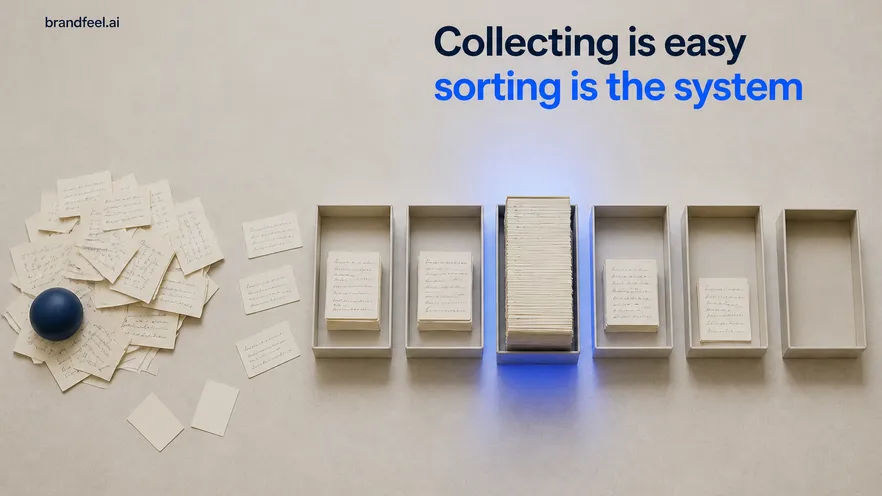
A review generation system is a repeatable process that asks a defined group of customers for a review at a defined moment, through a defined channel, and routes what comes back to an owner. The word that matters is system. A campaign produces a spike and then decays; a system produces a steady rate you can forecast, staff and improve.
- A system asks a defined group, at a defined moment, through a defined channel, and routes replies to an owner.
- A campaign produces a spike and decays. A system produces a steady rate, which is the whole difference.
- Default platform automation under-performs because it asks everyone the same thing at the same moment.
- The Review Engine has five stages, and the one teams skip is routing what comes back to somebody accountable.
- The value accumulates in the themes, not the star average: reviews are the cheapest customer research you own.
Most stores do not have a review generation system. They have a review app with the default automation switched on, which is a different thing wearing similar clothing. The app sends a request some fixed number of days after fulfilment, to everybody, with the same wording, and nobody owns what arrives. It produces reviews, so it looks like it is working, and it quietly under-performs for years. Last updated: August 2026.
The gap between that and a real system is not software. Omniconvert has measured how stores collect and present customer feedback across the CROBenchmark dataset of 7,000+ websites in 15+ industries, against 248+ audit criteria, over 13 years in eCommerce, and the stores with strong review coverage rarely have better tooling than the ones without. They have decided four things the others left on default: when to ask, who to ask, what to ask, and where the answer goes. This guide covers those four decisions, the five-stage Review Engine that holds them together, and the measurement that stops the whole thing drifting back to default.
What a review generation system actually is
Start with why the distinction is worth making at all. A campaign is a push: you email your back catalogue, you get a burst of reviews, and the rate returns to baseline within a fortnight. It is a reasonable thing to do once, usually when launching a widget on a store that has none. What it cannot do is keep a product page current, because the products you sell next quarter were not in the catalogue you emailed.
A system attaches the ask to the transaction instead of to the calendar. Every order becomes a candidate, the candidacy is evaluated against rules you set, and the request goes out when that specific customer is ready rather than when the marketing team remembers. The output is a rate rather than a spike, and a rate is something you can plan around: you can forecast coverage on a new product, you can staff the response workload, and you can tell whether a change you made helped.
The second half of the definition is the part almost everyone skips. A system routes what comes back. Reviews arriving into a widget and nowhere else are a display asset and nothing more. Reviews arriving into a widget, a monthly theme summary for whoever owns the product, and an alert for anyone naming a safety or sizing problem, are an intelligence asset that happens to also display well. The routing is what turns collection into something that changes the business.
Why the default automation under-performs
The defaults are not stupid. They are generic, which is a different failure and a more expensive one, because generic settings are invisible. Nothing is broken, so nothing gets fixed.
Take timing. A vendor default of seven days after fulfilment is a compromise across every category the vendor serves. For a coffee subscription that is roughly right. For a mattress it is far too early, and the review you collect describes the unboxing rather than the product, which is the single most common reason review text reads as shallow. For a fast-moving consumable it may be too late, after the moment of satisfaction has faded into routine.
Take audience. Asking everybody includes the customer whose parcel arrived damaged and whose support ticket is still open. That customer will review, promptly and at length, and the review will be about your courier. Every store has some of this, and the stores that suppress it are not hiding negative feedback: they are routing a delivery complaint to the place delivery complaints belong instead of onto a product page where it misinforms the next shopper about the product.
Take the prompt. "How did we do?" is an invitation to write "great, thanks", which is worthless to a shopper and worthless to you. A prompt that asks one specific thing produces specific text. This is the cheapest single change in the whole discipline and the one most stores have never tried, because the default wording came with the app and nobody treated it as a decision.
The Review Engine: five stages that keep it running
The order matters. Improving your email copy while asking the wrong customers at the wrong moment is a common way to spend a quarter and move nothing.
- Define the ask window. Per category, not per store. Write down when a customer has genuinely experienced the product: one to two weeks for a consumable, three to four for a durable, longer for anything seasonal. If you have no idea, ask support when complaints about a category typically arrive, and place the window just before that.
- Segment who gets asked. Exclude open support tickets, known delivery exceptions, orders that were refunded, and anyone asked in the last ninety days. This suppression list is usually five rules long and it does more for review quality than any copy change.
- Write the ask for one answer. Replace the rating request with a single specific question tied to the product: how the fit compared to expectation, how it held up after two weeks, what nearly stopped them buying. The rating still gets collected; the text becomes usable.
- Route what comes back. Three destinations, decided in advance: the widget for display, a monthly theme summary for the product owner, and a named person for anything naming safety, sizing or a repeated defect. A review with no destination teaches nobody anything.
- Measure coverage, not volume. Track the percentage of actively selling variants that carry a recent review, and treat a gap as a work item. Volume flatters; coverage is what a shopper actually meets on the page.
Run those five and the character of the programme changes within a quarter. The review count may not rise dramatically. The usable review count, the share of pages carrying something worth reading, and the number of product decisions traceable to customer text all rise sharply, and those are the outputs that were supposed to be the point.
Timing, incentives and the response rate question
Two questions dominate every conversation about review collection, and both have clearer answers than the debate suggests.
On incentives, the line is between rewarding the action and rewarding the outcome. Offering everyone you ask an entry into a monthly draw, disclosed plainly, rewards the action: it raises the number of people who bother, without selecting for how they feel. Offering a discount code for a five-star review rewards the outcome, breaks the policies of every major review platform, and poisons the data you were collecting in order to learn something. The practical test is simple: if the incentive changes who replies rather than whether they reply, it has corrupted the sample.
On rate, the honest position is that most stores optimise the wrong number. A high response rate on a catalogue of twelve products is easy and tells you little. A modest rate spread across every actively selling variant is harder and is what a shopper experiences, because shoppers do not browse your average. They land on one product, and either there is something recent to read or there is not. Baymard Institute's research on product-page decision-making has consistently found that shoppers hunt for specific reassurance rather than a headline score, which is another argument for coverage and for text over ratings.
There is a retention argument here too, and it is usually undersold. The ask itself is a touchpoint, and a well-timed, specific question from a brand that then visibly acts on the answer strengthens the relationship. Bain and Company's work with Fred Reichheld put the economics of that plainly: a five percent lift in retention can raise profits by twenty-five to ninety-five percent. A review programme that treats customers as a feedback source rather than a rating farm is doing retention work whether or not it is filed that way.
If you are still working on volume rather than on the system around it, our tactical guide to how to get more product reviews covers the asking mechanics in detail. For how review evidence sits alongside conversion and visibility work rather than in a silo of its own, the full growth system is the wider picture.
Where the value actually accumulates
The table below is the honest accounting of what each part of a review programme returns, and it is why routing matters as much as collecting.
| Output | Who uses it | Time to value | Compounds? |
|---|---|---|---|
| Star rating on the page | Shopper | Immediate | No, resets with each product |
| Recent review text on the variant | Shopper | Immediate | Partly, decays with age |
| Recurring complaint theme | Product owner | One quarter | Yes, each fix is permanent |
| Recurring praise language | Creative and copy | One month | Yes, becomes proven messaging |
| Objection raised pre-purchase | Page and CRO owner | One month | Yes, one fix serves every future visitor |
| Competitor comparison in review text | Positioning | Two quarters | Yes, hardest to obtain elsewhere |
Read the compounding column and the priority becomes obvious. The two rows that do not compound are the two rows most stores measure, and the four that do are the ones that require somebody to read the text rather than count it. That reading is the work. At small volume a person does it monthly with a spreadsheet and a set of theme buckets, and that is genuinely fine. Past a few hundred reviews a month, hand-tagging stops being reliable, which is where Brandfeel, Omniconvert's sentiment-intelligence layer, does the same job at scale by aggregating review, NPS and support-ticket themes so a movement and its reason surface together.
What a store owner should do this month
- Set the ask window per category. Open your app's automation and replace the single global delay with one delay per product group. Ask support where complaints cluster if you are unsure.
- Build the suppression list. Open ticket, delivery exception, refunded order, asked within ninety days, flagged account. Five rules, written once, applied forever.
- Rewrite one prompt. Take your best-selling product and replace the generic ask with one specific question about it. Leave everything else alone so you can attribute the change.
- Count your coverage. What share of your actively selling variants carry a review from the last six months? Most teams have never calculated it and most are unpleasantly surprised. That number is your baseline.
All four are operational rather than strategic, which is the point. Review programmes fail from unattended defaults far more often than from bad strategy, and the same discipline that makes feedback trustworthy is what makes experimentation trustworthy. If your customer data is spread across tools that disagree, that is the upstream problem: collecting customer data well is the foundation the rest of this sits on. Brands that want the same loop run across the whole growth stack can see how Nexus by Omniconvert unifies commerce data and ranks the experiments worth running, with a human approving what goes live.
FAQ: review generation system
What is a review generation system?
A review generation system is a repeatable process that asks a defined group of customers for a review at a defined moment, through a defined channel, and routes what comes back to an owner. The word that matters is system. A campaign produces a spike and then decays; a system produces a steady rate you can forecast, staff and improve.
When is the best time to ask for a review?
Ask after the customer has experienced the product, not after they have received it. For a consumable that is usually one to two weeks post-delivery; for a durable good it can be three to four. Asking on delivery day measures your courier, not your product, and it is the single most common reason review programmes produce shallow, unhelpful text.
Should you incentivise reviews?
You can incentivise the act of reviewing, never the sentiment of the review. A small entry into a prize draw offered to everyone asked is generally acceptable and disclosed; a discount offered only for a positive rating breaks platform policy and destroys the data. If an incentive changes who replies rather than whether they reply, it has corrupted your sample.
What is a realistic review response rate?
Single digits is normal for a cold email ask and the low tens of percent is strong for a well-timed, well-segmented one. Chasing a headline rate is less useful than chasing coverage: enough recent reviews on your top-selling variants that a shopper never lands on a product with nothing to read. Coverage is the metric that moves conversion.
What should you do with negative reviews that come in?
Route them, do not just answer them. A reply protects the shopper reading it later, but the value is in the theme: three reviews naming the same sizing problem is a product brief, not a customer service ticket. Systems that only reply treat every complaint as an isolated event and learn nothing across a year of them.
The bottom line
A review generation system is four decisions and a routing rule, not a piece of software. Decide when each category gets asked, decide who is excluded, ask one specific question instead of requesting a rating, and give every kind of answer a destination before you collect it. Then measure coverage across the variants you actually sell, because that is the number a shopper meets and the one that moves conversion. Do that and the reviews stop being a widget on a page and start being the cheapest continuous research your business has access to.