
How to Get More Reviews for Fashion Brands
Getting more reviews for fashion brands is a timing and attribute problem: ask after the fit verdict, and capture the size the reviewer actually kept.
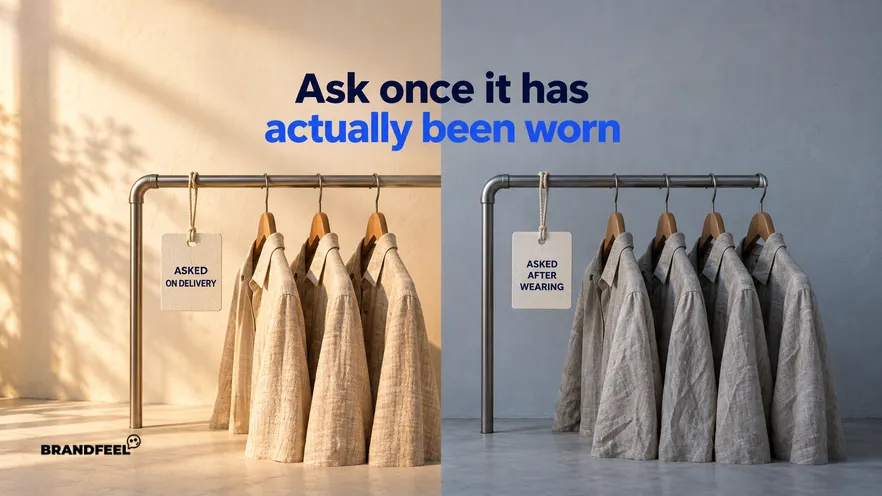
A fit verdict is defined as the moment a customer decides whether a garment fits well enough to keep, which happens after wearing rather than after delivery. Getting more reviews for fashion brands depends on it, because it is the earliest point at which a review of a garment can be truthful and it falls several days later than the request most review tools send by default. Around 70% of carts are abandoned, frequently where a shopper goes looking for a fit opinion and finds none [Baymard Institute, 2025]. This guide covers why fashion programmes under-collect, what attributes make a fashion review useful, and the request timing that fixes both.
- Time the request to the fit verdict, not to the delivery confirmation.
- Capture size ordered, size kept and how it ran as fields, not as free text.
- Ask returners for a fit comment, because theirs is the most precise data you have.
- Request one specific photograph rather than inviting photographs in general.
- Build review volume at style-family level, since individual styles retire too fast.
- Expect the average rating to drop slightly when fit comments become honest.
- Measure the change in return rate, not only in review count.
Omniconvert has measured how product evidence is published across the CROBenchmark dataset of 7,000+ websites in 15+ industries, against 248+ audit criteria, over 13 years in eCommerce [CROBenchmark Report 2026, Omniconvert]. In fashion the gap is rarely review volume in the abstract. It is that the reviews present almost never carry the reviewer's own measurements, which is the only thing that makes a fit opinion transferable to somebody else.
Why getting more reviews for fashion brands is harder than it looks
Start with timing. A review request sent on delivery collects an opinion about the parcel: it arrived, the packaging was nice, the colour looks right. None of that is the information the next shopper wants, and the customer knows it, which is part of why response rates in this category disappoint.
The second problem is sharper and less discussed. A style that sells through in one season is gone before its review corpus matures, so the brand is permanently collecting against products that will not be there long enough to benefit. A homewares brand accumulates reviews on the same twelve products for five years. A fashion brand starts again every drop.
That is why the useful unit here is not the style but the family. The Collection Clock is the observation that review value in fashion accrues to a fit pattern rather than to a product: if the same block, the same grading and the same fabric weight recur across seasons, the fit evidence collected on last year's version is still true about this year's, provided your data model can connect them.
Ask after the fit verdict, which is later than you think
This is the cheapest change on the list and the one most likely to be sitting at a default. Review tools ship with a short delay because a short delay works for consumables, and nobody revisits it when the catalogue is clothing.
The cost of getting it wrong is the familiar cost of a missing fact. Unexpected cost and unclear information have been among the leading reasons shoppers abandon purchases for as long as Baymard Institute has measured it, at around 70% average cart abandonment [Baymard Institute, 2025], and in fashion the missing fact is almost always about fit.
Lengthening it feels counterintuitive, because the instinct is that enthusiasm decays. In fit-critical categories the opposite dominates: a customer who has worn the garment twice has something to say and is more willing to say it than one who has only opened the bag. The mechanics of running that reliably are in how to build a Review-Generation system, and the general timing argument is in the best time to ask for a review.
There is a second request worth adding, and it is the one almost nobody sends. Ask the customers who returned. A return for fit is the most precise signal in your dataset, the customer has no incentive to flatter you, and a fit comment from them is exactly the content that prevents the next return. Frame it as help for the next shopper rather than as feedback for you and the response rate is surprisingly good.
Capture the attributes, not just the stars
Review utility is defined as the degree to which a review lets a different shopper predict their own outcome, which in fit-critical categories depends almost entirely on structured reviewer attributes rather than on the quality of the prose.
So the fix is a form rather than an incentive. Four fields, all optional, all single-tap where possible: height band, usual size, size ordered, and whether it ran small, true or large. Those four turn a vague compliment into a usable data point, and they also aggregate: once you have a few hundred, the product page can state how the style runs rather than leaving every shopper to work it out.
| Captured | Why it matters | Common failure |
|---|---|---|
| Size ordered | Anchors every other comment | Not asked at all |
| Usual size | Lets a shopper translate the verdict | Free text, unusable in aggregate |
| Ran small, true, large | The single most read fit signal | Buried inside the review body |
| Height band | Decides length on dresses and trousers | Treated as too personal to ask |
| Kept or returned | Separates preference from fit failure | Never joined to the review |
| Worn photograph | Outperforms studio imagery on fit | Requested in general, not specifically |
Shopify's merchant guidance has pushed complete and consistent product data across sales channels for years, and reviewer attributes are the same argument applied to the evidence layer rather than the catalogue [Shopify, 2026]. The display side of this, which is where most of the conversion effect is realised, is covered in how to display reviews for maximum conversion.
The way fashion review programmes most often stall is by treating the fit question as intrusive. A team decides that asking for height and usual size is too personal, ships a star rating and a comment box, and then spends a year wondering why a page with four hundred reviews still converts like a page with none. The fields are optional and most customers fill them in willingly, because they remember arriving at that product page needing exactly this information and not finding it.
Volume strategy: collect against the family, not the style
Most fashion catalogues carry the information needed for this and do not expose it. The same trouser block appears in four fabrics across three seasons under different names, and each one starts its review life at zero despite fitting identically.
Connecting them is a merchandising data task: a shared style-family attribute, assigned honestly. Once it exists, a new colourway launches with the fit evidence of its predecessors rather than with nothing, which is the difference between a page that can answer a fit question on day one and one that cannot answer it until the season is nearly over.
AliveCor used Omniconvert to run a structured A/B testing programme and achieved +21% conversion rate, +5% revenue per visitor, and 94% statistical relevance across their experiments. [Omniconvert, AliveCor case study] That is a testing result rather than a reviews result, and the transferable discipline is the same: change the request timing on one cohort, hold everything else still, and resist reading the first week.
What to do this week
- Move the request delay. From the tool's default to the point where somebody has worn the item. One setting, measurable in a fortnight.
- Add the four fit fields. Height band, usual size, size ordered, how it ran. All optional, all single-tap.
- Send a returner request. Fit comment only, framed as help for the next shopper. Start with one category.
- Assign a style-family attribute. Then let fit evidence carry across seasons instead of resetting with each drop.
Above the mechanics sits interpretation: what the fit comments are telling you about the grading itself, which is a product decision rather than a content one. Brandfeel, Omniconvert's sentiment-intelligence layer, aggregates reviews, NPS and support-ticket themes so a recurring fit complaint surfaces as a theme rather than as a slow drift in an average. Downstream of that, Omniconvert Commander (formerly Nexus) is an AI for eCommerce growth engine that unifies commerce data, prioritises experiments by True Profit, and generates campaigns and creative you approve before they go live. The adjacent category, where the deciding verdict is efficacy rather than fit and the request has to be split in two, is covered in how to get more reviews for beauty brands. For how a healthier review corpus reads to answer engines, see how fresh reviews improve your AI visibility, and for the arithmetic linking reviews to revenue, how reviews affect conversion.
Frequently asked questions
How do you get more reviews for fashion brands?
Ask after the fit verdict rather than after delivery, and ask for the one thing the next shopper needs: the size ordered, the size kept, and how it ran. A request that arrives the day a parcel lands collects an opinion about the courier, which is why fashion request timing under-collects even when the sequence is well written.
Why do fashion review programmes under-collect?
Because collections turn over faster than reviews accumulate. A garment that sells for one season is retired before its review corpus matures, so the brand restarts from zero every drop and never builds the volume that a slower category takes for granted.
What makes a fashion review useful?
The reviewer attributes attached to it. A five-star comment saying the dress is lovely helps nobody. The same comment with height, usual size, size ordered and whether it ran small is the single most persuasive piece of content on the page, and it is a form field rather than a writing problem.
Should I ask for reviews on returned items?
Yes, and most brands do not. A customer who returned a garment for fit has the most precise information in your dataset and no incentive to exaggerate. Asking them for a fit comment rather than a star rating turns a refund into the content that prevents the next refund.
How do I get photo reviews without discounting?
Ask for one specific thing instead of a photograph in general. A request for a picture of the item worn, with the size noted, converts far better than an open invitation, because the customer knows what is wanted and roughly how long it will take.
What should a fashion brand fix first?
The delay between delivery and the request. Most tools default to a few days, which is before anyone has worn the item to anything. Pushing it to the point where a fit verdict exists raises both response rate and usefulness, and it costs nothing but a setting.
Move one setting, add four fields
Find the review request delay in your tool and push it out to the point where a customer could plausibly have worn the garment somewhere. Then add the four fit fields and make them optional. Those two changes take an afternoon between them and they alter both how many reviews arrive and whether the next shopper can use them.
Read the result in return rate alongside review count, because the point of a fit comment is not the rating it carries. A programme that collects honest fit evidence will show a slightly lower average and a materially lower return rate, and the second number is the one that pays for the work.