
How to Get More Product Reviews
To get more product reviews, change three things: when you ask, what you reward and what you actually ask. Timing, incentives and templates.
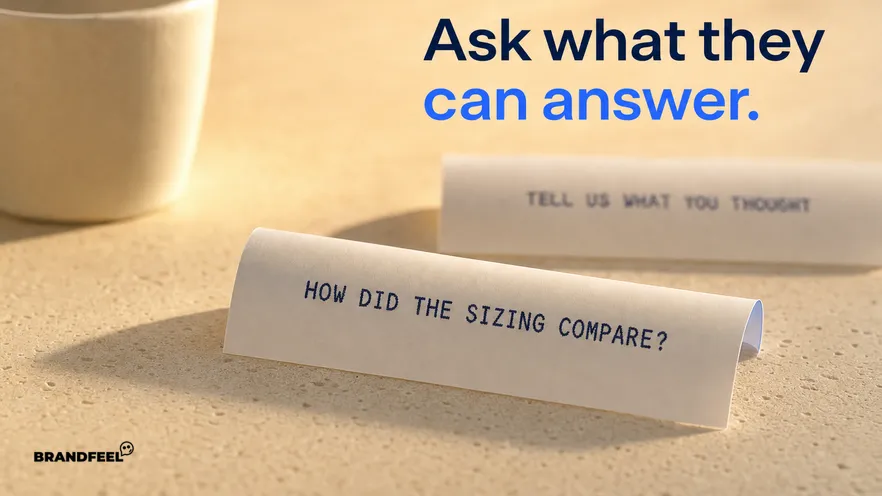
To get more product reviews, ask after the customer has used the product rather than after it shipped, reward the act of reviewing rather than the sentiment, and replace the open request with one specific question that can be answered from memory in a sentence. Those three changes cost nothing and account for most of the gap between stores.
- Ask after the customer has used the product, not after it shipped.
- Reward the act of reviewing, never the sentiment. Incentivising positivity buys you unusable data.
- Replace the open request with one specific question answerable from memory in a sentence.
- All three changes cost nothing and can be made this week without new software.
- More reviews will not fix a weak product, and a rising count on falling sentiment is a worse position than before.
Getting more product reviews is usually treated as a volume problem, so it gets a volume solution: send more requests, send them again, add a discount code. That approach has a ceiling and most stores hit it in the first quarter. The reason is that the three decisions which actually govern response were made once, by a default setting, and never revisited. Last updated: August 2026.
Omniconvert has measured how stores collect and display customer feedback across the CROBenchmark dataset of 7,000+ websites in 15+ industries, against 248+ audit criteria, over 13 years in eCommerce, and the stores with strong review coverage are rarely the ones sending the most requests. They ask at a moment the customer can answer, they offer a reward that does not distort what gets said, and they ask something specific. This guide covers those three levers: timing, incentives and templates. If you need the process that holds them together, our guide on how to build a Review-Generation system covers the ownership and routing side.
Timing: when to ask to get more product reviews
Watch what a fulfilment-triggered request actually asks. It arrives some fixed number of days after a parcel was marked delivered, and it asks the customer to evaluate a product they may have unboxed and put in a cupboard. The honest answer at that moment is that they do not know yet, so they either leave a star rating based on the packaging or they defer, and deferral is the same as a no.
Time to first use is the interval between delivery and the first occasion on which the product is used in the way that forms an opinion. For a coffee bean it is a day. For a winter coat bought in September it might be two months. For a mattress protector it is the first wash rather than the first night. The figure is different per category and is usually knowable from your own support tickets, where the first questions about a product cluster around exactly this moment.
Setting the ask window from that figure produces two effects at once. Response rate rises because the customer has something to say. Review quality rises for the same reason, and quality is the half that compounds, since a review naming a specific situation helps a future buyer decide while a bare rating does not.
| Category shape | Opinion forms at | Common default | What the default captures |
|---|---|---|---|
| Consumable, daily use | First use, within days | Too late | A faded memory, often skipped |
| Apparel, immediate try-on | Fit check, within days | Roughly right | Fit, which is the useful part |
| Durable goods, learning curve | After repeated use, weeks | Too early | Unboxing and delivery only |
| Seasonal purchase | At the season, months | Far too early | Anticipation, not experience |
| Gift purchase | Never, for the buyer | Wrong person entirely | Packaging, at best |
| Replenishment order | Already formed, at purchase | Redundant ask | A duplicate of an existing review |
The last two rows are worth acting on immediately because they are pure waste. A gift buyer cannot review a product they never used, and a replenishment customer has usually already told you what they think. Suppressing both raises your response rate on the requests that remain, without sending anything extra.
Incentives: reward the act, never the sentiment
Draw the line in one sentence: you may pay for the effort, never for the verdict.
Rewarding the act means every customer who leaves a review receives the same thing, whatever they wrote, and the offer says so plainly. Loyalty points, entry into a monthly draw and a small credit on the next order all work this way and all are defensible. Rewarding the verdict means the reward depends on the rating, or is offered only to customers you expect to be positive, or is quietly withdrawn from those who were not. That is prohibited by the major review platforms, treated as a deceptive practice by consumer-protection regulators, and worth avoiding for a colder reason too.
The colder reason is that it destroys the asset. Reviews are valuable because a shopper believes them, and Nielsen's long-running work on advertising trust has consistently found that people trust other consumers far more than they trust brand messaging. Buy the verdict and you have bought yourself an expensive imitation of your own marketing copy, while giving up the honest signal that told you what to fix.
Size matters less than most teams expect. A modest reward offered consistently outperforms a large one offered occasionally, because the size of the incentive is not what converts. The perceived cost of answering is, which is the subject of the next section.
Templates: ask one question, not for a review
Read a standard request as a task and the problem is obvious. "Tell us what you thought of your purchase" asks the customer to decide what is relevant, organise it and write it down. That is a small essay, requested by email, for no deadline. Meanwhile "How did the sizing compare to what you expected?" can be answered while walking to the kitchen.
Three shapes cover most catalogues, and the right one depends on what future buyers are uncertain about rather than on what you want to hear.
- The expectation question. "How did this compare to what you expected?" Best where purchase anxiety is about accuracy: sizing, colour, scale, strength, capacity. The answers are directly reusable on the product page because they address the exact hesitation the next buyer has.
- The situation question. "What did you use it for?" Best where the product serves several distinct uses and buyers are unsure whether theirs is covered. These answers build the coverage that makes a review section useful rather than merely populated.
- The comparison question. "What were you using before this?" Best for replacements and upgrades. It produces the most commercially useful text of the three, since it names the alternative in the customer's own words and gives you a competitive read you did not have to buy.
Whichever you pick, keep three mechanical details right. Ask exactly one question, because a second one halves the response to the first. Put the answer field in the message rather than behind a click where the platform allows it. And say how long it takes, honestly, since a request that promises one sentence and delivers a five-field form teaches customers to ignore the next one.
What a merchandiser should do this week
- Estimate time to first use for your top three categories. Read the support tickets for each and find when the first product questions arrive. That cluster is your answer, and it is already in your helpdesk.
- Suppress the customers who cannot answer. Gift orders, replenishment orders, open tickets, in-progress returns and late deliveries. This costs you nothing and improves both response rate and average rating, because you stop asking people who are currently annoyed with you.
- Rewrite one prompt into one question. Pick your highest-volume category, choose the shape that matches its buying anxiety, and run it for a month against the old wording.
- Count coverage, not volume. List your selling variants and count reviews per variant. Baymard Institute's product-page research has documented for years how much shoppers rely on reviews that match their own situation, and a variant with none is a gap no total can compensate for. To see how your coverage compares with the rest of your category, where you stand on reviews is one of the six dimensions a benchmark score reads.
All four are operational rather than strategic, which is the point: review programmes underperform from unattended defaults far more often than from bad thinking. The same discipline applies further upstream, since feedback is only as trustworthy as the customer data behind it. Our guide to collecting customer data well covers that foundation, and teams who want the same loop across the whole growth stack can see how Nexus by Omniconvert unifies commerce data and ranks the experiments worth running, with a human approving what goes live.
What more product reviews will not fix
Three limits, stated plainly.
First, more reviews make a product problem more visible, not less. That is the correct outcome and teams sometimes experience it as a failure of the review programme. If forty customers name the same friction, the programme worked and the product needs a change. Bain and Company's retention research holds that a five percent improvement in retention can raise profits by twenty-five to ninety-five percent, and repeat purchase is exactly what an unaddressed recurring complaint suppresses.
Second, a star average hides the information. Two products with the same average can have completely different distributions, and the useful signal is nearly always in the text and in the spread rather than in the mean. Displaying only the average discards most of what you collected.
Third, reviews are volunteered and therefore skewed toward the strongly satisfied and the strongly annoyed. Marketing Metrics puts the probability of selling to an existing customer at roughly sixty to seventy percent against five to twenty percent for a new prospect, which makes the quiet middle of your customer base commercially important and structurally under-represented in your review data. Surveys and post-purchase questions reach that group; review requests mostly do not.
The timing and wording that carry most of the result are set out in the Review-Request sequence that actually gets responses.
The bottom line
Three levers, in order of impact. Move the ask from a fulfilment date to a moment the customer can answer, which is the single biggest change available and costs one afternoon per category. Keep incentives tied to the act rather than the verdict, both because the alternative is prohibited and because it destroys the thing you are collecting. Replace the open request with one specific question chosen from what future buyers are uncertain about. Then measure coverage across your selling variants instead of counting totals, because a review section is useful when a shopper can find their own situation in it, not when it is long. Stores that make those three changes usually find the volume problem was never a volume problem.