
How to Respond to Negative Reviews (Templates by Scenario)
How to respond to negative reviews, with eight templates matched to the situations that produce them and the three audiences every reply must satisfy.
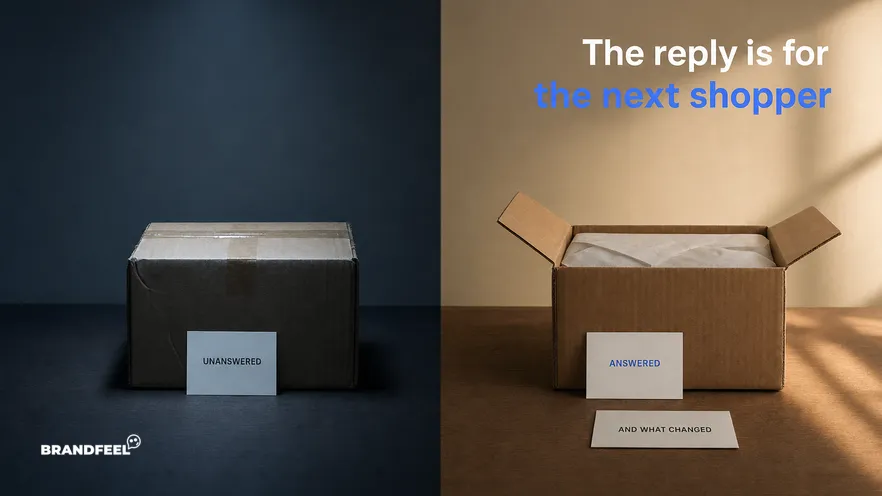
A negative review response is defined as a public reply to a critical review, written for the next shopper as much as for the reviewer. Shoppers read it: 70% say they trust opinions that other consumers post online [Nielsen, 2012], and the reply now travels with the opinion. To respond to negative reviews well, name the specific problem, state the remedy without the amount, say what changed and move the arrangements somewhere private. You will learn the shape of a reply that works and eight templates for the situations that generate one-star reviews.
- Write the reply for the next shopper, because it is read mainly by people who will never review anything.
- Name the remedy, never the amount: a public figure becomes a price list every later reader quotes.
- Fix the structure and vary the first sentence, because identical openings prove nobody read the review.
- Answer the one-star reviews with no text too; silence there is read as having nothing to say.
- Say what changed, because a reply that does converts a complaint from a pattern into a resolved incident.
Omniconvert has measured how stores collect and display customer feedback across the CROBenchmark dataset of 7,000+ websites in 15+ industries, against 248+ audit criteria, over 13 years in eCommerce [CROBenchmark Report 2026, Omniconvert]. A common pattern costs real money: stores reply diligently to positive reviews and leave the detailed complaints unanswered. Shoppers read it as a brand that answers when the news is good.
What follows is the shape of a reply that works, then eight templates matched to the eight situations that generate negative reviews. For the machinery that collects the reviews in the first place, see how to build a Review-Generation system. For where the themes inside those reviews should end up, Omniconvert's guide to customer sentiment covers the analysis side.
How to respond to negative reviews: the Three Audiences
The Three Audiences is defined as the three readers every public reply has: the reviewer, the next shopper and the answer engine. The reviewer's question is the easiest and the least valuable to answer. Acknowledging someone specifically, in their own terms, takes one sentence. Almost every brand manages it, and it buys almost nothing on its own, because the person has usually finished with you by the time the reply appears.
The next shopper's question is where the money is. They are not weighing your apology; they are looking for evidence of a mechanism. Did this brand find out what happened? Did anything change? Is there a path to a remedy that does not require writing a review? A reply containing those three facts is persuasive to someone who was not involved. A reply containing only regret is not.
The third audience is new and easy to forget. Assistants asked whether a brand is reliable will reach for text that characterises how it behaves, and a reply naming a specific problem and a specific remedy is exactly the sort of passage that gets reused. Nielsen's long-running work on trust in advertising has consistently placed consumer opinions posted online among the most trusted sources a buyer meets [Nielsen, 2012], and the reply now travels with the opinion.
Why the reply matters more than the review
The mechanism is ordinary inference. One person describing a broken item tells a reader something about one item. Twelve such descriptions with no response beneath any of them tells a reader something about the organisation, and the second inference is far more damaging than the first because it generalises to the order they are about to place.
Bain and Company's work with Fred Reichheld holds that a five percent improvement in retention can raise profits by twenty-five to ninety-five percent [Harvard Business Review, 2014], and the recovered complaint is one of the few moments where a brand can measurably move that number in one interaction. Suppressing those customers, which many stores do out of nervousness, removes the cheapest goodwill available to them.
The eight scenarios, with templates
1. The genuine defect. "You are right that the [item] should not have arrived like that, and the photograph makes it clear. A replacement is on its way and you do not need to return the damaged one. We have flagged the batch with the maker. If anything else looks wrong, reply to the message we have just sent you." Lead with agreement, because arguing about a photograph is unwinnable and looks worse than the defect.
2. The late or missing delivery. "This shipment sat with the carrier for [n] days and we did not tell you. That was ours to catch. We have refunded the delivery charge and sent a replacement on a tracked service. We have also changed when our alerts fire so the next one does not go unnoticed." Name the part that was your fault even when the carrier caused it, because the reader does not care about your contracts.
3. The expectation mismatch. "The [item] is [honest description], and our page did not make that clear enough for you to judge before ordering. We are rewriting the description and adding the measurements. A return is arranged and the postage is on us." Do not tell someone they misread you; fix the page and say you fixed it.
4. The support failure. "You wrote to us three times and got one reply. There is no version of that which is acceptable and I am not going to explain why it happened. Your refund is processed. If you would rather have the item, we will send it today." Short, no reasons, remedy first. Explanations here read as excuses to every audience at once.
5. The price or value complaint. "Thank you for saying so plainly. The [item] costs what it does because of [one specific, true reason], and that trade will not suit everybody. If it is not right for you, our returns window is [n] days and we will collect it." Never negotiate publicly, and never apologise for a deliberate decision.
6. The review you believe is unfair. "Our records show the order was delivered on [date] and signed for, which does not match what you have described here, so something has clearly gone wrong between those two facts. We would like to find out what. A refund is available in the meantime." State your record once, offer the remedy anyway, stop. No adjectives about the reviewer.
7. The one star with no words. "We can see the rating and not the reason, and we would like the reason. If something went wrong with order [reference], tell us and we will put it right. If you simply did not get on with the [item], that is useful for us to know too." Reply to these. An unanswered wall of silent one-stars is read as a brand that does not engage.
8. The misuse or user error. "That result usually means the [item] was [what actually happened], which is easy to do and which our instructions do not warn about. We are adding that warning. In the meantime we are sending a replacement and a note on the step that catches people." Take the instruction failure, which is genuinely yours, rather than the operator error, which is not the point.
The eight scenarios at a glance
| Scenario | What the next shopper is checking | Lead with | Damage if unanswered |
|---|---|---|---|
| Genuine defect | Whether you accept evidence | Agreement | High |
| Late or missing delivery | Whether you own the carrier | The part that was yours | High |
| Expectation mismatch | Whether your pages are honest | The page fix | Moderate |
| Support failure | Whether you can be reached | The remedy, no reasons | Very high |
| Price or value | Whether you stand behind pricing | The reason for the price | Low |
| Believed unfair | Which party stayed calm | Your record, once | Moderate |
| One star, no words | Whether you engage at all | A direct question | Very high |
| Misuse or user error | Whether you blame customers | The instruction gap | Moderate |