
How Reviews Affect Conversion (and How to Prove It)
Reviews affect conversion through four separate levers, and most stores measure none. The mechanisms, and how to prove it in your own data.
Last updated: October 2026 · By The Brandfeel Team
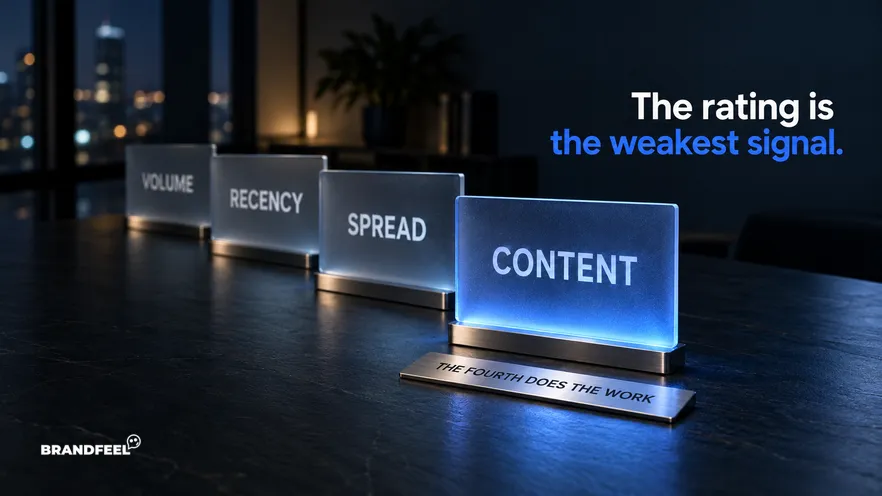
Review influence on conversion is defined as the combined effect of four levers: volume, recency, the spread of ratings and what the written reviews say. A product with five reviews is 270% more likely to sell than one with none [Spiegel Research Center, 2017]. The fourth lever, written content, is usually the strongest and the least measured. You will learn how reviews affect conversion and how to prove it in your own data.
- Separate four levers, not one: volume, recency, distribution and content, because they move conversion for different reasons.
- Use written content as your strongest lever, because it removes objections rather than adding reassurance.
- Expect a perfect score with few reviews to read as unverified, and no negatives at all to read as filtered.
- Spread collection across the catalogue, because the first handful of reviews on a product does most of the work.
- Prove it with a holdout in the request flow, not by removing reviews from live traffic.
Reviews affect conversion through four separate mechanisms, and treating them as one number is why so many review programmes cannot show a return. Omniconvert has measured how stores collect and display customer feedback across the CROBenchmark dataset of 7,000+ websites in 15+ industries, against 248+ audit criteria, over 13 years in eCommerce [CROBenchmark Report 2026, Omniconvert]. The mechanism doing most of the work is the one teams never instrument: not the star rating, but what the written reviews say about the objections the product page failed to answer. This piece separates the four levers, explains why a perfect average is a weak signal, and gives three ways to prove the effect in your own data instead of quoting somebody else's study.
How reviews affect conversion: volume and recency
A product with no reviews asks the shopper to be first, which is a different and harder decision than joining. The first few reviews remove that, and the effect of removing it is large. That is why spreading collection across a catalogue beats concentrating it: moving forty products from zero to five is worth far more than moving one product from two hundred to four hundred.
Recency does separate work. A listing whose most recent review is eighteen months old suggests a product nobody buys any more, or a store that stopped caring, and shoppers read dates.
Lever three: the distribution, not the average
This is the finding that surprises teams most, and it is easy to reason about from the shopper's side. Somebody considering a product knows that no product pleases everybody. A page implying otherwise contradicts their experience, and the conclusion they draw is about the page rather than about the product.
The operational implication is a hard one for most brands: do not suppress, filter or bury the critical minority. Answer it. A reply that addresses the complaint factually converts the exchange into evidence that somebody is paying attention, and that reply is read by every subsequent visitor. Nielsen's long-running research on consumer trust puts peer testimony above brand-controlled messaging, and a visible reply sits inside the peer record rather than beside it.
Lever four: what the reviews actually say
Review content is defined as the factual detail in written reviews that answers a question the product page left open. Independent research from the Baymard Institute has found repeatedly that absent information on fit, cost, delivery and returns is among the most consistent reasons buyers stop. Now notice where that information usually does exist on your site: in the reviews, written by customers, in the customer's own language, sitting below the point at which the shopper gave up.
That gap is the fastest conversion work available in this whole area, and it is not a review programme task. Read thirty reviews of your best-selling product, list every factual question they answer that the page itself does not, and fix the page. Then surface the review that answers the biggest remaining objection near the point of decision rather than at the bottom of the page.
How to prove it in your own store
- The request-flow holdout. Withhold the review request from a random share of customers for a quarter, then compare conversion on the products whose listings consequently grew against those that did not. It is slow, it costs you some reviews, and it is the only design that isolates the reviews themselves rather than their presentation.
- The threshold comparison. Track conversion as individual products cross from zero to five reviews, and from five to twenty. Control for traffic mix and season, and expect the first threshold to dominate. This uses data you already have and is observational, so treat it as strong evidence rather than proof.
- The presentation test. A genuine A/B test on where and how review content appears: an objection-answering excerpt near the buying decision against the standard block below the fold. This is the design that produces an actionable result quickly, because presentation is what you control day to day.
Two designs to avoid. Do not test removing reviews from live traffic: the cost is asymmetric, the result is predictable, and on some marketplaces it breaches the terms you agreed to. And do not compare your conversion rate to a published category benchmark and call the gap a review effect, because that gap contains your price position, traffic mix and assortment as well. If you want category context for the numbers you do have, the method sits in the DTC competitor research stack, which is also where you can benchmark your reviews against the category rather than against a global average.
| Lever | What the shopper reads from it | Relative strength | How to measure it |
|---|---|---|---|
| Volume | Other people bought this | Strong at the low end, flat after | Threshold comparison at zero to five |
| Recency | This is still a current product | Moderate and steady | Date of most recent review per listing |
| Distribution | This page is honest with me | Moderate, and asymmetric when absent | Share of critical reviews, and replies to them |
| Content | My specific question is answered | Strongest | Presentation test on an objection excerpt |
| Average rating alone | Very little on its own | Weak | Not worth isolating |
| Replies to reviews | Somebody is paying attention | Moderate, cheap to improve | Reply coverage on critical reviews |
What to do this month
- Read thirty reviews of your best seller and list the questions they answer that the page does not. Fix the page. This is an afternoon and it is the highest-return item here.
- Reply to every critical review, factually, once. Start with the most recent twenty. Coverage matters more than eloquence.
- Make collection continuous. Requests triggered by the customer's experience rather than by a monthly send, which also fixes the ageing front page problem. The system is in how to build a review-generation system, and the timing is in the best time to ask for a review.
- Pick one measurement design and start it. The threshold comparison needs no new instrumentation, so there is no reason to wait a quarter to begin.
Where this becomes an ongoing operation rather than a project, Brandfeel by Omniconvert, the sentiment-intelligence layer, aggregates reviews, NPS responses and support-ticket themes and groups the recurring objections, which is the content lever turned into a repeatable input instead of an afternoon's reading. Brandfeel is a module inside Omniconvert Commander (formerly Nexus), the AI for eCommerce growth engine that unifies commerce data, segments customers by behaviour and value, and queues the experiments most likely to close a gap, with you approving what goes live. Omniconvert's work on customer value optimization is where this connects to retention, and Bain and Company's research, associated with Fred Reichheld, is the reason it sits there rather than inside acquisition: a shopper whose objection was answered honestly before buying is a materially better retained customer than one who was persuaded past it.
The adjacent case is now documented too: fresh reviews improve your AI visibility.
Frequently asked questions
How do reviews affect conversion rate?
Through four separate mechanisms that are usually treated as one. Volume signals that other people bought it, recency signals that the product is current, the distribution of ratings signals honesty, and the content of the reviews answers specific objections the page did not address. The fourth is almost always the strongest and is the one nobody measures, because it works by removing a reason not to buy rather than by adding reassurance.
Does a higher average rating always convert better?
No. A perfect score with few reviews reads as unverified, and a product with no negative reviews at all raises the suspicion that the negatives were removed. What performs is a credible distribution: mostly positive with a visible minority of critical reviews, each answered sensibly. The critical reviews also do practical work, because a shopper who reads a complaint that does not apply to them has had an objection resolved rather than raised.
How do you prove reviews affect conversion in your own store?
Three designs, in descending order of rigour. Run a genuine test on review presentation rather than on the reviews themselves, such as surfacing review content answering a common objection higher on the page. Compare conversion before and after a product crosses a review count threshold, controlling for traffic mix and season. Or run a holdout in your review request flow, so some customers are never asked, and compare the resulting listings over a quarter. The third is slow and the cleanest.
Why can you not just A/B test removing reviews?
Because it is a destructive test with an asymmetric cost. If reviews matter, you have deliberately worsened the experience for half your traffic for the duration, and the information you gain is a figure you could have predicted. It can also breach platform or marketplace requirements on displaying collected reviews. Test the presentation and the prominence of reviews instead, which is where the decisions you can actually act on live.
How many reviews does a product need?
Enough that the number stops being a question, which is lower than most teams fear and is a threshold rather than a curve. The first handful do most of the work, moving a product from unverified to plausible. After that each additional review adds less, until volume matters mainly for how convincingly recent the latest ones are. The practical implication is to spread collection across the catalogue rather than concentrating it on the products that already have plenty.
Teams measuring review impact often compare conversion on well-reviewed products with conversion on thinly reviewed ones and call the gap the review effect. The well-reviewed products are also the bestsellers, with more traffic, better placement and often different prices, so the comparison measures popularity rather than reviews.
AliveCor used Omniconvert to run a structured A/B testing programme and achieved +21% conversion rate, +5% revenue per visitor, and 94% statistical relevance across their experiments. [Omniconvert, AliveCor case study] The three designs above apply the same discipline to your review data.
Start with the lever you already own
Reviews move conversion through four levers, and the one every dashboard reports is the weakest. Volume matters most in the jump from none to a few, recency decides whether the product looks current, the spread of ratings decides whether the page looks honest, and the written content does the heaviest work by answering the questions your page left open. Start with that last lever, because the answers already exist in reviews you have collected: read thirty, fix the page, and surface the objection-answering review near the decision. Then prove the effect with a holdout in your request flow rather than by taking reviews away from live traffic.