
The Best Review Platforms for DTC, Compared by Type
Review platforms for DTC come in five kinds, compared here on who owns the evidence and what it costs to leave. Pick the type before the vendor.
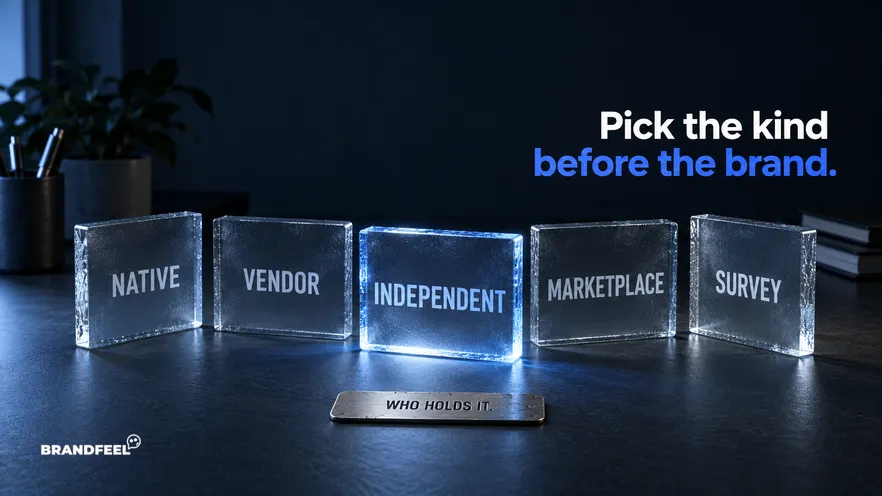
Evidence ownership is defined as the question of who holds, publishes and can withdraw a set of customer reviews, and it is the single difference that separates the five kinds of review platforms for DTC brands. The choice is usually made on price and features, and it should be made on which job you are buying for, because the types answer different questions and two of them cannot do each other's work at all. Around 70% of carts are abandoned, frequently at the point where a shopper looks for reassurance [Baymard Institute, 2025]. This guide compares the five types on ownership, independence, syndication, schema and exit cost.
- Choose the type before the vendor, because the types do different jobs.
- Independence is a property of who hosts the reviews, not of the vendor's branding.
- Running two platforms for the same job splits volume and weakens both.
- Ask what the export file contains before signing, not when you are leaving.
- Check whether the type can earn star ratings on your own product pages.
- Match the type to how cautious your category's buyers actually are.
Review platforms for DTC brands are usually shortlisted by price and feature grid, and that is the wrong starting point. This comparison deliberately names no vendors. Product claims move faster than any article can track, and a comparison that states a feature a vendor has since changed is worse than no comparison at all. What does not move is the shape of the categories, and the shape is what decides most of the outcome. Check current pricing and features on each vendor's own site before you shortlist.
Omniconvert has measured how customer evidence is published across the CROBenchmark dataset of 7,000+ websites in 15+ industries, against 248+ audit criteria, over 13 years in eCommerce [CROBenchmark Report 2026, Omniconvert]. The recurring finding is not a bad tool choice. It is a tool chosen for a job the brand did not need doing, usually because the shortlist started with vendors rather than with the question.
The five types of review platforms for DTC brands
The platform-native app is the review tool built into or bundled with your commerce platform. It is cheap, it is already integrated, and the reviews sit in your own store data. For a brand whose buyers are not especially cautious, it is frequently enough.
The dedicated vendor is a specialist tool that does collection, moderation, display and syndication properly. It costs more and earns the difference on collection rates and display flexibility rather than on the reviews themselves being any more credible.
The independent host publishes reviews on its own domain, where you cannot edit or remove them. That restriction is the product. Brands in categories where buyers are wary, or where a purchase is expensive and infrequent, buy that restriction on purpose.
Marketplace reviews arrive whether you want them or not, attached to listings you may not fully control, and they are often your largest corpus by volume. Treating them as somebody else's problem is a common and expensive habit.
Survey and voice-of-customer tools are the odd one out: they collect structured feedback rather than public reviews. They do not put stars on a page and they tell you why something is happening, which the others largely do not.
What actually differs between them
| Type | Who holds the evidence | Reads as independent | Exit cost |
|---|---|---|---|
| Platform-native app | You, inside your store | No | Low |
| Dedicated vendor | The vendor, shown on your site | Partly | Depends on the export |
| Independent host | The platform, on its domain | Yes | High, by design |
| Marketplace | The marketplace | Yes | Not applicable |
| Survey and voice of customer | You | Not its purpose | Low |
The independence column is the one that is usually misread. A dedicated vendor's badge on your own product page is not independent evidence, however reputable the vendor: the reviews are displayed by you, on your domain, under your control. That is not an accusation, it is a description of the arrangement, and systems reading the page treat it accordingly.
Exit cost deserves more attention than it gets at signature. Ask for a sample export and look for four things: the review text, the author, the date and the product it attaches to. An export missing any of those is not really an export, and the reviews stay where they are.
The specific mistake this category produces: a brand buys an independent trust platform for the badge, then also runs the platform-native app for product pages, and splits its review requests between the two. Both corpora end up thin, the product pages show single digits, the trust page shows a few dozen, and the brand concludes that reviews do not work for it. One job, one platform, one request flow.
Matching the type to the job
- What is being doubted: the product or the company? Product doubt wants product-level reviews on product pages. Company doubt, which dominates in higher-priced and newer categories, wants company-level evidence somewhere you do not control.
- Where does the doubt occur? On the product page, in the cart, or before the visitor ever arrives. Evidence has to be present at the moment of hesitation, which is often earlier than the page the brand was optimising.
- How expensive and how infrequent is the purchase? The more a buyer stands to lose and the less often they buy, the more independence is worth paying for. For a low-priced repeat purchase, volume and recency matter far more than who hosts the file.
Those three questions also explain most of the disagreements inside a team. Marketing is usually answering the first question about the product while finance is answering it about the company, and the argument about tooling is really an unresolved argument about what buyers are nervous about.
AliveCor used Omniconvert to run a structured A/B testing programme and achieved +21% conversion rate, +5% revenue per visitor, and 94% statistical relevance across their experiments. [Omniconvert, AliveCor case study] That is a testing result rather than a tooling result, and the transferable discipline is to prove the placement before committing to the platform: test where evidence has to appear, then buy the thing that can put it there.
The questions to ask every vendor
- What exactly does the export contain? Text, author, date, product mapping, and in what format. Ask for a sample file rather than a description.
- Who hosts the reviews, and can we remove one? If you can, your evidence is not independent, and you should know that going in rather than discovering it in an audit.
- What markup do you emit on our pages? It has to describe a specific item and match a rating a visitor can see. The current eligibility rules are set out in Google's review snippet documentation and they change.
- How is the request timed? After delivery or after use. The difference decides whether you collect opinions about couriers or about products.
- What happens to reviews on a product variant? Shared across the range, or per variant. Both are defensible and only one of them is honest for a range where variants differ.
- How do you handle a bad review? The honest answer involves publishing it. Shopify's merchant guidance has pushed complete and consistent product information across channels for years, and suppressed negatives are the clearest case of information that is neither.
What to do this week
- Write down the job. One sentence: what is being doubted, where, and how much the purchase costs. Circulate it before anyone opens a vendor site.
- Audit what you already have. Count your reviews by source, including marketplaces. Brands routinely find their largest corpus is one they had written off.
- Ask for one export file. From your current tool. What comes back tells you more about your position than any comparison article can. The collection mechanics are in how to build a Review-Generation system, the display arithmetic in how reviews affect conversion, and the markup rules in review schema.
Whichever type you land on, the layer worth adding afterwards is interpretation rather than collection. Brandfeel, Omniconvert's sentiment-intelligence layer, aggregates reviews, NPS and support-ticket themes so a change in what customers are saying surfaces as a theme rather than as a slow drift in an average. Downstream of that, Omniconvert Commander (formerly Nexus) is an AI for eCommerce growth engine that unifies commerce data, prioritises experiments by True Profit, and generates campaigns and creative you approve before they go live.
Closely related to this is best UGC tools for eCommerce brands.
Frequently asked questions
What are the main types of review platform for DTC brands?
Five. The review app built into your commerce platform, a dedicated review vendor, an independent trust platform that hosts the reviews on its own domain, the marketplace review systems you inherit by selling there, and survey and voice-of-customer tools that collect structured feedback rather than public reviews. Each answers a different question, and most brands end up running two.
Which type produces the most credible evidence?
An independent platform hosting reviews on a domain you do not control, because the credibility comes precisely from the fact that you cannot edit or remove them. That independence is also the cost of the option, which is why brands who want it should decide for that reason rather than discovering it later.
Do we need more than one?
Most brands over a certain size do, and the common pairing is a platform-native or dedicated tool for product-level reviews plus one independent source for company-level trust. The failure mode is running two that do the same job, which splits the volume and makes both look thinner than one would have.
How much does the exit cost matter?
More than the subscription. Reviews are an asset that took years to accumulate, and a platform that exports them as a flat file without authors, dates or product mapping effectively keeps them. Ask what the export contains before you sign, not when you are leaving.
Does the choice affect star ratings in search?
It affects how easily you can earn them. The markup has to describe one specific item, the same rating has to be visible on the page, and the reviews cannot be ones you supplied about yourself. Some types satisfy those conditions on your own domain and some by design do not, which is a question to settle before the contract.
How should a small brand choose?
Start with the job rather than the shortlist. If you need product-level evidence on product pages, that is one type. If you need company-level trust for a category where buyers are cautious, that is another. Write down which job you are buying for, then compare only the type that does it.
Decide the type before the demo
Write one sentence describing what your buyers doubt, where they doubt it and how much the purchase costs them if it goes wrong. That sentence eliminates three of the five types immediately, which is most of the work a comparison is supposed to do.
Then ask your current vendor for a sample export and read it. Whether the author, the date and the product mapping come back tells you what your review history is actually worth, and that number should be in the room before anyone signs anything new.