
How to Get More Reviews for Supplement Brands
Reviews for supplement brands fill with delivery and taste, because the benefit is imperceptible. Ask about an observable proxy and adherence.
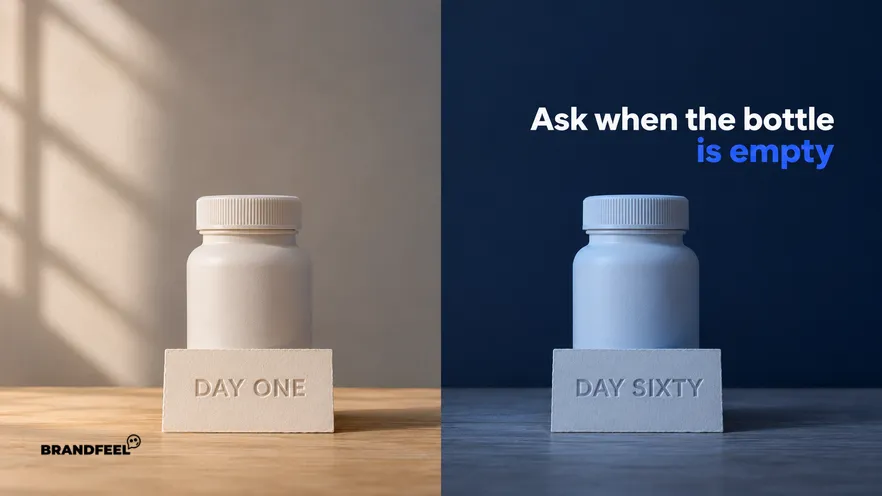
Perceptibility is defined as the degree to which a customer can directly notice the effect of a product, and in supplements it is frequently zero. Getting more reviews for supplement brands therefore depends on asking a question the customer is in a position to answer: one observable proxy, plus how many days they actually took it. Around 70% of carts are abandoned, often where a shopper looks for evidence from somebody like them and finds only comments about the courier [Baymard Institute, 2025]. This guide covers the observable proxy, the adherence field, the request timing that produces either, and where claim rules draw the line.
- Ask about one observable proxy per product, never about the benefit itself.
- Capture how many days they took it, because adherence decides what the review means.
- Trigger the request from pack size and dose, not from the delivery confirmation.
- Publish reviews unedited, and write a quoting rule before marketing needs one.
- Read repeat purchase beside the rating, since enjoyment and efficacy diverge here.
- Expect fewer reviews and far more usable ones once the timing moves.
- Treat delivery and taste comments as a measurement fault, not as customer feedback.
Omniconvert has measured how product evidence is published and collected across the CROBenchmark dataset of 7,000+ websites in 15+ industries, against 248+ audit criteria, over 13 years in eCommerce [CROBenchmark Report 2026, Omniconvert]. In supplements the shortfall is not review volume. It is that the review corpus on a typical product page answers a question nobody asked, because the request arrived when the only assessable part of the purchase was the parcel.
Why reviews for supplement brands collect the wrong thing
Read your own corpus for ten minutes and the pattern is unmistakable. Arrived quickly. Easy to swallow. Pleasant flavour. Good value. Those are real comments from real customers and not one of them tells the next shopper whether the product does anything.
This is a measurement fault rather than a customer problem. A review tool configured with a global delay of a few days after fulfilment is asking about a parcel. Nobody at the brand decided to ask about the parcel; the default did.
The second complication is harder. Even with perfect timing, a large share of supplement benefits cannot be felt. A vitamin D course corrects a blood level the customer cannot sense. A magnesium supplement may change something they will describe as nothing in particular. Asking those customers whether it worked invites them to invent an answer or to shrug.
Ask about an observable proxy instead
The Observable Proxy is worth naming because naming it settles an argument that otherwise recurs every quarter. Marketing wants to ask whether the product worked. Compliance does not want a page full of customer efficacy claims. Operations wants one question. The proxy satisfies all three: it asks about a lived detail rather than about a benefit.
In practice that means one question per product, chosen deliberately. For a sleep formulation, how long it took to fall asleep. For a recovery product, how the day after training felt. For a greens powder, whether it replaced something else in the morning routine. Each of those is specific, answerable and modest.
What it is not is a question about the mechanism. Nobody can report on absorption, bioavailability or a blood marker from their kitchen, and a review that claims to is a liability rather than an asset. The mechanics of running any of this reliably are in how to build a Review-Generation system, and the general timing argument sits in the best time to ask for a review.
Adherence is the field that makes a rating mean anything
This is the cheapest change on the list and the one most often skipped, because it feels like interrogating a customer. One tap, four options, no free text: most of it, about half, a few days, I stopped.
What it buys is the ability to read the corpus at all. Separate the reviews by adherence and two stories appear. Among people who finished, the proxy moved or it did not, and that is your efficacy read. Among people who stopped, the answers cluster tightly: too many capsules, unpleasant aftertaste, forgot, ran out and did not reorder.
That cluster is a product and packaging roadmap in plain sight, and no amount of review volume surfaces it while the two groups are averaged together. Shopify's merchant guidance has pushed complete and consistent product data across sales channels for years, and adherence is the same argument applied to the evidence layer rather than to the catalogue [Shopify, 2026]. How to present the result so it actually moves conversion is covered in how to display reviews for maximum conversion.
| Trigger or field | What it can honestly collect | Common failure |
|---|---|---|
| Three days after delivery | Taste, capsule size, packaging | Treated as the product review |
| End of the first course | The observable proxy | Never configured at all |
| Observable proxy field | One lived, reportable detail | Replaced by "did it work" |
| Adherence field | Whether it was actually taken | Absent, so averages blur |
| Stop-reason field | The packaging roadmap | Free text, unusable |
| Repeat purchase join | The hardest efficacy signal | Never joined to the review |
The way supplement review programmes get themselves into trouble is by promoting their best outcome comments. A brand with a thin corpus starts featuring the most enthusiastic customer sentences on the product page, then in email, then on a paid landing page, and somewhere in that sequence it stops publishing what a customer said and starts asserting what the product does. Nobody decides to cross that line; it happens one promotion at a time, usually while the person who would have objected is on holiday, and the fix is a written rule about which reviews may be quoted in marketing copy and who signs that off.
Time the request to the container
Most brands already hold both inputs and use neither. The label says sixty capsules, two a day. The review tool asks on day three. Connecting the two is a calculation, not a system.
Setting the request at the end of the course lands it as the customer decides whether to reorder, so it is a retention touch as well as a measurement one. A 5% retention lift can raise profits by 25% to 95% [Harvard Business Review, 2014].
Keep the first request if you want the logistics data. Just stop calling it a product review. Two requests, each asking about what is knowable at that moment, is the arrangement that works, and the second one is the one shoppers read.
Unexpected cost and unclear information have been among the leading reasons shoppers abandon purchases for as long as Baymard Institute has measured it, at around 70% average cart abandonment [Baymard Institute, 2025]. In supplements the unclear information is whether the product does anything for somebody in their situation, and the only source for that is a review written after the first course finished.
Read repeat purchase beside the rating
Plot average rating against ninety-day repeat rate for every product. Four quadrants appear and the interesting one is high rating, low repeat, which in this category is crowded.
It usually holds products that taste good and did nothing perceptible, and products bought once for an episode that then resolved. Both are actionable and neither is visible in the review corpus alone.
AliveCor used Omniconvert to run a structured A/B testing programme and achieved +21% conversion rate, +5% revenue per visitor, and 94% statistical relevance across their experiments. [Omniconvert, AliveCor case study] That is a conversion-testing result rather than a reviews result, and the transferable discipline is to move the request timing on one product family at a time, so the effect on rating and repeat rate can be read honestly.
What to do this week
- Calculate the course length. Pack size divided by daily dose, as a per-product field. It is the trigger for everything else.
- Write one observable proxy per product. One sentence, chosen deliberately, never a question about the mechanism.
- Add adherence and stop-reason. Four options each, single tap, no free text.
- Plot rating against repeat rate. Ninety days. The high-rating, low-repeat quadrant is the week's finding.
The adjacent categories make useful contrasts: where the customer can feel the texture immediately and the outcome arrives weeks later, in how to get more reviews for beauty brands, and where fit rather than efficacy decides the verdict, in how to get more reviews for fashion brands. Above the mechanics sits interpretation: Brandfeel, Omniconvert's sentiment-intelligence layer, aggregates reviews, NPS and support-ticket themes, so a recurring aftertaste complaint or a cluster of stop reasons surfaces as a theme rather than as a slow drift in an average. Downstream, Omniconvert Commander (formerly Nexus) is an AI for eCommerce growth engine that unifies commerce data, prioritises experiments by True Profit, and generates campaigns and creative you approve before they go live. The arithmetic linking reviews to revenue is in how reviews affect conversion.
Also worth reading alongside this: get more reviews for home & garden brands.
Frequently asked questions
How do you get more reviews for supplement brands?
Ask a question the customer can actually answer. Most supplement benefits are imperceptible, so a request that asks how the product worked collects comments about delivery, taste and capsule size instead. Asking about one observable proxy, plus how many days they took it, produces reviews that carry information.
What is an observable proxy?
The single everyday thing a customer could plausibly notice and report: how long it took to fall asleep, whether the afternoon slump moved, how recovery felt the day after training. It is not the mechanism and it is not a health claim. It is the one change a person is in a position to describe.
Why do supplement reviews talk about delivery so much?
Because that is the only part of the experience the customer can assess when the request arrives. A request sent three days after the parcel lands asks about a product that has barely been taken, so the reviewer answers about the thing they do know, which is the packaging, the taste and the courier.
Should a supplement brand quote reviews in marketing copy?
Only under a rule written in advance. Publishing reviews unedited is straightforward. Selecting the most enthusiastic outcome comments and promoting them moves a customer statement toward a claim the brand is making, and in this category what a brand may claim is constrained. Decide the rule and the approver before anyone needs it.
How does adherence change what a review means?
Completely. A one-star review from somebody who took four capsules out of sixty is a review of their intention, not of your product. Without an adherence field, those sit in the same average as reviews from people who finished the course, and the average then describes nothing in particular.
What should a supplement brand fix first?
Move the review request from a delivery trigger to a course-completion trigger, calculated from pack size and dose. It is a configuration change, it costs nothing, and it is the difference between asking about a parcel and asking about a product.
Ask on the day the bottle empties
Take one product, divide the pack size by the daily dose, and move its review request to that day. Replace the question with two: the observable proxy you chose for that product, and how many days they actually took it. Leave the delivery request where it is and stop treating what it collects as product feedback.
You will get fewer reviews and they will be longer, more specific and far more frequently read. Then split the corpus by adherence and look at the people who stopped, because their reasons are a packaging and formulation roadmap that no amount of extra review volume would ever have surfaced.