
How to Get More Reviews for Home and Garden Brands
More reviews for home and garden brands is a calendar problem: the product is judged over a season, so one post-purchase ask collects a delivery review.
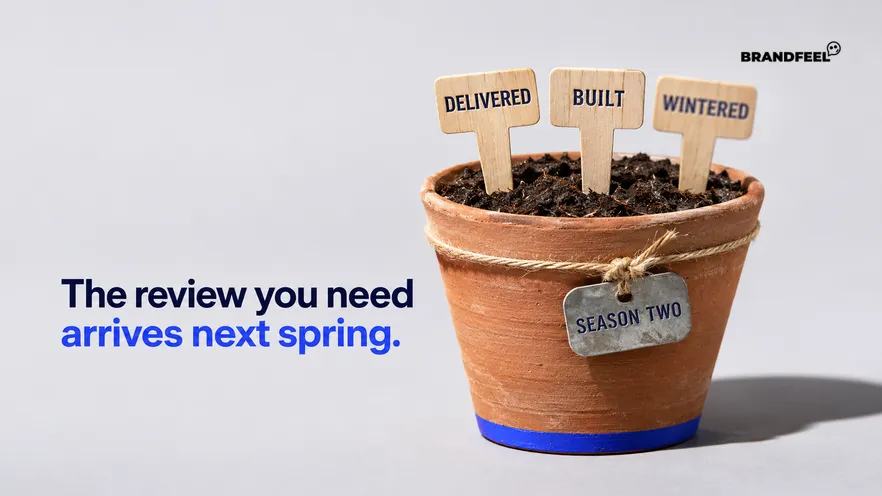
Verdict lag is defined as the interval between a purchase and the moment the buyer can actually judge the product. It is the reason getting more reviews for home and garden brands fails on a standard schedule: a request sent nine days after delivery arrives before the customer has assembled the item, used it or seen it through any weather. Around 70% of carts are abandoned, with unclear information among the most cited causes [Baymard Institute, 2025], and a thin review corpus is exactly that. This guide covers the four verdicts worth asking against, how to separate logistics from product, and how to harvest the second-season review.
- Ask four times against four verdicts: delivery, assembly, first use and first season.
- Keep logistics feedback out of the product rating, because bulky goods generate real complaints.
- Set the season-two trigger at purchase, as a date rather than a number of days.
- Ask for the customer photograph at first use, while the product is newly in place.
- Treat a durability review as worth several ordinary ones, and accept a low response rate.
- Give the assembly answers to the team that can fix them, not to merchandising.
- Expect a lower average rating and a better-informed shopper, which is the trade worth making.
Omniconvert has measured review behaviour and funnel quality across the CROBenchmark dataset of 7,000+ websites in 15+ industries, against 248+ audit criteria, over 13 years in eCommerce [CROBenchmark Report 2026, Omniconvert]. Categories with a long verdict lag consistently under-collect, and the cause is almost never the incentive or the subject line. It is that the request arrives before the customer has anything to say.
Why getting more reviews for home and garden brands is a calendar problem
Think about what a buyer of outdoor furniture knows at day nine. They know whether the pallet arrived when promised, whether the box was damaged, whether the fixings were all in the bag, and whether it looks the way they expected in their own garden. Every one of those is worth knowing and none of them is the question the next shopper is asking.
The next shopper wants to know whether the frame is still rigid after a winter, whether the fabric faded, whether the finish lifted. That information exists, in the heads of last year's customers, and almost nobody asks for it, because review programmes are built on a fixed offset from dispatch.
The same structure applies across the category with different clocks. A plant is judged at the end of a growing season. A paint is judged when it has been through a summer on a south-facing wall. A mower is judged in its second spring. The general method for building the programme is in build a Review-Generation system, and this piece is about setting its clock.
The Four Verdicts, and asking against each one
Call it the Four Verdicts and build the schedule around it rather than around a single send. The point is not more email. It is that each ask is short, arrives when the customer has just learned something, and routes the answer to whoever can act on it.
The delivery verdict is immediate and belongs to operations. Ask it within days, keep it to the courier, the packaging and the condition on arrival, and do not let the answer touch the product's star rating. The assembly verdict follows a few days later, and it is the one with the highest unrealised value: time taken, anything missing, whether the instructions matched the item in the box.
The first-use verdict is the conventional product review, and in this category it should arrive later than a standard schedule allows, once the thing has been in place long enough to have been lived with. The first-season verdict is the one that differentiates you, and it needs a date set at purchase.
| Verdict | When it is answerable | Who should read it |
|---|---|---|
| Delivery | On arrival | Operations and the carrier |
| Assembly | Within the first week | Product and packaging |
| First use | After living with it | Merchandising, as the review |
| First season | Next spring or summer | Merchandising and the next shopper |
| Second season | A year later again | Quality and warranty |
| Photograph | At first use | The product page |
The way home and garden teams get this wrong is by fixing the rating instead of the question. Average ratings on bulky lines sit low, somebody traces it to delivery complaints, and the response is to move the review request later so the courier is less fresh in mind. Ratings recover, the team records a win, and the delivery problem stops being visible to anyone at all. It did not go away: it is still happening, it is still costing refunds, and the only instrument that was reporting it has been quietly retuned. Separating the two asks solves both halves. Burying one of them solves the reporting.
Keep the logistics review out of the product rating
This is partly fairness to the product and mostly usefulness to the shopper. A planter that arrives chipped once in twenty deliveries is a packaging problem, and a product page that averages that into a score tells the next buyer nothing about the planter. Trust in peer feedback has been one of the most durable findings in consumer research, and Nielsen's long-running work on recommendation trust is the usual reference point for it, which is exactly why a muddied score is costly rather than cosmetic.
Practically, this means two separate forms, two separate stores of data, and a rule that only the product form feeds the public rating. The delivery answers go to a dashboard somebody in operations actually opens, with the carrier and the lane attached.
It also means being honest in the public corpus. Where a delivery issue was real and was resolved, that story belongs in the review, and suppressing it is both wrong and detectable. The distinction is between letting a courier's bad week set a product's score and hiding that the week happened. Getting more reviews for fashion brands faces the mirror image of this problem, where the logistics are simple and the verdict is immediate.
Harvesting the second-season review
Seasonal triggering is defined as scheduling a review request against a calendar event relevant to the product's use rather than against a fixed interval after dispatch, so that the ask lands when the customer has just formed the opinion you want.
The mechanics are simple and almost nobody does them. At purchase, record the product's season and set a dated task. In March, write to everyone who bought outdoor furniture last year with one question: how did it come through the winter. One question, no star rating required, no incentive needed beyond being asked.
Expect a response rate well below your normal one and value each answer much higher. A paragraph from a customer confirming that a frame is still solid after a winter outranks forty five-star reviews written on arrival, because it is the only kind of evidence that answers the objection holding the next shopper back. Unexpected cost remains the most cited reason shoppers abandon purchases in Baymard Institute research, at around 70% average cart abandonment [Baymard Institute, 2025], and in this category the feared cost is buying something twice because the first one did not last.
AliveCor used Omniconvert to run a structured A/B testing programme and achieved +21% conversion rate, +5% revenue per visitor, and 94% statistical relevance across their experiments. [Omniconvert, AliveCor case study] That is a testing result rather than a review-programme one, and the transferable discipline is to change one ask at a time: splitting the delivery form and moving the product trigger in the same month leaves you unable to say which change produced the movement.
What to do this week
- Split the form. One short delivery form, one product form. Only the second feeds the public rating.
- Add the assembly questions. Time taken, anything missing, instructions matched. Three fields, routed to product.
- Set one dated trigger. Pick your most seasonal line and schedule next spring's durability ask now, while the orders are in front of you.
- Ask for the photograph at first use. Not at delivery, when the item is still in a box, and not a season later when it is weathered.
On tooling, the themes matter more than the counts. Brandfeel, Omniconvert's sentiment-intelligence layer, aggregates reviews, NPS and support-ticket themes so a recurring assembly complaint surfaces as a theme rather than as a scattering of three-star ratings nobody groups. Further upstream, Omniconvert Commander (formerly Nexus) is an AI for eCommerce growth engine that unifies commerce data, prioritises experiments by True Profit, and generates campaigns and creative you approve before they go live.
One caution on sequencing. Teams here usually want to begin with an incentive, because incentives are quick to launch and lift response rates measurably. Begin with the split and the dated trigger. An incentive applied to a badly timed ask buys you more reviews of your courier.
Frequently asked questions
How do you get more reviews for home and garden brands?
By asking more than once, against different verdicts. A single request a week after delivery collects an opinion about the courier and the packaging, because that is all the buyer can judge yet. Separate asks for delivery, assembly, first use and the first full season collect four reviews where most programmes collect one.
Why do review requests fail in this category?
Because the trigger is the dispatch date and the verdict is months away. A buyer asked to rate outdoor furniture nine days after it arrived has assembled it and sat on it twice. Whether it survives a winter, which is the thing the next shopper wants to know, is not knowable yet and never gets asked.
Should delivery feedback and product feedback be separated?
Yes, and keeping them together is the most expensive mistake in home and garden review programmes. Bulky goods generate real logistics complaints, and when those land in the product rating they depress a score that the product did not earn and give the next shopper no usable information.
How do you collect a second-season review?
Deliberately, with a dated trigger set at purchase. Schedule the request for the start of the next relevant season rather than a fixed number of days later, and ask one question about durability. Response rates are lower and the content is worth several ordinary reviews.
What should the assembly ask look like?
Short, specific and separate. Time taken, whether anything was missing, and whether the instructions matched the product. That feedback is actionable by a different team from the one that reads product reviews, and it rarely survives being folded into a star rating.
Do photographs matter more in this category?
They matter unusually much, because scale and finish are hard to judge from studio imagery. A customer photograph of a planter in a real garden answers a question your own photography structurally cannot, so ask for the image at the first-use stage when the product is newly in place.
Set one dated trigger today
Take your most seasonal line, open last year's orders, and schedule a single-question durability ask for the start of the next relevant season. One question, no incentive, no rating required. It takes twenty minutes and it is the only review in your corpus that answers the objection actually holding shoppers back.
Then split the delivery form from the product form, which is the other twenty minutes. Between those two changes you will collect fewer reviews about couriers and several about whether your products last, and the second kind is what the category is bought on. Read the result in conversion on the affected lines alongside review count, because the average rating may fall slightly while the page gets materially more persuasive.