
The UGC Flywheel: Turning Buyers Into Content Creators
A UGC flywheel is a loop where published customer content recruits the next contributor. Four stages, the one that always breaks, and how to start it.
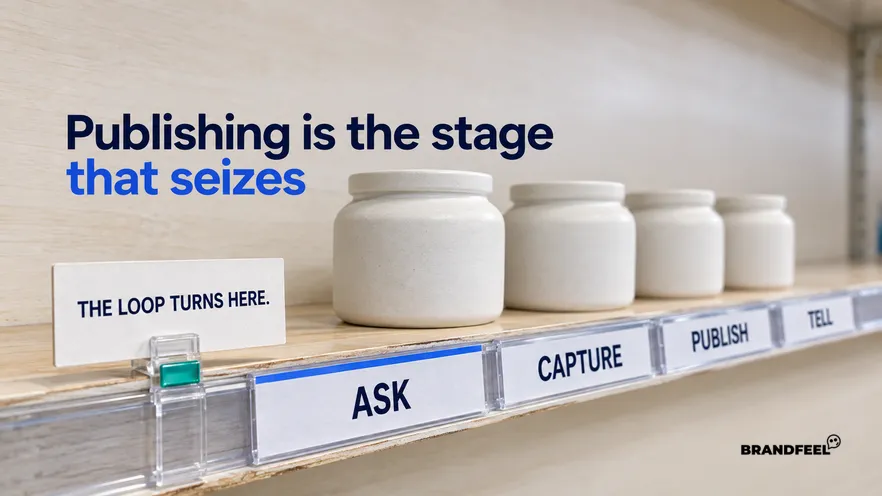
A UGC flywheel is defined as a loop in which published customer content recruits the next contributor, so each cycle needs less prompting than the one before. Shoppers trust that content: 70% say they trust opinions that other consumers post online [Nielsen, 2012]. Four stages turn the flywheel: ask at proven satisfaction, make contributing take under two minutes, publish where a customer will see it, and tell the contributor where it went. You will learn why publishing is the stage that breaks.
- Build a loop, not a campaign: published content recruits the next contributor.
- Ask on a satisfaction signal, not on day fourteen after dispatch.
- Fix the publish stage first, because it is what breaks and supply is almost never the constraint.
- Tell a contributor where their content appeared, which costs nothing and compounds.
- Collect permission at the point of contribution, naming every placement.
A UGC flywheel is a loop rather than a campaign, and the distinction decides whether the work compounds or has to be repeated every quarter. Omniconvert has measured review and social-proof behaviour across the CROBenchmark dataset of 7,000+ websites in 15+ industries, against 248+ audit criteria, over 13 years in eCommerce [CROBenchmark Report 2026, Omniconvert]. Stores struggling for customer content often have more of it than they are using. Omniconvert Commander (formerly Nexus) is the AI for eCommerce growth engine that unifies commerce data, prioritises experiments by True Profit and generates campaigns and creative you approve before they go live, and Brandfeel by Omniconvert, its sentiment-intelligence layer, is the part that turns review and survey language into something a campaign can use. Last updated: October 2026.
If the collecting half is where you are starting, read build a Review-Generation system first, and get customer UGC without a big budget for the version of this with no production spend at all.
What makes a UGC flywheel different from a UGC campaign
A campaign is defined as a push: a competition, an incentive, a burst of outreach. It produces a spike of submissions and then stops, and the next spike costs the same as the first because nothing was left behind that makes asking easier.
A flywheel leaves something behind. When a customer lands on a product page and sees three other customers' photographs, and then receives an invitation to add theirs, the invitation has a context. The social proof is doing two jobs at once: convincing the buyer and recruiting the contributor. That dual function is the whole mechanism, and it only exists if the content is published where buyers go.
This also explains the characteristic failure. A team that collects well and publishes badly has built neither a campaign nor a flywheel. It has built a drive full of files, and the people who contributed to it have learned that contributing is invisible.
The four stages, and what each one actually requires
Ask at proven satisfaction. The usual trigger is a fixed number of days after dispatch, which asks everyone including the people whose order went wrong. A better trigger is evidence that the product worked: a second order, a high survey score, a replenishment, a support conversation that ended well. The same message sent on a satisfaction signal rather than a calendar rule performs differently because it reaches a different person.
Make it take under two minutes. Every requirement you add removes contributors, and the requirements that feel most reasonable remove the most. A specific format removes people. A brief removes people. An account login removes people. The version that works accepts the photograph already on someone's phone, in whatever shape it is in, with one question attached.
Publish it where a customer will see it. Product pages first, then advertising, then email. Not a social gallery nobody visits and not a quarterly round-up. This is the stage with no natural owner, because selecting and cropping and approving is unglamorous work that sits between marketing and merchandising.
Tell the contributor where it went. One short message, naming the place. This costs nothing, takes a minute, and is the single most reliably skipped action in the entire loop. It is also what turns one contributor into a repeat contributor and, frequently, into someone who tells other customers.
| Stage | What it requires | The usual miss | Cost of getting it wrong |
|---|---|---|---|
| Ask | A satisfaction signal as the trigger | A fixed day after dispatch | Asking the unhappy alongside the happy |
| Capture | Under two minutes, any format | A brief, a format spec, a login | Most willing contributors drop out |
| Publish | A named owner and a weekly slot | Nobody owns selection and approval | The loop stops turning entirely |
| Close the loop | One message naming the placement | Skipped as a nicety | No repeat contributors, no referrals |
| Permission | Written, specific, at contribution | Chased afterwards, if at all | Usable content nobody dares publish |
| Recruit the next | Published content visible pre-ask | Content filed instead of placed | Every cycle costs what the first did |
The permission row is worth a sentence of its own, because it is the one that produces the most wasted effort. Content you cannot confidently use is identical in value to content you never collected, and the difference between the two is one sentence asked at the right moment.
Why the publish stage is the one that breaks
When a UGC programme stalls, the report says submissions dried up. What actually happened is that the first batch was collected, a handful were used, the rest were filed, and the second ask performed worse because the first contributors saw nothing. Supply did not fall. Demand for the supply never materialised inside the company.
The fix is unglamorous and specific: a named person, a recurring slot of thirty minutes a week, and a standing target of placements rather than collections. Measured on pieces published per week instead of submissions received per month, the programme behaves completely differently, because the metric points at the stage that was actually blocking it.
There is useful outside evidence on why the published content matters so much. The Baymard Institute's product-page research has consistently found that shoppers look for evidence from other buyers at the point of decision and often cannot find it, and Nielsen's long-running work on advertising trust has repeatedly placed peer recommendation above brand-authored messaging. Both point at the same conclusion: the content has value on the page, not in the archive.
What a brand manager should do this month
- Count what you already have. Open the folder, the inbox, the tagged posts. The number is usually larger than the team's impression of it, and that gap is the whole diagnosis.
- Publish five pieces this week. On your three best-selling product pages. Not a gallery, not a round-up. This is the stage that has been broken and five is enough to restart it.
- Add one permission sentence. At the point of contribution, naming product pages, advertising, email and social. Store it with the file.
- Message every past contributor whose content you used. One line naming where it went. Expect a response rate that surprises you, and a second contribution from some of them.
- Change the metric to placements. Pieces published per week, owned by a named person with a recurring thirty-minute slot. Submissions received is the metric that hid the problem.
Where your review text, survey responses, support themes and social mentions sit in four separate systems and have to be assembled before anyone can see which customers are worth asking, that unification is the problem Brandfeel and Omniconvert Commander address together, with every proposed campaign staying something a person approves before it goes live.
The flywheel describes why this compounds. The operational version, four loops hung off touchpoints you already own, is in building a Always-On UGC engine for DTC.
FAQ: the UGC flywheel
What is a UGC flywheel?
A UGC flywheel is a loop in which published customer content recruits the next contributor. Four stages turn it: ask at a moment of proven satisfaction, make contributing trivially easy, publish what arrives somewhere visible, and tell the contributor where it went. The difference from a campaign is that each cycle makes the next ask easier, because a customer who can see other customers in your advertising and on your product pages reads the invitation as joining something rather than doing you a favour.
Which stage of the flywheel usually breaks?
Publishing, almost always. Teams get good at asking, collect a folder of usable content, and then use a fraction of it because selecting, cropping and approving is unglamorous work with no owner. The loop stops turning at that point: contributors learn that contributing changes nothing visible, the next ask performs worse, and the conclusion drawn is that customers are not interested. The constraint was never supply.
Do you need to pay for UGC?
Not for the loop to turn, and paying changes what you receive. A paid contributor produces content aimed at your brief, which is useful and reads as advertising. An unpaid contributor at a moment of genuine satisfaction produces something that reads as a customer, which is the asset you cannot buy. Pay where you need specific coverage of a specific product, and keep the unpaid loop separate rather than replacing it.
How much UGC do you actually need?
Far less than people assume to start, and consistency matters more than volume. A handful of pieces on your best-selling product page, visibly real and clearly from customers, does more than a hundred unused files on a drive. Start with your top three products and one advertising placement. Volume becomes the constraint only after the publish stage is genuinely working, which is later than most plans assume.
What permission do you need to use customer content?
Explicit, written and specific about where it will appear, collected at the point of contribution rather than afterwards. Ask once, in plain words, naming product pages, advertising, email and social. Retrospective permission chasing is slow, has a poor response rate and tends to arrive after the content was useful. Record the permission with the file so that whoever builds an advertisement in six months does not have to ask again.
Teams that build a flywheel usually fund the asking and forget the publishing. Submissions arrive, nobody owns a weekly slot to place them, and the folder grows while the product pages stay unchanged. Contributors never hear where their content went, supply dries up, and the report says customers lost interest.
AliveCor used Omniconvert to run a structured A/B testing programme and achieved +21% conversion rate, +5% revenue per visitor, and 94% statistical relevance across their experiments. [Omniconvert, AliveCor case study] Apply the same discipline to the publish stage: test the pages that carry customer content against pages that do not.
Publish first, then ask again
The flywheel metaphor is worth taking literally, because it tells you where to push. A wheel that will not turn is not short of force at the handle, it is seized somewhere in the mechanism, and in a UGC programme that place is almost always publishing. So start at the stage nobody owns. Open the folder you already have, put five pieces on your three best-selling product pages this week, and send one message to each contributor telling them where their content went. Then change the number the programme reports from submissions received to pieces published, and give that number a named owner with half an hour a week. Everything else in this article follows from those two moves, and a team that makes them finds the supply problem it thought it had was never the problem.