
Building an Always-On UGC Engine for DTC
A UGC engine produces customer content every week with no campaign behind it. The four loops that keep one fed, and the one that quietly fails first.
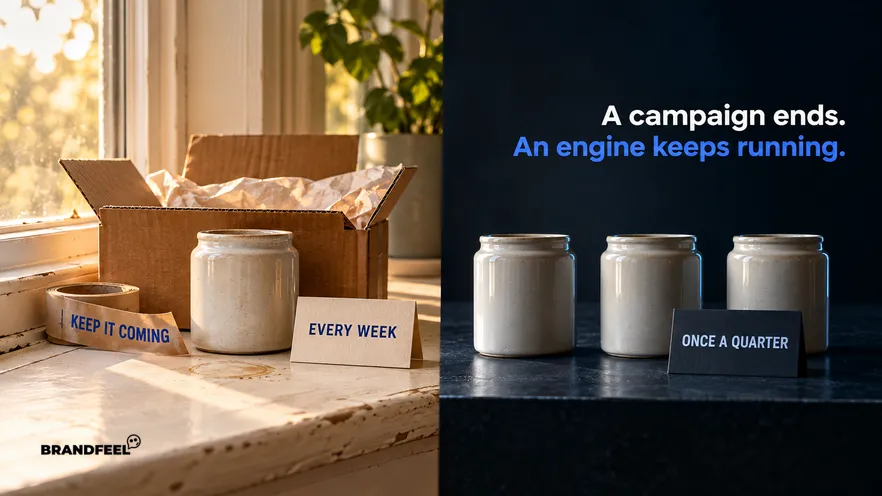
A UGC engine is defined as a standing set of loops that produces customer-made content as a by-product of normal operations, rather than a campaign that produces a batch and then stops. Shoppers value that content: 70% say they trust opinions that other consumers post online [Nielsen, 2012]. Four loops keep an engine fed, and the one that fails first is almost never the one brands watch. You will learn what the four loops are and how to measure them.
- Build an engine that produces content without a launch, because a campaign produces a spike followed by a drought.
- Run four loops: the post-purchase ask, service recovery, a standing community prompt, and reuse.
- Check the reuse loop first, because it fails first and its failure is misread as customers losing interest.
- Avoid paying for engine content, because payment turns a self-sustaining loop into a recurring cost and lowers credibility.
- Measure weekly usable volume and placements filled, not quarterly submission totals.
Last updated: October 2026 · By The Brandfeel Team
Most brands do not have a UGC engine. They have a UGC campaign that ran once, produced a folder of content, and left behind a vague sense that it should be repeated. The folder gets used until it looks dated, and then somebody proposes another contest. That cycle is expensive in attention and produces content in bursts that never line up with when you actually need an asset.
The alternative is to treat customer content as an operational output rather than a marketing project. Omniconvert has spent 13 years measuring what moves eCommerce performance, across the CROBenchmark dataset of 7,000+ websites and 70,000+ experiments [CROBenchmark Report 2026, Omniconvert], and the consistent finding about social proof is that its value comes from freshness and specificity, both of which require steady supply rather than volume. Brandfeel by Omniconvert, the sentiment-intelligence layer, aggregates reviews, NPS responses and support-ticket themes, which is where the signals that feed an engine already sit. This guide covers what a UGC engine is, the four loops that keep it running, which one breaks first, and how to measure the thing you actually built.
What a UGC engine is, and how it differs from a campaign
The distinction is not semantic. A campaign is staffed by a project owner, measured in totals, and repaired by running it again. An engine is staffed by whoever already owns the touchpoint it hangs off, measured in weekly flow, and repaired by finding which loop stopped. Those are different management problems, and treating the second as the first is why so many brands conclude that their customers are not the type to make content.
The Four Loops that keep an engine fed
The Four Loops framework is defined as four standing routines, each attached to an operational moment that already happens. The point is that nobody has to remember to run them.
Loop one: the post-purchase ask. Attach the request to first use rather than to dispatch. Shipping confirmation arrives when the customer has an empty box and no opinion; the ask needs to land when they have used the product and formed one. For most categories that is somewhere between three days and three weeks after delivery, and the only way to find yours is to vary the delay and watch the response. Ask for one specific thing. A request for a photo of the product where you actually keep it returns usable content far more reliably than an invitation to share your experience, which returns nothing because it asks for a decision as well as a favour. If you have not yet built the review side of this touchpoint, build a Review-Generation system first: it uses the same trigger and the same timing work, so the two loops share most of their setup.
Loop two: service recovery. This is the loop almost nobody builds, and it is the highest-yield one. A customer whose problem was resolved generously is in an unusual state: they have had a real experience, they have a story with a resolution in it, and they feel a debt. Route resolved tickets, after a short delay, into the same ask. The content that comes back is more credible than anything from a satisfied first-time buyer, because it contains a difficulty. Bain and Company research on retention economics is relevant here in a way brands rarely connect: a 5% retention lift can raise profits by 25% to 95% [Harvard Business Review, 2014], and recovered customers are disproportionately represented in retained ones. The loop pays twice.
Loop three: the standing prompt. Replace occasional contests with one repeating prompt that never changes format. A monthly theme with the same mechanic and the same deadline becomes a habit, and habits produce flow. Contests produce events, and an event by definition has a before and after with nothing in them. The standing prompt also removes the biggest hidden cost of contests, which is that each one has to be designed, briefed and explained from scratch.
Loop four: reuse and acknowledgement. Every accepted asset should be planned into at least three placements, and every contributor should be shown where theirs appeared. This is the loop that feeds the other three, and the next section is about why it is the one that breaks.
Why the reuse loop fails first
Think about why somebody makes content for a brand they do not work for. It is not the discount code. It is the small, real pleasure of having made something that was used, seen and credited. That reward is the engine's fuel, and it is delivered entirely by the reuse loop. Skip it and you are asking for unpaid work with no return, which people will do once out of goodwill and not twice.
The failure is hard to see because it is slow and because the diagnosis points the wrong way. Submissions fall month over month, somebody concludes the audience is tired of the prompt, the prompt gets changed, and submissions fall further. The contributors from four months ago never heard anything back, told nobody, and the social proof that would have recruited the next cohort never circulated.
The four loops compared, and what each one yields
Build in the order the last column suggests rather than the order that feels natural, because the loop that starts fastest is not the one that sustains the engine.
| Loop | Effort to build | What it returns | Build order |
|---|---|---|---|
| Post-purchase ask | Low: one message on an existing flow | Steady, plain, on-product photography | First |
| Reuse and acknowledgement | Low: one tracking column and a habit | Nothing directly; it sustains every other loop | Second, before volume arrives |
| Service recovery | Medium: needs a trigger on resolved tickets | The most credible content, with a difficulty in it | Third |
| Standing community prompt | Medium: one format, then repetition | Variety and volume once the habit forms | Fourth |
| One-off contest | High: designed and briefed each time | A burst, then nothing | Not part of the engine |
| Paid creator commission | High and recurring | Polished assets with lower credibility | A separate line, not a loop |
What a DTC marketer should do this week
Concrete actions, in order:
- Find your existing post-purchase message and check when it sends. If it fires on dispatch, move it to a delay based on first use and watch the response rate change.
- Rewrite the ask so it requests one specific thing, in one sentence, with no choice to make. The tactics for how to get customer UGC without a big budget apply directly to the wording.
- Add a column to wherever you store assets recording every placement each one has appeared in. This is the reuse loop in its entirety.
- Send this week's live placements to the customers who made them.
- Ask support to flag resolved tickets where the customer expressed satisfaction, and route those into the same ask after a delay.
- Start recording three numbers weekly: usable assets received, placements filled by customer content, and days from request to usable asset.
Platforms like Omniconvert Commander (formerly Nexus) connect review and content themes to ad-copy briefs and experiment hypotheses, so what an engine produces feeds a test queue rather than a folder, and you approve what goes live. For the rules that constrain how you ask, read the FTC's endorsement guides before you offer anything in exchange.
If the four loops are more structure than you want to build this quarter, the tactical subset is worth having instead: the 9 Low-Budget UGC tactics for DTC brands are the individual moves these loops are assembled from, and several of them are a single wording change.
Frequently asked questions
What is a UGC engine?
A UGC engine is a standing set of loops that produces customer-made content as a by-product of normal operations, rather than a campaign that produces a batch and stops. The distinguishing feature is that nobody has to launch anything for content to arrive this week. A campaign has a start and an end date; an engine has a weekly volume and a failure mode you monitor.
How much content should an always-on engine produce?
Enough to cover your placements without a backlog or a drought, which for most DTC brands is a handful of usable assets a week rather than a hundred a quarter. Volume targets set in quarterly totals hide the problem an engine exists to solve, because a quarter can be hit with one good month and two empty ones while every placement in those two months went unfilled.
Which loop fails first?
The reuse loop, almost always. Brands build the asks, collect content, use each asset once and never tell the contributor it was used. Contribution then decays quietly, because the social reward that motivated it never arrived. The failure looks like declining customer willingness and is actually a missing acknowledgement step.
Do I need to pay for user-generated content?
Not for the kind an engine produces. Payment changes the relationship into a commission, which raises production quality and lowers credibility, and it also converts a self-sustaining loop into a recurring cost. Recognition, early access and a visible placement are what sustain voluntary contribution. Keep paid creator work as a separate line with a different purpose.
How do I measure a UGC engine rather than a campaign?
Measure weekly usable volume, the share of placements filled by customer content, and the time from request to usable asset. Those three describe whether the engine is running. Campaign metrics such as total submissions or hashtag reach describe an event, so they look healthy right after a push and tell you nothing about the weeks in between.
Teams that stand up an engine often fund the asks and skip the tracking column. Without a record of where each asset ran, nobody can tell a contributor it was used, and the same three assets get reused while forty sit unopened. The folder looks full and every placement still waits.
AliveCor used Omniconvert to run a structured A/B testing programme and achieved +21% conversion rate, +5% revenue per visitor, and 94% statistical relevance across their experiments. [Omniconvert, AliveCor case study] Treat your first-use trigger as a test in the same way: send it alongside the old timing and compare the response rates.
Build the four loops in this order
An always-on UGC engine is four loops hung off things your business already does, and the one that sustains it returns nothing by itself. Start with the post-purchase ask timed to first use, build the acknowledgement column before volume arrives, then add service recovery and one standing prompt. Measure weekly usable assets and placements filled, never quarterly submissions, because the quarterly view is what lets a two-month drought pass unnoticed. Do that and the folder stops being something you refill in a panic before each campaign.