
How to Get Customer UGC Without a Big Budget
Five sources of customer UGC without a big budget, the moment in the order cycle when asking works, and the three things that stop people sending anything.
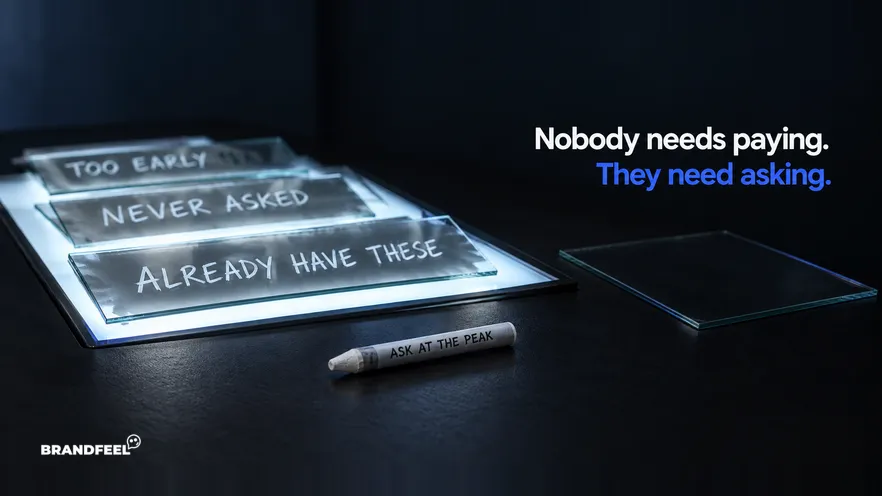
Getting customer UGC without a big budget is defined as collecting content from people who already bought, at the moment they are most pleased, in exchange for nothing but a reply. Shoppers trust that content: 70% say they trust opinions that other consumers post online [Nielsen, 2012]. Five sources cover almost all of it, and the constraint is rarely willingness but a vague request, an extra step and silence about where the photograph will appear. You will learn the five sources and how to fix those three blockers.
- Ask at the peak of satisfaction, which is first real use for some categories and several weeks in for others, not delivery day.
- Ask for one specific artefact. An invitation to share your experience produces almost nothing.
- Remove every step beyond replying to the email, because each one removes most of the remaining volume, portals especially.
- Avoid paying or discounting, which changes what you get, usually into something posed and unusable as evidence.
- Collect four honest photographs per product rather than forty, because the purpose is corroboration, not volume.
Customer content is treated as a budget line when it is mostly a timing and wording problem. A first-use request is defined as a request sent when the customer has actually used the product, rather than when the parcel was delivered. Last updated: October 2026.
Omniconvert has examined how stores collect and use customer evidence across the CROBenchmark dataset of 7,000+ websites in 15+ industries, against 248+ audit criteria, over 13 years in eCommerce [CROBenchmark Report 2026, Omniconvert]. The stores with the most usable customer content are rarely the ones spending the most on creators. Omniconvert Commander (formerly Nexus) is the AI for eCommerce growth engine that unifies commerce data and ranks the next action by True Profit, and its Brandfeel by Omniconvert module is the sentiment-intelligence layer that aggregates reviews, NPS and support themes, which is where most of the content you already own is sitting unnoticed. The collection discipline behind this is the same one in build a Review-Generation system. For the motivation side, see how to motivate customers to create content.
Why willingness is not the constraint
The assumption is that customers will not produce content, so it has to be bought. What actually happens in most stores is that customers are never asked in a way that could work. The request goes out on delivery day, invites them to share their experience, and routes them to a branded upload page requiring an account.
Each of those three decisions removes most of the response. Delivery day is before the product has been used. Share your experience gives no idea what would help. And an upload portal is a project rather than a reply.
Replace those three and the same audience behaves differently. Ask at first real use, ask for one photograph of the item in the place it lives, and let people reply to the message with the photograph attached. Nothing about the customer changed.
How to get customer UGC without a big budget: five sources
- The post-purchase request, timed properly. One email, at the peak for your category, asking for one specific thing. This is the highest-yield source and the timing is the whole of it.
- Photographs already in your review platform. Most review tools accept images and most stores never audit what they have collected. There is frequently a usable set already sitting there, submitted with permission.
- Support conversations that ended well. A customer whose problem you solved properly is at a satisfaction peak that nothing else produces, and almost nobody asks at that moment.
- Unprompted social mentions. People already post about products they like. The work is finding them and asking permission, which is a search task rather than a budget.
- Three-time buyers. A small group, easily identified in your own order data, and the most willing people you have. They will also tell you why they keep buying, which is worth more than the photograph.
Notice that two of the five are collection problems rather than acquisition problems. You already own the content and have not looked.
Finding the peak for your category
For an immediate-appeal product, two or three days after delivery is usually right: long enough to have unpacked and used it, short enough that the pleasure is current.
For a slow-proving product, three to six weeks is more realistic, and the request can be more interesting because the customer now has something to say. "Has it held up" is a better question than "do you like it" and it produces more credible content.
What to ask for, and what it costs you
| Source | When to ask | What to ask for | Real cost |
|---|---|---|---|
| Post-purchase request | At first real use, not on delivery | One photograph of it in use | An hour to write, then automated |
| Review-platform photographs | Nothing to ask, already submitted | An audit of what you hold | An afternoon, once |
| Resolved support tickets | Immediately after the fix lands | A sentence about the outcome | One line in the agent script |
| Unprompted social mentions | Within days of the post | Permission to reuse it | A weekly search, half an hour |
| Three-time buyers | After the third order ships | A photograph and the reason | A query against your own orders |
| Paid creators | When you need a specific look | A brief and a licence | A fee, and content that reads as paid |
The three things that stop people sending anything
The vague request is a copy problem. "Share your experience" asks somebody to decide what you want, and most people conclude that nothing they have would qualify. "Could you send one photograph of the shelf in the room it ended up in" is answerable in ninety seconds.
The extra step is a process problem and it is the most expensive of the three. A reply with an attachment is one action. A portal is an account, a password, an upload and a confirmation. Volume collapses between those two, and the portal exists for the store's convenience rather than the customer's.
The silence about usage is a trust problem and the cheapest to fix. One sentence: where it may appear, that you will credit by first name only, and that they can say no later. Without it, a proportion of willing people simply do not reply, and you never learn why.
What a store team should do this week
- Audit your review platform for customer photographs already submitted with permission. Count them by product. This is the cheapest content you will ever find.
- Move the post-purchase ask from delivery day to the real peak for your category, and say so in one sentence to whoever owns the automation.
- Cut the portal. Let people reply with an attachment. Accept the mild inconvenience of handling email, because the volume difference is large.
- Add the usage sentence to the request. Where it appears, how it is credited, and that they can withdraw.
- Write to twenty three-time buyers by hand. Ask for a photograph and for why they keep buying. The second answer usually reshapes a product page.
Where order history, review submissions and support themes have to be read together before anybody can tell who is worth asking, that unification is what Omniconvert Commander is built for, with every proposed message staying something a person approves before it goes live. On why this is worth the hours, Bain and Reichheld's finding that a five percent retention improvement can raise profits by 25 to 95 percent [Harvard Business Review, 2014] explains why your three-time buyers deserve a personal email, and Baymard Institute's usability research is the standing reference on how heavily shoppers weigh customer imagery against studio photography when they are deciding.
FAQ: collecting customer content on no budget
How do you get customer UGC with no budget?
Ask recent buyers for one specific artefact at the moment they are most pleased with the purchase, and make replying to your email the whole process. Five sources cover most of it without money changing hands: post-purchase requests, your existing review photographs, support conversations that went well, unprompted social mentions, and the customers who have already bought three times. None of them needs a creator fee.
When is the best time to ask a customer for content?
At the peak of satisfaction, which is not the same moment for every category. For an item whose appeal is immediate, that is within a day or two of first use. For something that proves itself slowly, a tool or a skincare product, it is several weeks in. Asking on delivery day is the common default and it is usually too early, because the customer has opened a box rather than used anything.
Should you pay or discount in exchange for UGC?
A discount changes what you receive, usually for the worse. Paid-for content tends to be posed, positive and unusable as evidence, because the sender is fulfilling a transaction. Unpaid content from a pleased customer is plainer and more convincing for exactly that reason. Where you want to recognise people, do it after the fact and without announcing a rate.
How much customer content do you actually need?
Far less than most plans assume. A handful of honest photographs per product, refreshed occasionally, does most of the work, because the purpose is corroboration rather than volume. A product page with four customer photographs and a studio set is more persuasive than one with forty near-identical images, and it is also faster to review and to keep rights-cleared.
What stops customers from sending anything?
Three things, in order of cost. A vague request, because nobody knows what would count as helpful. Any step beyond replying to the message, since a portal or an upload form removes most of the remaining volume. And doubt about where it will end up, which a single sentence about usage resolves. Fix all three and the response rate changes without any money being spent.
Teams chasing free UGC usually fix the wording and leave the upload step. The request asks for one photograph, but the reply goes to a branded portal that wants an account. Most customers who meant to send a photo stop at the login, and the team reads the silence as a lack of interest.
AliveCor used Omniconvert to run a structured A/B testing programme and achieved +21% conversion rate, +5% revenue per visitor, and 94% statistical relevance across their experiments. [Omniconvert, AliveCor case study] Find your category's peak the same way: test two delays against each other and compare the replies.
Fix the request, the step and the silence
Before you brief a creator, look at what you already hold and fix how you ask. The photographs in your review platform are free, permissioned and usually unaudited. The post-purchase email is probably firing on delivery day, which is before anybody has used anything. The portal in the middle of the process is costing you most of the volume it was built to organise. And the sentence about where the image will appear, the one nobody writes, is why a proportion of willing customers quietly do not reply. None of that is a budget problem, and working through it in an afternoon changes what you have to show the next shopper.