
The Best UGC Tools for eCommerce Brands
UGC tools fall into five jobs, and most brands buy the wrong one first. Compared here on the rights chain and on where the asset is allowed to run.
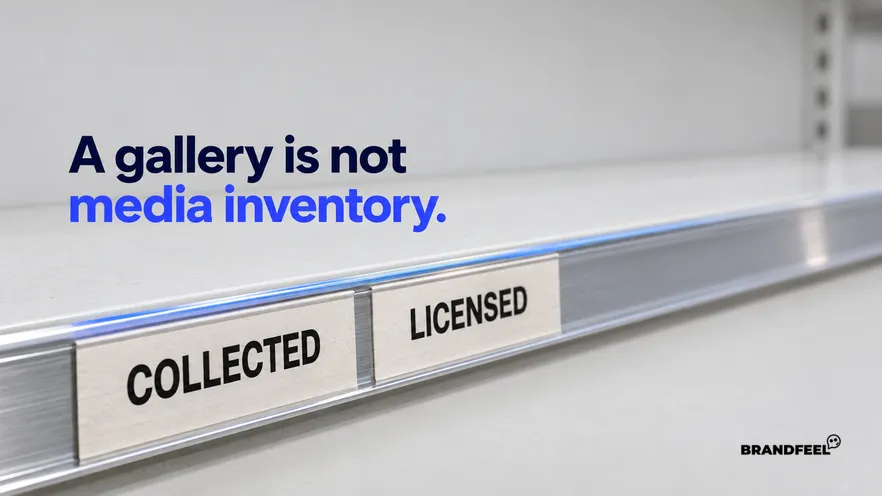
A UGC rights chain is defined as the unbroken record showing that the person who made a piece of customer content agreed to the specific uses a brand intends to make of it. It is the right way to sort UGC tools, because it decides whether an asset is media you can spend behind or a picture you can only admire. Across the CROBenchmark dataset of 7,000+ websites in 15+ industries, against 248+ audit criteria, customer content is displayed far more often than it is licensed [CROBenchmark Report 2026, Omniconvert]. This guide sets out the five jobs a UGC tool can do, what each actually fixes, and the questions to ask before buying one.
- Sort tools by the job they do, because there are five and not one market.
- Fix rights before collection, since an unlicensed library cannot be spent behind.
- Treat a public post and a usable asset as two different things entirely.
- Buy against one measured bottleneck rather than against a feature list.
- Measure licensed assets per month, not content collected per month.
- Select differently for product pages and for advertising, from one library.
Omniconvert has measured how customer content is used across the CROBenchmark dataset of 7,000+ websites in 15+ industries, against 248+ audit criteria, over 13 years in eCommerce [CROBenchmark Report 2026, Omniconvert]. The recurring pattern is a large and growing library with a small usable fraction, because collection was solved with software and permission was never solved at all.
The five jobs UGC tools actually do
The reason the split matters commercially is that the five jobs have very different costs of failure. A weak collection tool means less content. A weak rights process means a library you legally cannot use, which is a far more expensive condition and much harder to detect, because the content is right there and looks available.
So the first question is not which tool is best. It is which of the five you are currently failing at, and that is answerable in an afternoon by counting what you have and what you are allowed to do with it.
If you have not built the upstream habit yet, the request side is covered in how to build a review-generation system, which is the same discipline applied to written feedback.
Compared on the rights chain
| The job | What it produces | Where the asset may run |
|---|---|---|
| Collection | Volume, and a backlog | Nowhere, until licensed |
| Rights and licensing | Recorded, specific consent | Paid media and owned pages |
| Moderation and curation | A shortlist worth using | Wherever rights allow |
| Distribution to your pages | Galleries on product pages | Owned pages only |
| Performance measurement | Which asset earned its place | Informs the other four |
| Creator payment and briefing | Commissioned content | Broadest rights, highest cost |
Read the middle row as the gate. Everything above it accumulates material, everything below it uses material, and a brand that has bought from both ends and skipped the middle has a pipeline with no valve in it.
Why a social mention is not an asset
This is the confusion that quietly creates most of the risk in this area. Reach is granted by a platform; copyright stays with the person who pressed the shutter. A tool that scrapes mentions is therefore building you a list of candidates, not a library of assets, however much it looks like the latter.
Asset readiness is defined as the state in which a piece of customer content has a recorded, specific permission covering the exact placements a brand intends to use it in, including paid social if that is one of them. Anything short of that is a candidate.
The failure specific to UGC programmes is a successful first quarter that creates a liability. The team runs a hashtag campaign, collects several thousand posts, builds a gallery, and reports the volume as the result. Nobody asked for permission, because asking slows collection and the posts were public. Eighteen months later the brand wants to put the best twelve behind paid spend, discovers it has no consent for any of them, and cannot reach the creators because the campaign never captured a way to contact them.
Selecting for the product page and for advertising
On a product page, customer content is doing evidence work. It answers whether the fit runs small, whether the colour matches the photograph, whether the thing is as large as it looks in a kitchen. Unexpected cost and unclear information have been among the leading reasons shoppers abandon purchases for as long as Baymard Institute has measured it, at around 70% average cart abandonment [Baymard Institute, 2025], and a photograph from a real room resolves a doubt that no amount of studio photography can.
In advertising the job is different. Meta's own creative guidance has pushed advertisers toward varied, native-feeling assets and frequent refreshes for years [Meta, 2026], and customer content is the cheapest supply of that variety. The selection criterion there is whether an asset stops somebody, not whether it answers a question.
AliveCor used Omniconvert to run a structured A/B testing programme and achieved +21% conversion rate, +5% revenue per visitor, and 94% statistical relevance across their experiments. [Omniconvert, AliveCor case study] That is a testing result rather than a UGC result, and the transferable part is the method: put two assets against each other in one placement and let the placement decide, rather than letting the brand team vote.
What to ask before buying any of them
- What exactly does the consent you capture permit? Ask to see the wording. "Permission to feature" is not permission to advertise, and the difference is the entire value of the tool.
- Can we export the assets and the consent records together? A library you cannot take with you is rented, and the consent is the part that is expensive to recreate.
- How do you handle a withdrawal? People change their minds and have a right to. A tool with no revocation path turns a routine request into a manual search through everything you have ever published.
- What does it report? If the headline metric is content collected, the tool is measuring its own activity. Licensed assets, and the performance of those assets, are the numbers that matter.
What to do this week
- Count your licensed fraction. Total pieces of customer content held, and how many have recorded permission for paid use. The ratio is the finding, and it is usually under a tenth.
- Read your own consent wording. Whatever your request currently says, check whether it covers advertising. If it does not, rewriting one sentence is the highest returning thing available to you this quarter.
- Pick twelve assets and license them properly. Twelve, contacted individually, with explicit permission recorded. A small licensed library beats a large unusable one and it can run next month.
Beyond the mechanics, the layer worth adding later is interpretation. Brandfeel, Omniconvert's sentiment-intelligence layer, aggregates reviews, NPS and support-ticket themes so the recurring doubts in your category surface as themes rather than as anecdotes, which tells you which doubt your next twelve assets should answer. Downstream of that, Omniconvert Commander (formerly Nexus) is an AI for eCommerce growth engine that unifies commerce data, prioritises experiments by True Profit, and generates campaigns and creative you approve before they go live. For the adjacent decision on written feedback, the companion piece is the best review platforms for DTC, compared by type, and for filling the library without a budget there is how to get customer UGC without a big budget.
Frequently asked questions
What are the best UGC tools for ecommerce brands?
There are five kinds rather than one leaderboard: collection, rights and licensing, moderation and curation, distribution onto your own pages, and performance measurement. The best tool is the one doing the job you are currently failing at, and most brands buy a collection tool while their actual bottleneck is rights, which is why the library fills up and nothing is allowed to run.
Why does the rights chain matter more than the volume of content?
Because an asset you cannot license is an asset you cannot spend money behind. A thousand pieces of customer content with no recorded permission are a gallery, while fifty with explicit consent for paid use are media inventory. The second library is worth more despite being twenty times smaller.
Is a social mention the same as a usable asset?
No, and treating them as equivalent is the most common and most expensive confusion here. A public post is evidence that somebody liked your product. Permission to reproduce that post in an advertisement is a separate agreement with that person, and a platform granting you reach does not grant you their copyright.
Should we buy one platform or several specialised tools?
Start with one job rather than one platform. Suites are efficient once you know which of the five jobs actually constrains you, and expensive before that, because you pay for four capabilities to fix one problem. Identify the bottleneck with a month of manual work, then buy against it.
How do we measure whether a UGC tool is paying for itself?
On licensed assets produced per month and on the performance of those assets where they run, not on content collected. Collection volume is the metric every tool reports and the one least connected to revenue, because it counts things you may have no right to use.
Where does UGC actually change conversion?
Most reliably on the product page, where it answers a question the brand cannot answer credibly about itself, such as how something fits or looks in a real room. In advertising it buys attention and relevance instead. Those are different jobs and they need different selection criteria from the same library.
License twelve, then buy
Before you shortlist a single vendor, count how much of the customer content you already hold carries recorded permission for paid use. That one ratio tells you which of the five jobs is actually constraining you, and it is almost never the one the brand was about to buy.
Then license twelve assets by hand, properly, and run them. A tool bought against a measured bottleneck pays for itself, and a tool bought against a feature list fills a library you will still not be allowed to spend behind next year.