
Negative-Review Response Templates for 10 Common Situations
Ten negative-review response templates, written out in full, with the reason each one is shaped the way it is and the line to never include.
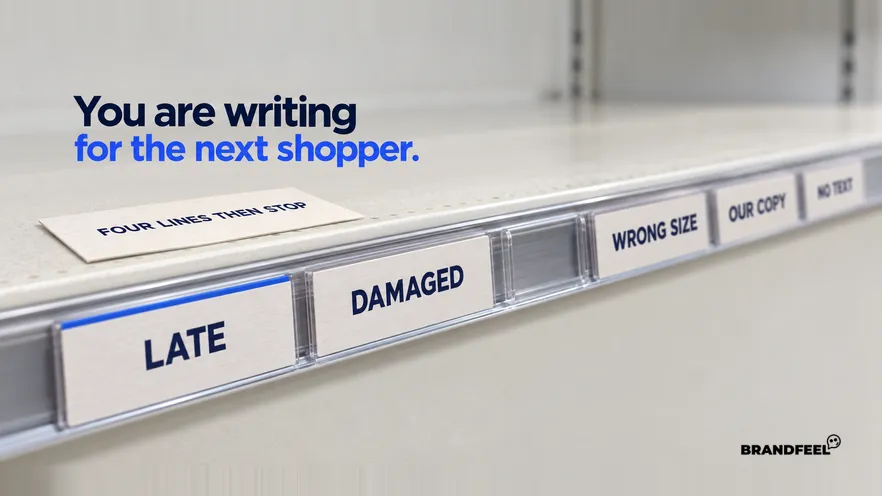
A negative-review response template is defined as one fixed four-line structure rather than a fixed set of words: acknowledge the specific problem, state what is true, say what you have already done, and offer one private route to continue. Shoppers read the reply: 70% say they trust opinions that other consumers post online [Nielsen, 2012]. Ten situations cover almost everything a store meets, and the reply states facts rather than feelings and stops at four lines. You will learn the four-line structure and ten negative-review response templates with the reasoning for each.
- Write for the next shopper, because the reviewer has had their experience and the reply is read by the people still deciding.
- Stop after four lines, because the fifth sentence is always a defence or a plea and it undoes the first four.
- Name the specific problem in the reviewer's own words, or the whole reply reads as generic however good the rest is.
- Say what you have done, not what you will do, because a later reader is judging competence, not remorse.
- Never ask for a review to be removed or changed, because it turns a service problem into an integrity problem in public.
Last updated: October 2026 · By The Brandfeel Team
Omniconvert has examined how stores handle customer feedback across the CROBenchmark dataset of 7,000+ websites in 15+ industries, against 248+ audit criteria, over 13 years in eCommerce [CROBenchmark Report 2026, Omniconvert]. Replies that work are structural rather than tonal. Omniconvert Commander (formerly Nexus) is the AI for eCommerce growth engine that unifies commerce data so a one-off complaint can be told apart from a recurring fault, and you approve what goes live. The method behind all of this is in respond to negative reviews. This article is the library: ten situations, each with the reply written out.
The four-line reply, which every template below uses
The four-line reply is defined as an acknowledgement of the specific problem, a true statement, the action already taken and one private route to continue.
- Acknowledge the specific thing. One sentence, naming what went wrong in the reviewer's own terms. No thanks for the feedback, no appreciation of the opportunity.
- State what is true. The fact a later reader needs: the usual case, the cause, or simply that this is unusual. This is the sentence doing the commercial work, and most replies omit it entirely.
- Say what you have done. Past tense. An action already taken is evidence; an intention is a promise a stranger has no reason to believe.
- Offer one private route. One. An email address or a direct line. Then stop.
Ten negative-review response templates, with the reasoning
1. Late delivery. "Your order arrived [four days] later than the date we gave you, and that date was ours to meet. Most orders in that service leave the same day and arrive within the window, so this was a miss rather than our normal. We have [moved that line to a tracked service / added a buffer to that estimate] since. Email [address] and we will sort the shipping cost."
2. Damaged on arrival. "The [bowl] reached you broken, which should not happen and is entirely ours to fix. Breakage at this stage is rare in this range and we check it each quarter. We have [changed the inner packing on that item / raised it with the carrier as a claim]. Email [address] and we will replace it today."
3. Wrong item sent. "We sent the [wrong size] and you ordered the [other one], so this is a picking error on our side. We pick to barcode rather than by eye, which is why this is unusual, and it means we can trace exactly where it happened. We have [corrected the bin / retrained on that line]. Email [address] for the right one, and keep the other."
4. Expectation set by your own copy. "You expected [a fitted cover] and received [a loose one], and reading our page back, our wording allowed that. The product is as described in the specification but the lead copy was not clear enough. We have rewritten that section. Email [address] and we will take it back whether or not it has been used."
5. Sizing complaint. "The [jacket] ran smaller than you expected. This style does run about half a size under our usual cut, which is now stated on the page. Our size chart is measured flat rather than taken from a label, so the numbers are reliable even where the cut is not what you expected. Email [address] and we will exchange the size with the postage covered."
6. Quality below the price paid. "You felt the [finish] did not justify what you paid, and that is a fair thing to say out loud. The [material] is [what it is], which we describe on the page, and it will not suit someone expecting [the heavier alternative]. We have added that comparison to the description. Email [address] for a return, used or not."
7. Support failure. "You wrote to us [twice] and heard nothing for [a week], which is not acceptable and is a separate failure from the original problem. Our stated reply time is [one working day] and we report against it internally. We have [added cover on that queue / found and cleared the backlog]. Email [address] directly and it will reach me."
8. Courier failure. "Your parcel was [left at the wrong door] and that is still our problem to resolve even though we did not deliver it. We use [one carrier] for that route and we track failures by route each month. We have [raised this one as a claim / changed the default to a signed service]. Email [address] and we will make it right."
9. One-line rating with no text. "Thank you for the rating. We would genuinely like to know what went wrong, because a score on its own does not tell us what to fix. Email [address] with a sentence and we will act on it."
10. A product you no longer sell. "This review is of the [previous version], which we stopped making in [year] for the reason you describe. The current version [changed the specific thing], and we kept the name, which is confusing and ours to own. The page now says which version is which. Email [address] if you would like to try the new one at cost."
What to put in the second line, by situation
| Situation | The fact a later reader needs | The line that ruins it |
|---|---|---|
| Late delivery | That on-time is your normal case | Blaming seasonal volume |
| Damaged arrival | That breakage is rare and checked | Asking for photographs in public |
| Wrong item | That picking is traceable | Implying the order was placed wrong |
| Expectation from your copy | That you have rewritten the copy | Pointing at the specification |
| Sizing | That the chart is measured, not labelled | Telling them to read the chart |
| Quality below price | What the material is and is not for | Arguing about value |
| Support failure | Your stated reply time, and the fix | Explaining that email went to spam |
| Courier failure | That you track failures by route | Naming the carrier as responsible |
| Rating with no text | That you want the detail | Guessing at the complaint |
| Discontinued product | Which version changed, and when | Saying the review is out of date |
What a store team should do this week
- Pick your three most common situations from the last hundred reviews.
- Write the second line as house copy for each, agreed with whoever knows the operational truth. That sentence is a factual claim and it has to be right.
- Audit the last fifty replies for removal requests and carrier explanations, and stop both. These are the two that actively cost you.
- Set the four-line rule and give whoever writes the replies permission to stop.
- Count the recurrences. If the same complaint appears eight times, the reply is not the fix, and build a Review-Generation system covers getting enough recent coverage that one outlier stops mattering.
For the cases where the review itself breaks a platform rule rather than describing a real experience, see handle a review you believe is unfair. On the underlying economics, Bain and Reichheld's finding that a five percent retention improvement can raise profits by twenty-five to ninety-five percent [Harvard Business Review, 2014] is the reason a recovered customer is worth four sentences of care. Baymard Institute's usability research shows how heavily shoppers weigh this evidence.
FAQ: replying to negative reviews
Who is a review reply actually written for?
The next shopper, not the reviewer. The reviewer has already had their experience and will rarely change the rating. The reply is read by dozens or hundreds of people deciding whether to buy, and they are assessing one thing: does this store seem competent when something goes wrong. Every structural choice in a good template follows from that, including the decision to state facts rather than feelings.
How long should a negative-review reply be?
Four sentences, and the discipline is in stopping. Acknowledge the specific problem, state what is true, say what you have done, offer one private route to continue. A fifth sentence is almost always either a defence or a plea, and both undo the first four. Length reads as anxiety to a later reader, which is the opposite of the impression you want.
Should you apologise in a review reply?
Once, briefly, and only for the outcome rather than for the diagnosis. A single plain apology reads as adult. Repeated apology reads as either insincere or alarmed, and apologising for something that was not your fault teaches a later reader that you accept blame indiscriminately, which makes your other statements less credible rather than more.
Is it acceptable to use templates for review replies?
Yes, provided the specific sentence is written fresh each time. A template gives you the structure and the discipline, which is where most replies fail. What a reader detects is not the structure but the generic first line, so the acknowledgement has to name the actual problem in the reviewer own words. The same skeleton underneath that sentence is invisible and genuinely useful.
What is the single worst line to put in a reply?
Any version of asking the reviewer to take the review down or change it. It converts a service problem into an integrity problem in front of every future reader, and it is the one move that damages a product page more than the original review did. The second worst is explaining that the failure belongs to a courier or a supplier, which reads as deflection however true it is.
Teams that adopt templates tend to paste them verbatim. The bracketed parts get filled in, but the second line, the one that says what is true, stays generic, so ten replies in a row read as one. Later readers learn that nobody read the reviews.
Northwestern University's Spiegel Research Center found that purchase likelihood typically peaks at ratings in the 4.0 to 4.7 range and begins to fall as ratings approach 5.0, and it advises retailers to embrace negative reviews because they establish credibility and authenticity. [Spiegel Research Center, 2017]
Keep the structure fixed and the second line specific
Fix the second line and the rest of the reply takes care of itself. The acknowledgement and the private route are nearly mechanical, and the sentence that states what is true is the only one carrying commercial weight, because it is the only one that tells a later reader whether this failure was typical. Write that sentence once per situation, agree it with whoever knows the operational facts, and then hold the four-line limit. Then count how often each situation recurs, because a template is a way of handling a problem gracefully and not a way of solving it, and eight identical reviews are telling you something the reply cannot fix.