
How to Handle a Review You Believe Is Unfair
An unfair review is one that breaks a platform rule, not one that stings. The Fairness Test, what platforms really remove, and how to reply to the rest.
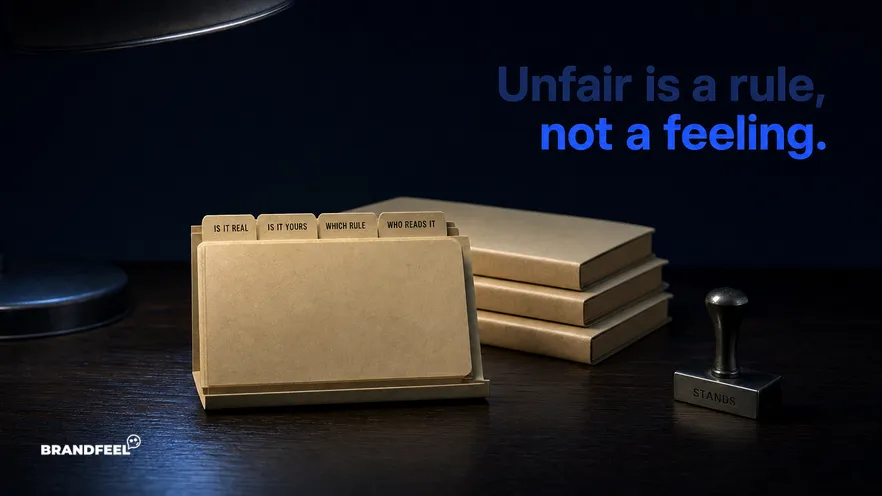
An unfair review is defined as a review that breaks a published platform rule: it describes a purchase that never happened, reviews the wrong product, contains abuse or carries a commercial interest. A product with five reviews is 270% more likely to sell than one with none [Spiegel Research Center, 2017], so one harsh review rarely decides the page. A harsh review about a courier failure is accurate, not unfair, so it needs a public reply rather than a report. You will learn which reviews to report, which to answer and which to leave alone.
- Report the rule, not the unfairness, because platforms remove reviews for breaking rules, never for being wrong or damaging.
- Reply to reviews that feel unfair but describe a real experience you did not control, instead of requesting removal.
- Own the outcome without accepting the diagnosis, because explaining that delivery is a third party reads as deflection to every later reader.
- Check the order record before suspecting a fake, because reporting a real customer as fake costs more than the review did.
- Build review coverage as your real defence, because a product with many recent reviews absorbs an outlier without any intervention.
Every store eventually gets a review that feels wrong. The product was used incorrectly, the complaint is about a courier, the reviewer expected something the page never promised, or the whole thing reads as though it belongs to somebody else's order. The instinct is to get it taken down. Last updated: October 2026.
That instinct is usually expensive, because it starts from the wrong question. Omniconvert has examined how stores handle customer feedback across the CROBenchmark dataset of 7,000+ websites in 15+ industries, against 248+ audit criteria, over 13 years in eCommerce [CROBenchmark Report 2026, Omniconvert], and the pattern is that time spent arguing for removal is almost always better spent on a reply the next shopper will read. Omniconvert Commander (formerly Nexus) is the AI for eCommerce growth engine that unifies commerce data and ranks the next action by True Profit, and its Brandfeel by Omniconvert module is the sentiment-intelligence layer that aggregates reviews, NPS and support-ticket themes, which is how a pattern of genuinely mistaken reviews gets separated from a pattern of real failure.
What an unfair review actually is, in the only sense that matters
Your definition is about accuracy and representativeness: this review misdescribes the product, or it describes an edge case as though it were typical, or the reviewer did something the instructions told them not to. All of that may be true, and none of it is actionable, because no major platform offers accuracy as a removal ground. If they did, every negative review would be contested.
The platform's definition is about compliance. Did the reviewer buy the thing. Is this a review of the product or of something else. Does it contain abuse, personal data or a commercial interest. Is it on the right listing. These are checkable questions with yes or no answers, which is precisely why they are the grounds that exist.
The Fairness Test: four questions, in order
The Fairness Test is defined as four questions, asked in order, that decide whether a review is reported, answered or left alone. The test takes about five minutes per review and it replaces an argument with a decision.
- Is the experience described real? Check the order record first, every time. Most reviews that read as fabricated turn out to belong to a real order with a real problem, sometimes under a different name or a gift address. A real experience you did not control is still a real experience, and treating it as fake is the most damaging error available here.
- Is the complaint about something you influence? Separate your product and your service from the courier, the platform, the payment provider and the expectation somebody else set. This is a diagnostic step, not an excuse: the answer changes what you do about the cause, and it changes nothing about whether you reply.
- Does it break a stated platform rule? Find the specific published rule and the specific sentence of it. If you cannot name the rule, there is no report to make, and submitting one anyway spends goodwill you may want later for a case that qualifies.
- Would the next shopper be misled? This is the question that actually decides whether to act, and it is usually answered yes with a reply rather than yes with a removal. A review claiming the product lacks a feature it has is misleading, and one clear factual sentence underneath it fixes that for every future reader.
What platforms will and will not remove
| What the review is | Removal realistic? | What to do instead |
|---|---|---|
| No matching purchase in your records | Yes, on most platforms | Report once with the order search evidence |
| Review of a different product or seller | Yes, usually straightforward | Report with both listings identified |
| Abuse, or personal data about staff | Yes, and treat it as urgent | Report, and do not reply publicly first |
| Names a competitor commercially | Often, where a rule covers it | Report, quoting the commercial-interest rule |
| Blames a courier failure on the store | No | Reply owning the outcome and state the fix |
| Describes a real but unusual edge case | No | Reply with the typical case stated plainly |
| Factually wrong about a feature | No | Reply with the correction, once, without argument |
| Harsh, one-sided, or simply disappointed | No | Reply, then improve coverage so it is an outlier |
How to reply so the next shopper is the one you persuade
Own the outcome without conceding the diagnosis. A late parcel is your problem even though you did not drive the van, so the reply says what you have done, not who is responsible. "We have moved that route to a different carrier after a run of late deliveries in your area" is a sentence that makes a future shopper more likely to buy. "Delivery is handled by our courier partner" makes them less likely, and the reviewer no more satisfied.
Correct factual errors exactly once, in a flat tone, with the fact. If a reviewer says the product has no warranty and it carries a two-year one, say that. Do not add that the information is on the page, which is both true and the kind of true that makes a store look defensive to the next reader.
And then stop. A single measured reply is strong. A thread of replies is a store arguing with a customer in public, and Baymard Institute's ecommerce usability research is clear that shoppers read this material closely when deciding, which means they read the argument too. Response patterns for each common scenario are set out in how to respond to negative reviews.
When to leave it standing, and the defence that actually works
Think about what an unfair review actually costs. On a product with sixty recent reviews, one hostile outlier is visibly an outlier, and shoppers discount it the way they discount any extreme. On a product with three reviews, that same review is a third of the available evidence, and it is decisive. Bain and Company retention research adds the commercial case: a five percent retention lift can raise profits by 25 to 95 percent [Harvard Business Review, 2014], so a well-answered complaint is worth more than a removed one.
That is an argument for treating collection as the primary defence and reporting as the exception, which is roughly the inverse of how most teams allocate their attention here. Build the standing programme first: how to build a Review-Generation system covers it, and the companion piece on how to turn an angry reviewer into a repeat customer covers the case where the complaint is valid. Repeated complaints are worth ranking and fixing, which is the job Omniconvert Commander does with a prioritised backlog, and you approve what goes live.
FAQ: handling a review you believe is unfair
What counts as an unfair review?
In platform terms, a narrow set: reviews that break a published rule, such as describing a product the reviewer never bought, containing abuse, naming a competitor commercially, or reviewing the wrong item. A review that is harsh, one-sided or about a delivery you did not perform is not unfair in that sense. It is accurate about an experience you did not control, which is a different problem with a different remedy.
Can you get a negative review removed?
Only by identifying the specific published rule it breaks and reporting that rule. Platforms do not remove reviews for being wrong, unrepresentative or commercially damaging, and a report that argues the review is unfair rather than non-compliant is almost always rejected. Quote the rule, supply the evidence, and submit once. Repeated reports on the same review do not help.
How do you reply to a review that blames you for the courier?
Accept ownership of the outcome without accepting the diagnosis, and be specific about what you did. The reviewer experienced a late parcel from your store, which is genuinely your problem even though you did not drive the van. A reply that says what you have done about it reads as competence; a reply explaining that delivery is handled by a third party reads as deflection, to the reviewer and to every shopper after them.
How can you tell whether a review is fake?
Check the order record first, because the absence of a matching purchase is the only strong signal available to you. Weaker signals are a cluster of similar reviews arriving in a short window, generic language that names no specific feature, and reviewer accounts with no other history. Suspicion is not evidence, and reporting a genuine customer as fake is a worse outcome than leaving a bad review standing.
When should you leave an unfair review alone?
When it breaks no rule, when a factual reply already protects the next shopper, and when it sits among enough recent reviews that one outlier reads as an outlier. A single poor review in a well-populated set does very little damage and visibly arguing with it does more. Coverage is the real defence: a product with plenty of recent reviews absorbs an unfair one without help.
Teams facing an unfair-feeling review usually open a ticket with the platform and wait for the outcome before replying. Meanwhile the review sits unanswered at the top of the page, and later shoppers read the silence as the store's answer. A short factual reply written for the next shopper on day one does more than a removal request that is refused.
Northwestern University's Spiegel Research Center found that purchase likelihood typically peaks at ratings in the 4.0 to 4.7 range and begins to fall as ratings approach 5.0, and it advises retailers to embrace negative reviews because they establish credibility and authenticity. [Spiegel Research Center, 2017]
Report the rule, answer the experience, leave the outlier
Adopt the platform's definition of unfair rather than your own, and the problem shrinks to something manageable. A few reviews break a stated rule and get reported once, with the rule quoted and the evidence attached. The rest describe a real experience you may not have controlled, and they get one factual reply written for the next shopper: own the outcome, correct the error, state what is typical, stop. Then spend the effort you were going to spend on reporting on collecting more reviews instead, because an outlier only does damage when there is nothing else on the page to read beside it.