
How to Increase Review Volume After Delivery
To increase review volume after delivery, fix coverage before copy. How to find the delivered orders nobody ever asked, and close the gap.
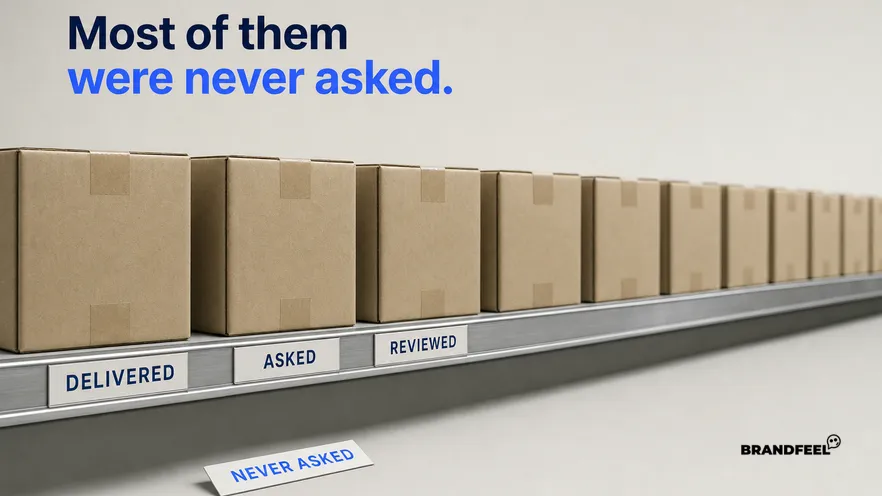
Review volume is defined as the number of reviews a store collects in a period, which equals coverage multiplied by response rate. A product with five reviews is 270% more likely to sell than one with none [Spiegel Research Center, 2017]. To increase review volume after delivery, count the share of delivered orders that were ever asked, because that gap is usually larger than any gain from rewriting the email. You will learn the four causes of the gap and how to measure it in an afternoon.
- Treat volume as coverage times response rate, because almost every store is losing more to the first term.
- Trigger on the carrier delivery event, not on dispatch, or you are asking about an unopened parcel.
- Look for four causes of the gap, because none of them is the wording of the email.
- Add the order-status page, which reaches customers email cannot, and they arrive there without being asked.
- Expect wider coverage to raise the average rating, because small samples over-represent strong feelings.
Omniconvert has measured how post-purchase programmes are assembled across the CROBenchmark dataset of 7,000+ websites in 15+ industries, against 248+ audit criteria, over 13 years in eCommerce [CROBenchmark Report 2026, Omniconvert]. The recurring finding is an arithmetic one. Review volume is coverage multiplied by response rate, teams optimise the second term almost exclusively, and the first term is where the larger and cheaper gains sit untouched.
The neighbouring guides cover the other levers. The survey of every lever is in get more product reviews, and ownership and routing are in how to build a Review-Generation system. For a dated plan rather than a survey, see 12 ways to get more reviews this quarter. This one is about the orders that never entered any of those systems.
Why you increase review volume by fixing coverage, not copy
Work the arithmetic once and the priority becomes obvious. Take a thousand delivered orders, six hundred requests sent, an eight percent response: forty eight reviews. Lifting the response rate to ten percent, which would be a genuinely good result from a rewrite, produces sixty. Lifting coverage to ninety five percent at the original eight percent produces seventy six. The second change is larger, and it is usually a configuration fix rather than a creative project.
The four causes of the Coverage Gap
The Coverage Gap is defined as the share of delivered orders that were never sent a review request.
The delivery event never fired. Marketplace orders, orders shipped by a carrier with no callback, click-and-collect, and anything dispatched manually outside the normal flow. If the automation waits for a delivery signal that never arrives, those orders wait forever, quietly, without producing an error anyone sees.
The contact record cannot be used. Guest checkouts with a typo, marketplace relay addresses that reject anything promotional, customers who unsubscribed from marketing before ever receiving a transactional review request, and orders placed by one person for another. This group is larger than most teams estimate and it is not recoverable by email at all.
A suppression rule removed the order. Almost every programme carries rules: do not ask twice in thirty days, do not ask anyone with an open support ticket, do not ask on discounted orders. Each is sensible alone. Stacked without anyone auditing the combination, they routinely exclude a quarter of delivered orders, and nobody notices because each rule is doing what it was asked to do.
The message never reached an inbox. Sent is not delivered. Review requests sit in an awkward position between transactional and promotional, which means they land in promotional tabs and spam folders more often than order confirmations do. A send report showing ninety eight percent success is reporting handoff, not arrival.
How to measure your own gap in an afternoon
Use a completed month rather than a rolling window, because orders delivered near the edge of a rolling window have not had time to be asked and will inflate the gap. Count delivered rather than placed, since undelivered orders are correctly excluded from the programme and should not count against it.
Then attribute. Pull the orders with no request against them and sort by the four causes in order: no delivery event, unusable contact, suppressed, undelivered message. The distribution is the useful output, because it names the single fix worth doing first and usually reveals one cause carrying most of the loss.
| Where the volume goes | Why it happens | How to confirm it | Cost to fix |
|---|---|---|---|
| Delivery event never fired | Carrier, channel or manual dispatch outside the flow | Delivered orders with no trigger recorded | Low, a fallback delay |
| Contact record unusable | Guest typos, relay addresses, orders bought as gifts | Hard bounce and reject rates by channel | Medium, needs a second surface |
| Suppression rules stacked | Sensible rules combined without anyone auditing the total | Count orders excluded by each rule, then overlap them | Low, a rules review |
| Message not delivered | Filed as promotional, filtered, or never accepted | Delivery rate against order confirmations | Medium, sender and content work |
| Asked but ignored | Wrong moment, wrong channel, request too large | Open and click rates on the request itself | Medium, this is the copy work |
| Started and abandoned | Login walls, long forms, mandatory account creation | Click-to-submission drop on the review page | Low, remove the requirement |
The surfaces email cannot reach
The order-status page is the strongest option and the most frequently overlooked, because it is often owned by operations rather than by marketing and therefore never appears in a marketing plan. Customers return to it repeatedly while they wait, and after delivery it becomes a page with nothing left to say. A short request there costs no goodwill at all, since nobody was interrupted.
The parcel insert reaches the same unreachable group by a different route. It works best when it asks for something specific and small and when the route to answering is genuinely short. A card carrying a long address that has to be typed on a phone will be read and not acted on.
What this is worth, and what it is not
Bain and Company's work with Fred Reichheld puts a five percent retention improvement at 25 to 95 percent more profit [Harvard Business Review, 2014], and review coverage touches that indirectly: the customers you ask are being given a reason to think about the purchase again, and the ones you never ask are simply not in the relationship.
Where the list of candidate fixes outgrows the capacity to test them, the problem becomes prioritisation. Omniconvert Commander (formerly Nexus) is an AI for eCommerce growth engine that unifies your commerce data, prioritises experiments by True Profit, and generates campaigns and creative you approve before they go live, which keeps that queue ordered by value rather than by whoever raised it last. For where your review coverage sits against your category, ecommercebenchmark.ai shows where you stand on reviews.
What to do this week
- Run the two counts. One completed month, delivered orders against requests sent.
- Audit the suppression rules as a set. List every rule, count what each removes, then count the union. The combination is what matters and it is rarely what anyone intended.
- Add a delivery fallback. Where no carrier event exists, ask a fixed number of days after dispatch rather than never. Late and imperfect beats absent.
- Put one request on the order-status page. It reaches the unreachable group, it interrupts nobody, and it is usually a day of work.
- Check the review page itself. Remove any login wall or account requirement between the click and the submission. Omniconvert Explore is the CRO platform for measuring that change: A/B and multivariate testing, on-site surveys, heatmaps and session recordings.
FAQ: review volume after delivery
Why is my review volume low when my email copy is fine?
Because volume is set by coverage before it is set by persuasion. If only sixty percent of delivered orders are ever asked, the other forty percent cannot respond at any conversion rate, and no rewrite reaches them. Measure the share of delivered orders that received a request before changing a word, because that number is usually the largest single constraint and the one nobody has looked at.
What is the Coverage Gap?
The share of delivered orders that never receive a single review request. It has four causes: the delivery event never fired, the contact record was unusable, a suppression rule removed the order, or the message was sent but never reached an inbox. Each one is a plumbing problem rather than a copywriting problem, and each is fixable without asking anyone to write anything.
Should I trigger the request on dispatch or on delivery?
Delivery, and the difference is larger than it sounds. A dispatch trigger asks a customer to review a product they may not have opened yet, which produces both fewer reviews and worse ones. Dispatch is also a fixed guess at transit time, so it drifts badly across regions and carriers. Use the carrier delivery event where you have it, and a conservative delay from dispatch only where you do not.
How do I reach customers with no usable email address?
Put the request somewhere they already go. The order-status or tracking page is the strongest option, because customers return to it several times without being prompted and arriving there is their own decision. A card in the parcel works for the same reason. Both reach guest checkouts, marketplace orders and anyone whose address is a forwarding alias, which together are a large share of most catalogues.
Does more volume mean a worse average rating?
Usually the opposite. A small sample is dominated by people with a strong reason to write, and strong reasons skew negative. Widening coverage brings in satisfied customers who would not have volunteered, which typically raises the average and, more usefully, makes the rating trustworthy. A product with nine reviews tells a shopper very little regardless of its score.
Teams that chase volume often report a 98 percent send success rate and conclude coverage is fine. A send report counts handoff to the mail server, not arrival, and it never lists the orders that never got a request at all. The gap stays invisible until someone divides asked orders by delivered ones.
AliveCor used Omniconvert to run a structured A/B testing programme and achieved +21% conversion rate, +5% revenue per visitor, and 94% statistical relevance across their experiments. [Omniconvert, AliveCor case study] Treat the fix the same way: change one cause at a time and compare coverage before and after.
Repair the biggest coverage gap first
Before anyone rewrites the review email, find out how many delivered orders it was never sent to. That one division, delivered against asked, reorders the work in most stores, because the answer is rarely close to a hundred percent and the missing orders are invisible in every report the team currently looks at. The four causes behind the gap are all plumbing: a trigger that does not fire, a contact record that cannot be used, a stack of sensible rules that combine into an unintended exclusion, and messages that were counted as sent rather than as arrived. None of them is interesting, all of them are cheap, and together they usually hold more volume than a year of optimising the ones that did get asked. Fix the coverage, then earn the response.