
12 Ways to Get More Reviews This Quarter
Twelve ways to get more reviews this quarter, ordered by effort against return, including the four most stores skip and the one that changes coverage.
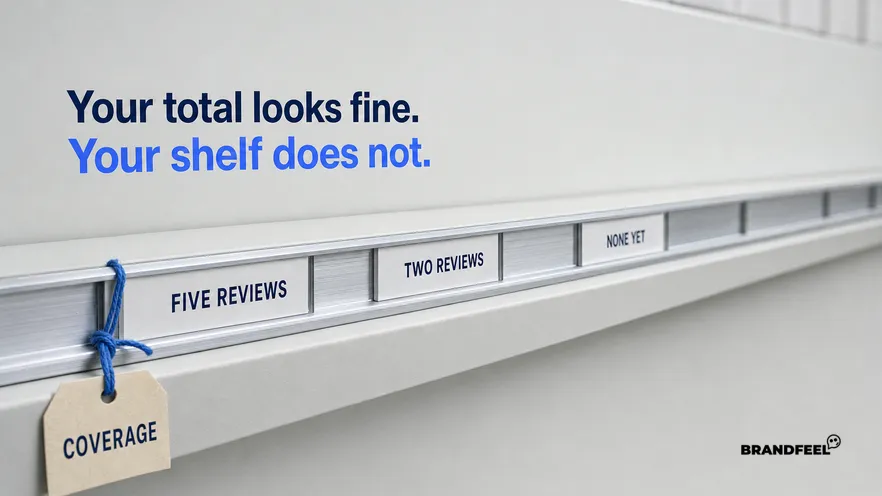
You can get more reviews this quarter by fixing when you ask, asking for less, and pointing the requests at products that have none. Those three changes cost nothing and usually move volume more than any incentive. The twelve tactics below are ordered by effort against return, starting with a one-off request to the delivered orders that were never asked, which is the largest single win most stores have available. The target worth chasing is coverage rather than total volume: the share of your catalogue carrying enough reviews to be useful on its own product page. A store with forty thousand reviews concentrated on nine products has a review problem that its headline number hides.
- Coverage beats volume: five reviews on forty products is worth more than a hundred more on one.
- The largest quarter-one win is usually a one-off request to past customers who were never asked.
- Ask after the product has been used, not after it has been delivered.
- Every extra field in the form removes people who would have submitted a rating.
- Replying in public raises the rate at which other customers are willing to write.
Getting more reviews is usually treated as a volume problem and is almost always a timing and routing problem. The store sends a request, some people answer, the number goes up slowly, and the obvious next move looks like sending more requests or attaching a bigger incentive to them. Both are the expensive options, and they are rarely the ones that were limiting you. Last updated: September 2026.
Omniconvert has measured how stores collect and display customer feedback across the CROBenchmark dataset of 7,000+ websites in 15+ industries, against 248+ audit criteria, over 13 years in eCommerce. The consistent finding is a distribution problem rather than a demand problem: review volume concentrates on a handful of products while most of the catalogue sits at zero, and the store's total makes that invisible.
What follows is twelve things to do in thirteen weeks, ordered by effort against return. For the underlying machinery, see how to build a Review-Generation system. For the three levers at a general level, see how to get more product reviews.
Start with coverage, not volume
The reason this matters is that a shopper never meets your total. They meet one product page, and the only number on it that affects them is the one attached to the thing they are considering. A store with a large total and thin coverage is well reviewed in aggregate and untested everywhere it counts.
Concentration happens by default rather than by choice. Requests follow orders, orders follow bestsellers, and the products that most need social proof, the new ones and the long tail, are the ones that receive the fewest requests. Nothing corrects this unless you correct it deliberately.
So the first measurement is the share of active products with five or more reviews. Most stores running a review programme for a year or more are somewhere between fifteen and forty percent, and almost none of them know the figure before they look.
Twelve ways to get more reviews, by effort against return
1. Ask the customers you never asked. Almost every store has delivered orders from before the programme existed, or from a period when it was broken. A single, clearly worded request to that backlog converts at a lower rate than a fresh request and comes from a vastly larger base. This is the largest one-off win available to most stores and it takes an afternoon.
2. Move the ask to after use. Delivery is the wrong trigger. It collects impressions of the box. Set the gap by category: about a week for a consumable, three to four weeks for a durable good, longer for anything seasonal or occasional.
3. Cut the form to a rating and one optional sentence. Every additional required field removes people. Title fields, category ratings, nickname fields and account creation each take a share of the people who were willing a moment ago.
4. Send one reminder, and only one. A single reminder three to five days later typically adds a third again to the response. A second reminder adds very little and costs goodwill.
5. Route requests to uncovered products. When an order contains several items, ask about the one with the fewest reviews rather than the most expensive one. This is the single biggest change on the list for coverage and almost no store does it.
6. Ask for the photo after the rating, never inside it. Submit first, then offer the photo upload on the thank-you screen. You keep the ratings you would have lost and still collect a useful share of images.
7. Put the request where the customer already is. A request inside the shipping notification or the order-tracking page reaches people who never open marketing email, and it arrives in a message they actually wanted.
8. Use SMS for the reminder, email for the first ask. Email carries the context and produces longer reviews. SMS produces higher response and shorter ones, which is exactly what you want from a reminder.
9. Reply in public to every critical review. This is a volume tactic as well as a service one. A visible reply tells the next reader that a person is on the other end, and willingness to write rises accordingly.
10. Seed new products deliberately. A new product launched into zero reviews stays there. Route the first weeks of requests toward it, and accept that this slows the accumulation on products that do not need more.
11. Ask for reviews of the experience separately from the product. Customers who feel neutral about a product often have something to say about delivery or support, and splitting the two questions recovers responses that a single product question loses.
12. Offer a neutral incentive, last. If the eleven changes above are in place and volume is still short, a small reward for submitting any review, offered to every buyer and disclosed to the reader, is the compliant version. Doing this first, which is what most stores do, buys volume that the free changes would have produced anyway.
What each tactic is actually worth
| Tactic | Effort | Moves volume | Moves coverage |
|---|---|---|---|
| Request to the un-asked backlog | One afternoon | Large, once | Moderate |
| Ask after use, not on delivery | A setting change | Moderate, ongoing | None |
| Shorter form | A template edit | Moderate, ongoing | None |
| One reminder | A flow step | Moderate, ongoing | None |
| Route to uncovered products | Logic change | Small | Large |
| Photo asked after submission | A screen change | Protects volume | None |
| Public replies to critical reviews | Ongoing time | Small, compounding | None |
| Neutral incentive | Money, ongoing | Moderate | Small |