
How to Turn an Angry Reviewer Into a Repeat Customer
An angry reviewer has already told you what went wrong and stayed to say it. The five-step Recovery Ladder that turns that complaint into a second order.
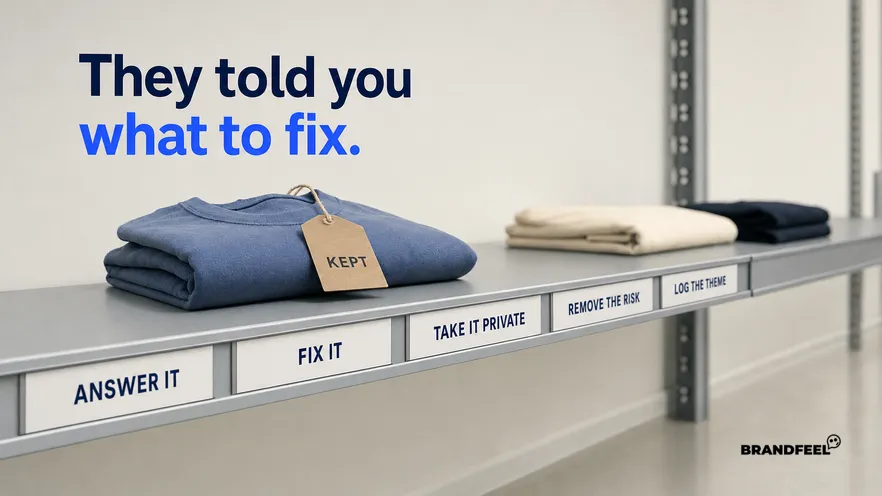
An angry reviewer is defined as a dissatisfied customer who has stayed engaged long enough to tell you precisely what failed, which makes them the most recoverable category of unhappy customer you have. A 5% lift in retention can raise profits by 25% to 95% [Harvard Business Review, 2014], so recovering a complainant pays. To turn an angry reviewer into a repeat customer, answer the specific complaint, fix the cause and say what you did, move the detail into a private channel, then remove the risk of ordering again rather than discounting. You will learn the five-step Recovery Ladder, the timing that decides it and how to measure recovery.
- Treat a written complaint as the most informative and recoverable form of dissatisfaction, because silence gives you nothing to work with.
- Fix before you offer, because compensation presented before a resolution reads as buying a rating.
- Remove risk instead of cutting price: free return postage and a guaranteed replacement bring people back, discounts rarely do.
- Reply within a day or two, because an instant reply reads as automated and a fortnight reads as indifference.
- Measure the repeat rate of customers who complained against those who did not, because star averages can improve while retention does not.
Most stores treat an angry review as a reputation problem to be contained. It is better understood as a customer who has done you two favours: they have told you exactly what went wrong, in detail, for free, and they have stayed present long enough to say it. Last updated: October 2026.
Omniconvert has examined how stores collect and act on customer feedback across the CROBenchmark dataset of 7,000+ websites in 15+ industries, against 248+ audit criteria, over 13 years in eCommerce [CROBenchmark Report 2026, Omniconvert]. The stores that recover complainants are not the ones with the best-written replies. They are the ones that treat the reply as the third step rather than the first. Omniconvert Commander (formerly Nexus) is the AI for eCommerce growth engine that unifies commerce data and ranks the next action by True Profit, and its Brandfeel by Omniconvert module exists for exactly this: the sentiment-intelligence layer that aggregates reviews, NPS and support-ticket themes so a complaint reaches whoever can fix the cause. This guide covers why an angry reviewer is recoverable, the five-step Recovery Ladder, the timing that decides it, and how to measure whether any of it worked.
Why an angry reviewer is your most recoverable customer
Now consider the person who writes four paragraphs about a zip that failed after a fortnight. They have handed you a defect report with a timeline. They have also, by writing it, demonstrated that they cared enough about the purchase to spend fifteen minutes on it, which is not the behaviour of someone indifferent to the outcome.
That combination is what makes recovery possible. You know what to fix and you know they are still listening. The customer who left in silence offers neither, and no process can recover someone whose departure you never detected.
The Recovery Ladder: five steps in the order that works
The Recovery Ladder is defined as five steps, taken in order, that turn a complaint into a repeat purchase. Each rung depends on the one below it, so taking them out of order tends to waste the whole sequence.
- Answer the specific thing. In their words, about their problem. "We are sorry you had a poor experience" tells the reviewer nobody read it. "The zip failing after two weeks is a manufacturing fault, not wear, and we treat it as one" tells them somebody did. This single difference does more than every other rung combined.
- Fix it without being asked, then say what you did. Resolve the thing. Then report the resolution as a fact rather than as an offer. The order is what makes it credible: a fix reported before any mention of compensation reads as responsibility, and the same fix reported after reads as a negotiation.
- Move the detail into a private channel. Once the public reply exists, take the specifics somewhere they can share an order number and a photograph. The public reply is for the next shopper reading it; the private thread is where the recovery actually happens.
- Give a reason to return, not a discount. What stops someone ordering again is risk, not price. Free return postage, a guaranteed replacement, a named person to contact: each removes a reason to hesitate. A 10% code does not, and on many platforms it reads as an attempt to buy a changed rating.
- Record the theme, not the incident. One zip failure is a service ticket. Four zip failures in a month is a product brief. Log the category so the pattern reaches whoever owns the product, because recovering customers one at a time while the cause persists is an expensive way to stand still.
The timing that decides whether recovery works
A reply within minutes is structurally unable to contain a finding. Nobody checked the batch, nobody looked at the order, nobody spoke to fulfilment. So it contains an apology and an invitation to contact support, which is the shape every reviewer recognises as automated regardless of how it is worded. Shoppers reading reviews recognise it too, which matters because the public reply exists mostly for them.
A reply after three weeks has the opposite problem. The reviewer has moved on, replaced the product and formed a settled view of your store. The reply now reads as reputation management rather than service, because the only thing that changed in three weeks is that someone noticed the review.
One to two days is where a reply can carry a finding and still arrive while the person is thinking about it. Note what this implies operationally: the constraint is not your response-time target, it is whether whoever writes the reply can get an answer from fulfilment or production inside a day. Teams that cannot usually discover that the real problem is internal routing, not review management.
How to measure recovery without gaming the star average
The honest measure is retention among complainants. Take customers who left a negative review in a period, measure what share ordered again within a defined window, and compare against the same share for customers who did not complain. The gap between those two numbers is your recovery performance, and it is hard to fake because it is a purchase rather than an opinion.
The table sets out which signals are worth tracking and which flatter you.
| Signal | What it actually measures | How easily it is gamed | Use as |
|---|---|---|---|
| Repeat rate of customers who complained | Whether recovery keeps people | Very hard: it is a purchase | Primary metric |
| Time from review to a reply with a finding | Whether internal routing works | Hard: a finding cannot be faked quickly | Primary operational metric |
| Share of complaints with a named theme logged | Whether causes reach an owner | Moderate: themes can be logged carelessly | Process health check |
| Reviews updated after a resolution | Partly recovery, partly asking | Easy: ask harder | Secondary, read with caution |
| Star average | Who you asked, as much as how you did | Very easy | Report it, never target it |
| Response rate to reviews | Whether anybody is replying at all | Trivial: template everything | Floor check only |
Two of the rows deserve a comment. Time to a reply with a finding is unusual as a service metric because it deliberately refuses to reward a fast empty answer, which is what most response-time targets reward. And the last row is worth keeping only as a floor: a store replying to a tenth of its reviews has a staffing problem that no technique fixes.
What this is worth, in money
The retention case is ordinary. Bain and Reichheld's much-cited finding that a 5% improvement in retention can raise profits by 25% to 95% [Harvard Business Review, 2014] applies here as it does anywhere, and complainants are a population where a process change can move retention measurably, because the current baseline is usually near zero.
For the reply wording, see how to respond to negative reviews, and for reviews that break platform rules, see how to handle a review you believe is unfair.
FAQ: turning an angry reviewer into a repeat customer
Can an angry reviewer really become a repeat customer?
Often, and more often than a silent unhappy customer can. Someone who writes a detailed complaint has told you exactly what failed and has stayed engaged enough to say it, which are the two things recovery needs. The customer who leaves without a word gives you neither. Treat a written complaint as the most informative and most recoverable form of dissatisfaction you receive.
Should you offer a discount to an angry reviewer?
Offer risk removal before you offer money. A discount says the relationship is a price negotiation, and it frequently reads as an attempt to buy a changed rating. Free return postage, a guaranteed replacement or a direct line to a named person removes the reason they would hesitate to order again, which is what actually brings someone back.
How quickly should you respond to a negative review?
Within a day or two, and not within minutes. A reply inside the hour reads as automated on most platforms, while a reply after a fortnight reads as indifference. The window that works is long enough to have actually looked into what happened and short enough that the reviewer is still thinking about it. Having something to report is what makes the reply land.
Should you ask a reviewer to update their review?
Only after you have genuinely resolved the problem, and only once. Asking before you have fixed anything converts a service interaction into a reputation request, which is the fastest way to lose a recoverable customer. If the resolution was real, many people update without being asked, and the ones who do not have still told you something worth knowing.
What should you measure to know whether recovery is working?
Measure the repeat-purchase rate of customers who complained, against the repeat rate of customers who did not. That comparison answers the only question that matters, which is whether your recovery process keeps people. Star-average movement and review-edit counts are easy to collect and easy to improve without keeping anybody, so they make poor primary metrics.
Teams that try to recover angry reviewers often lead with the compensation. A discount code arrives before anyone has said what went wrong, so the reviewer reads it as an attempt to buy a changed rating, and the platform may read it the same way. The recovery fails at step one because the reply never named the specific failure.
AliveCor used Omniconvert to run a structured A/B testing programme and achieved +21% conversion rate, +5% revenue per visitor, and 94% statistical relevance across their experiments. [Omniconvert, AliveCor case study] Validate your own recovery process the same way: compare the repeat rate of complainants you recovered against those you did not.
Fix first, reply second, then measure repeat purchase
An angry reviewer has already done the hard part, which is telling you what went wrong while still paying attention. The work is to answer the specific thing, fix it before offering anything, take the detail private, remove the risk of trying again, and log the theme so the cause reaches somebody who can end it. Measure the one number that cannot be gamed, which is whether complainants order again, and leave the star average as something you report rather than something you chase. Do that and the complaint stops being a reputation cost and becomes the cheapest product research and the most recoverable customer you have.