
How to Ask for Reviews Without Being Annoying
Every store has an annoyance budget with each customer. How to ask for reviews without overspending it: frequency, channel and consent.
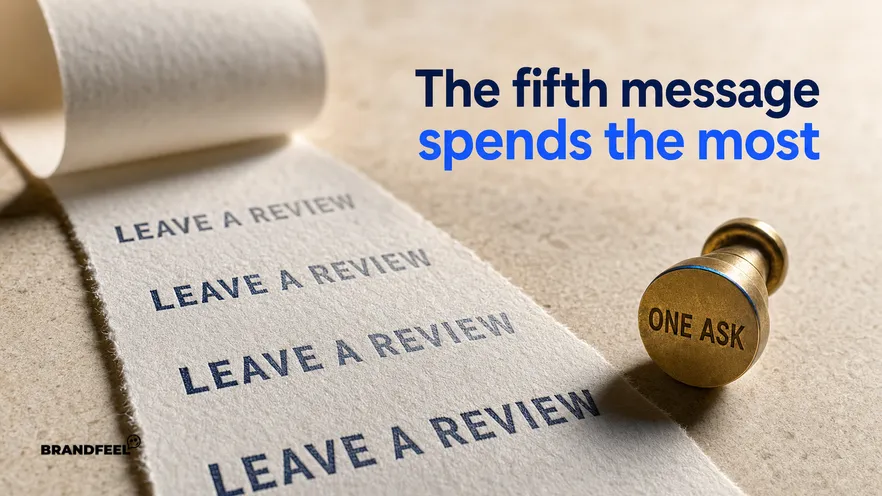
To ask for reviews without being annoying, treat your customer's tolerance as a budget you are already spending. One request and at most one follow-up, on a channel that suits the size of the favour, asking for the smallest useful thing first. Count every automated message the customer receives after an order, not only the review ones, because the request is spent from the same budget as the shipping updates, the survey and the newsletter. Suppress anyone who has already reviewed. A request feels annoying almost never because of its wording and almost always because of what arrived alongside it.
- Annoyance is cumulative, so the review request usually gets blamed for the whole programme's volume.
- Two asks is the ceiling, and the second one should be a smaller, different question.
- Channel decides how large a request you are allowed to make: email tolerates most, push tolerates least.
- Asking a customer who already reviewed is the single most expensive message you can send.
- Shorten the ask before you sweeten it, because an incentive on an irritating sequence still irritates.
The question of how to ask for reviews without being annoying is nearly always asked about wording, and wording is not where the problem lives. Teams rewrite the subject line, soften the opening, add a line of thanks, and the response rate does not move. It does not move because the customer is not reacting to that email. They are reacting to it being the fifth automated message from you this fortnight. Last updated: September 2026.
Omniconvert has measured how post-purchase programmes are built across the CROBenchmark dataset of 7,000+ websites in 15+ industries, against 248+ audit criteria, over 13 years in eCommerce. A pattern recurs: the review request is designed by one team, in isolation, against its own response rate, while nobody owns the total volume of automated contact a single customer receives. The request is then judged on a metric that is decided elsewhere.
This article covers the part the neighbouring guides leave alone. Timing is covered separately, the survey of all three levers is in get more product reviews, ownership and routing sit in how to build a Review-Generation system, and the rules around rewards are in how to incentivise reviews without breaking platform rules. What follows is frequency, channel and consent.
What actually makes an ask for reviews feel annoying
Ask someone why they unsubscribed from a brand and they rarely name a single email. They describe a feeling of being contacted too much, and then they name whichever message happened to be on screen when they reached that conclusion. Review requests are disproportionately that message, for a structural reason: they usually sit at the end of the post-purchase sequence, after the confirmation, the dispatch note, the delivery note, the how-is-it-going note and the cross-sell.
The second factor is proportion. Every request has a size, measured in what it asks the customer to do, and every channel has a tolerance for that size. An email asking for a paragraph of writing is proportionate. A text message asking for a paragraph of writing is not, because the channel implies brevity and urgency and the request implies neither. Mismatches of this kind read as thoughtless even when the wording is warm.
The third is redundancy. A request sent to somebody who has already reviewed is the most expensive message in the programme. It tells the customer that their effort was not noticed, which is worse than not asking at all, and it is almost always caused by a suppression rule nobody wrote rather than by a decision anyone made.
The annoyance budget, and how stores overspend it
The model is simple enough to hold in your head. A customer buys, and from that moment you have a small allowance of their attention. Each message spends some. A dispatch notification spends little, because it gives information they wanted. A newsletter spends more. A request for a favour spends most, because it transfers work to them.
What makes this hard to manage is that the budget is held by the customer and the spending is done by several teams. Lifecycle marketing sends the flows. Operations sends the transactional notices. Merchandising sends the launch announcements. Each optimises its own open and click rate, each sees a respectable number, and nobody sees the sum. The review request, arriving last, absorbs the accumulated irritation of everything before it.
There is a reason to care beyond politeness. Bain and Company's work with Fred Reichheld holds that a five percent improvement in retention can raise profits by twenty-five to ninety-five percent [Bain and Company], and the contact programme is one of the few levers that touches retention directly in both directions. The same sequence that brings a customer back can, at a slightly higher volume, be the reason they stop opening anything.
The practical move is a single count. Take one recent order and list every automated message that customer received in the following fortnight, from every system. Most teams have never done this, and the number surprises them. It is the only number that tells you whether your review request has room to exist.
Channel decides how much you are allowed to ask
Channels are not interchangeable delivery mechanisms with different reach. Each one carries an implicit contract about what it is for, and a request that violates that contract reads as intrusive regardless of its content.
Email is the workhorse because it is asynchronous and dismissible. It arrives, it waits, and ignoring it costs the customer nothing. That is precisely why it can carry the largest ask, including an open-ended request for written feedback.
SMS is different in kind. It arrives where personal messages arrive, it is usually read within minutes, and it cannot be ignored without a small act of attention. That buys reach and it spends budget quickly. A text message is the right vehicle for a request that resolves in one tap, such as a single rating, and the wrong vehicle for anything that requires the customer to compose a sentence.
Then there are the channels most stores underuse, which are the ones where the customer is already engaged. A prompt on the order-status page. A printed card in the parcel. A request inside an app session the customer opened themselves. These spend almost nothing from the budget, because the customer arrived voluntarily and the request does not intrude on anything. Nielsen's long-running work on advertising trust has consistently found that recommendations from other people outrank brand-controlled messages [Nielsen], which is the argument for collecting reviews diligently and for collecting them where the asking is cheapest.
The five rules for a request that gets answered
- Count every message, not just the review ones. Build the actual list for one order across every system that sends. Until that list exists, any decision about review frequency is being made without the relevant information.
- Send one ask and at most one follow-up. Two is the ceiling. Make the second ask a different, smaller question rather than the first one repeated, because a customer who ignored an open invitation will often answer one specific thing.
- Match the channel to the size of the request. Open-ended written feedback belongs in email. One-tap ratings can go to SMS where consent exists. Push notifications should not be asking for favours at all.
- Ask for the smallest useful thing first. A single rating, answerable in one action, with the invitation to add detail appearing only after the customer has already engaged. Asking for the essay up front is what produces silence rather than short reviews.
- Suppress anyone who has already reviewed. Recently, on any channel, for any product. This is a suppression rule rather than a campaign setting, and its absence is the most common defect in review programmes that otherwise look well built.
What each channel actually costs you
| Channel | Largest ask it carries | Budget spent | Main failure mode |
|---|---|---|---|
| Open-ended written review | Low to moderate | Arrives on top of four other automated emails | |
| SMS | Single rating, one tap | High | Used for requests that need a keyboard |
| Push notification | Nothing worth asking for | Very high | Interrupts, then devalues every later notification |
| Order-status page | Rating plus optional detail | Near zero | Rarely built, so the traffic goes unused |
| In-parcel card | Rating via a short link | Near zero | No timing control and no suppression |
| In-app prompt | Rating plus optional detail | Low | Fires on entry rather than after a completed action |
The row worth acting on is the order-status page. Customers visit it voluntarily, often more than once, and on most stores it asks them for nothing at all. Moving even part of your review collection there reduces the pressure on email without reducing volume.
What better manners cannot fix
It cannot fix bad timing. A perfectly polite request that arrives before the customer has used the product asks a question they cannot answer, and no amount of restraint elsewhere in the programme changes that. Timing and frequency are separate levers and improving one does not compensate for the other.
It cannot fix a weak experience. If deliveries run late and the packaging arrives damaged, a well-mannered review request is an invitation to say so publicly. That is useful information and it is not a review-programme problem. Baymard Institute's checkout research documents how unmet expectations late in a purchase damage completion, with roughly 70% of carts abandoned on average, and the same disappointment shows up afterwards in what customers are willing to write.
And it cannot manufacture enthusiasm. Some categories simply generate less to say than others, and a store selling replenishable basics will collect shorter reviews than one selling considered purchases, no matter how the asking is arranged. Reading that as a failure of the programme leads teams to add messages, which is the one response guaranteed to make things worse. To see how your review coverage compares with others in your category, where you stand on reviews is one of the six dimensions a benchmark score reads.
What to change this week
- Count the fortnight. One order, every automated message, every system. It takes an hour and it usually settles the argument about frequency on its own.
- Cut the sequence to two. If a third request exists, remove it and watch the unsubscribe rate rather than the response rate. The response you lose is smaller than teams expect.
- Write the suppression rule. Anyone who reviewed in the last ninety days receives no further request, on any channel. Check it works by looking for a customer who has.
- Put a rating prompt on the order-status page. The traffic is already there and voluntary, which makes it the cheapest collection you will ever build.
Where the harder problem is that review, support and order data sit in three systems that never meet, Nexus by Omniconvert is an AI for eCommerce growth engine that unifies commerce data, segments customers by behaviour and value, and ranks the next actions worth taking, with a human approving what goes live. Suppression rules of the kind above are simple to state and hard to enforce precisely because that data is scattered.
FAQ: asking for reviews without being annoying
How many times should I ask a customer for a review?
Once, plus at most one follow-up, and the follow-up should ask a different and smaller question rather than repeat the first. A third request adds very little response and reliably adds unsubscribes. If two well-timed asks produce nothing, the customer has answered you by not answering, and the correct response is to stop rather than to escalate.
Which channel is best for a review request?
Email for anything open-ended, because it is the channel people expect commercial contact on and can ignore without friction. SMS only for a request that resolves in a single tap, and only where the customer has explicitly agreed to it. Push notifications are the wrong channel for asking a favour: they interrupt rather than wait, and the cost of the interruption is paid by every future notification you send.
Does asking for a review annoy customers enough to lose them?
One well-timed request rarely costs you a customer. The damage is cumulative rather than singular: a review request landing on top of a shipping update, a survey, a cross-sell and a newsletter is the message that tips a tolerable volume into an intolerable one. The review request then gets blamed for a problem the whole programme created.
Should I offer an incentive so the ask feels worth answering?
An incentive changes who answers rather than how the ask feels, and it carries platform rules that vary by marketplace. Treat it as a separate decision with its own constraints, not as a way to buy back goodwill you spent by sending too many messages. Fix the frequency first, because an incentive attached to an irritating sequence still reads as irritating.
What should a review request actually say?
Name the specific product, state plainly how long it will take, and ask one question. Requests that open with gratitude for the order, restate the brand mission and then ask for detailed feedback read as a marketing email with a favour attached. The shortest honest version of the request performs better and is easier to write.
How do I know if my review requests are annoying people?
Read the unsubscribe rate on the review email against your other post-purchase messages, and read what people write when they unsubscribe. Then count the total number of automated messages one customer receives in the fortnight after an order. Most teams have never counted, and the number is usually higher than anyone in the room would have guessed.
The bottom line
Stop editing the email and start counting the programme. A review request is not judged on its own merits by the person receiving it, it is judged against everything else you sent that fortnight, and no rewrite survives being the fifth message in ten days. So count them, cap the sequence at two, send each ask on a channel sized to the favour it asks for, and stop contacting the customers who already did what you wanted. Then move part of the collection to the order-status page, where the customer arrived on their own and the request costs you nothing. None of this needs new software or a new agency, and it changes both how many people answer and whether they still open your email in six months.