
How to Incentivise Reviews Without Breaking Platform Rules
How to incentivise reviews inside the rules: what platforms prohibit, why it reduces to one principle, and the four-condition test an offer must pass.
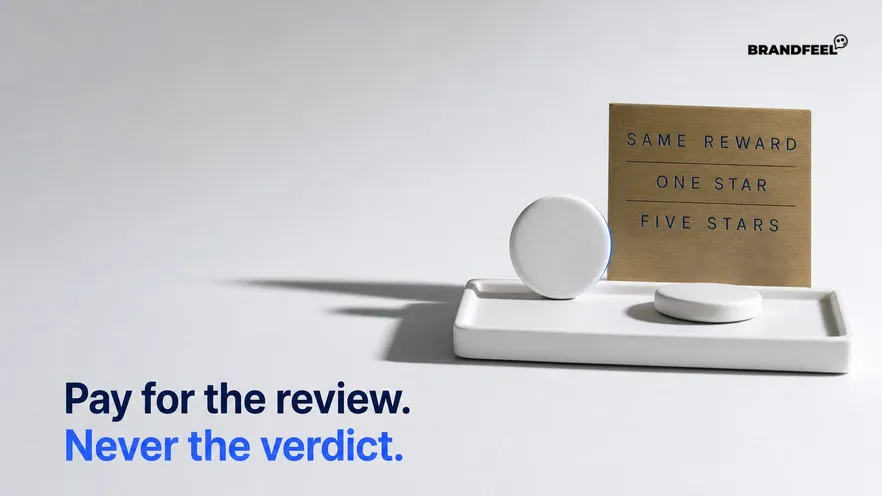
You can incentivise reviews inside platform rules by rewarding the act of submitting one rather than the verdict it reaches. Every major policy reduces to that single principle, with three supporting conditions: the offer goes to every buyer rather than a selected group, the reader is told the reviewer received something, and the reward is small enough that nobody would write dishonestly to earn it. Amazon prohibits incentivised reviews outright outside its own programmes, so treat it as a separate case rather than the general rule.
- Every platform rule on this reduces to one line: reward the act, never the verdict.
- Amazon is the strict case and prohibits incentivised reviews outside its own programmes.
- Disclosure is the condition merchants skip and regulators care about most.
- Pre-screening for happy customers breaks the rules even when no reward changes hands.
- Enforcement removes reviews in bulk, so an aggressive incentive risks the corpus you already earned.
Incentivising reviews is where a lot of well-run stores quietly break rules they have not read. The intent is rarely dishonest. Somebody wants more reviews, a discount code is the nearest lever, and the offer goes out phrased in a way that would fail an audit on the second clause. Last updated: August 2026.
Omniconvert has measured how stores collect and display customer feedback across the CROBenchmark dataset of 7,000+ websites in 15+ industries, against 248+ audit criteria, over 13 years in eCommerce, and non-compliant incentives are common in a specific way: the wording, not the intention. The offer says something like "leave us a five-star review and get ten percent off", when the same store would have been perfectly happy with an honest three stars. One clause turns a legitimate participation incentive into a purchase of sentiment.
This guide covers what the major platforms actually prohibit, the one principle all of it reduces to, a four-condition test for designing an incentive that survives, and what enforcement costs when it arrives. For the system that holds review collection together, see our guide on how to build a Review-Generation system; for the tactical levers of timing and templates, see how to get more product reviews.
What the platforms prohibit when you incentivise reviews
Take them in order of strictness. Amazon is the outlier and the one most merchants get wrong by generalising from it or to it. Reviews obtained in exchange for compensation are not permitted outside the programmes Amazon itself runs, and that includes discounts, free product, loyalty credit and gift cards. A policy that works on your own site is not portable there.
Google product and business reviews sit in the middle. The prohibition is on offering an incentive in exchange for a positive review, and on discouraging or gating negative ones. An offer made to every customer, unconditional on what they say, is a different thing from a bounty on five stars, and the policies read that way.
The independent review platforms mostly follow the same shape, with an added emphasis on invitation neutrality: you may invite customers, but you may not choose which customers to invite based on how happy you think they are. This is the condition merchants breach without any money changing hands, by running the satisfaction survey first and only inviting the people who scored well.
Your own product pages are not governed by a platform policy at all. They are governed by advertising and consumer protection law, which in most jurisdictions requires a material connection between a reviewer and a seller to be disclosed. That is a lower bar in some ways and a sharper one in others, because the penalty comes from a regulator rather than a marketplace.
The one principle underneath every rule
It helps to understand why the platforms care, because the reasoning tells you where the edge is. A review corpus is valuable to a shopper only insofar as it predicts their own experience. A four-star average that predicts a good experience is worth consulting. A four-star average produced by paying people to say four stars predicts nothing, and once shoppers work that out they stop reading reviews on that platform entirely.
So the platform is not protecting shoppers out of principle alone. It is protecting the only asset it has. That is why enforcement is harsher than the individual offence usually merits, and why it is applied in bulk rather than case by case.
The same logic explains why the rule survives on your own site even where no platform enforces it. A review section that has been incentivised toward positivity stops informing your buyers, which means it stops reducing returns, stops answering pre-purchase objections, and stops doing the job you built it for. You can break the rule successfully and still lose, because the thing you bought is not the thing you wanted.
The Neutral Incentive Test: four conditions
- Reward the act, not the verdict. The offer is made for submitting a review and the reward is identical at one star and at five. Practically, this means the reward is confirmed at submission and never withdrawn afterwards, because a reward that quietly does not arrive for critical reviewers is sentiment-linked in effect if not in wording.
- Offer it to everyone. Every verified buyer of the product receives the same invitation on the same terms. No pre-screening, no satisfaction survey acting as a filter, no separate path for customers your support team liked. This is the condition that catches otherwise careful stores.
- Disclose it in the review. The reader can see the reviewer received something. Most review software supports an incentivised badge; where it does not, a standard line appended at submission does the job. This costs you almost nothing and is the part a regulator will ask about first.
- Keep it small enough to ignore. The reward should be worth less than the effort of composing a dishonest review. A loyalty point or entry into a modest draw buys participation. A generous voucher buys agreement, and buying agreement is the thing every rule above exists to prevent.
Run an existing programme through those four and the failure is usually the second or the third rather than the first, because most merchants already know not to ask for five stars explicitly.
What a compliant programme looks like next to a non-compliant one
| Design decision | Fails an audit | Passes |
|---|---|---|
| What the reward is for | A positive review | A submitted review, any rating |
| Who is invited | Customers who scored well on a survey | Every verified buyer of the product |
| Disclosure | None, the reader cannot tell | Visible on the review itself |
| Reward size | Large enough to change what is written | Small enough to be ignored |
| Critical reviews | Routed to support instead of publication | Published, then answered in public |
| Reward delivery | Discretionary after the review is read | Automatic at submission |
| What the corpus predicts | Very little, ratings compress upward | The next buyer experience |
The last row is the commercial argument. Everything above it is compliance; that line is why compliance is also the better programme.
What enforcement actually costs
Consider the asymmetry plainly. An aggressive incentive might add several months of review volume ahead of schedule. A finding against it can remove every review associated with the programme, including the genuine ones submitted by customers who never saw the offer, because the removal is keyed to the collection method rather than to the individual review.
Beyond removal there is ranking. Reviews feed marketplace placement, rich results and increasingly what answer engines are willing to repeat about you. A corpus that vanishes takes those with it, and rebuilding is slower than the original accumulation because the customers who would have reviewed have already been asked.
There is also the internal cost nobody budgets. Once a corpus is known to be incentivised, your own team stops trusting it, which means the product feedback loop it was supposed to feed goes quiet. Bain and Company research associated with Fred Reichheld has long put the profit effect of a five percent retention lift at somewhere between twenty-five and ninety-five percent, and retention improvements start with knowing what is wrong [Bain and Company, Reichheld]. A corpus optimised for praise cannot tell you.
What to do this week
- Read your own offer wording aloud. If the sentence contains a rating, a star count or the word positive, rewrite it today. This is the fastest fix available and the most common finding.
- Trace who gets invited. Follow the actual trigger in your review software. If a satisfaction score, an NPS response or a support flag sits anywhere in that path, invitation neutrality has already failed.
- Check the disclosure. Look at three incentivised reviews on your live product pages and see whether a reader could tell. If not, turn the badge on or append the line at submission.
- Confirm the reward is automatic. If anyone reviews a review before the reward is released, remove that step. Discretion at that point is sentiment-linkage regardless of how it is exercised.
Where the harder question is what your review corpus is actually telling you, that is a sentiment problem rather than a compliance one. Brandfeel, Omniconvert's sentiment-intelligence layer, aggregates reviews, NPS and support-ticket themes to surface what customers keep saying, and it works properly only on a corpus that was collected honestly. The same signal feeds Nexus by Omniconvert, an AI for eCommerce growth engine that unifies commerce data, ranks experiments by True Profit, and generates campaigns and creative you approve before they go live. To see how your review coverage compares to the brands you compete with, the where you stand on reviews guide covers the competitive read.
What compliance will not fix
Volume will usually fall when you switch. That is the programme working: the reviews you lose are the ones an incentive was manufacturing, and their absence is information. A store that sees a large drop has learned something important about what its old numbers meant.
Compliance also cannot fix coverage, which is a different problem from volume. A thousand reviews concentrated on three bestsellers still leaves most of your catalogue unreviewed, and a shopper looking at an unreviewed variant is unaffected by your total. Coverage is solved by routing and prompt design, not by incentive policy.
And it cannot answer the reviews. Marketing Metrics has long put the probability of selling to an existing customer at roughly sixty to seventy percent against five to twenty percent for a new prospect, which makes a public, well-handled critical review one of the most valuable pieces of content a store owns [Marketing Metrics]. Collecting it honestly is the first half. Replying to it in public is the half that changes anything.
The bottom line
Reward the act, never the verdict, and the rest of the policy landscape stops needing to be memorised. Offer the same thing to every buyer, tell the reader that something was offered, and keep it small enough that nobody would write dishonestly to collect it. Amazon remains the strict exception and should be handled on its own terms rather than by generalising from your storefront. The reason to do this properly is not fear of enforcement, though enforcement is blunt and retroactive and takes honest reviews down with the rest. It is that a review corpus is only worth having if it predicts what the next buyer will experience, and an incentive attached to sentiment is the one intervention guaranteed to stop it predicting anything. Volume will fall when you switch. What is left will be worth reading, which is what the section was for.