
What Is Review Recency, and Why It Matters
Review recency is the age distribution of a product reviews, not the date of the newest one. Why it decays, what it costs, and how to measure it.
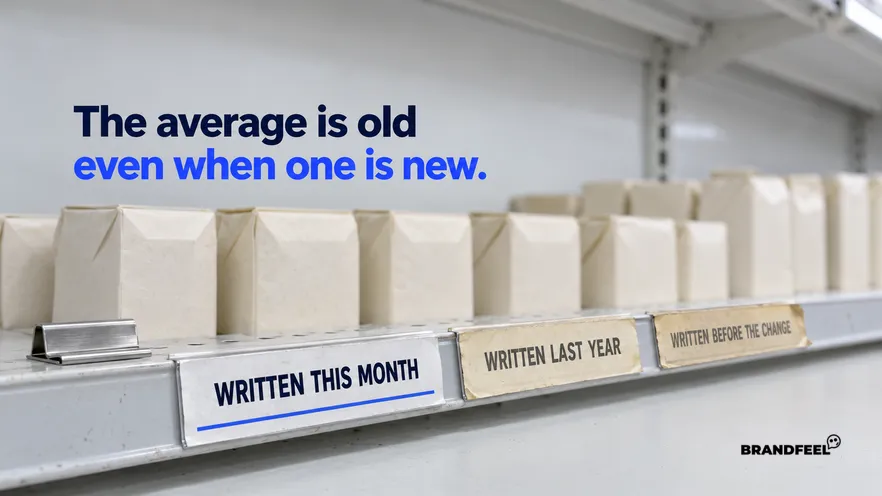
Review recency is defined as the age distribution of the reviews attached to a product, rather than the date of the single newest one. It matters because a review describes a product as it was on the day it was written, so a page carrying four hundred reviews from three years ago is making a confident claim about a version that may no longer exist. Around 70% of carts are abandoned, often at the point where a shopper goes looking for reassurance and does not find anything current [Baymard Institute, 2025]. This piece sets out what recency measures, what it costs when it decays, and the one distribution check worth running.
- Measure the distribution of review ages, not the date of the newest review.
- Treat your last material product change as the line that divides current from stale.
- Publish a visible date on every review, because undated evidence cannot be weighed.
- Ask recent buyers on a schedule rather than emailing the whole list once.
- Expect the average rating to move when recency improves, sometimes downward.
- Check recency per variant, since a popular size carries the whole product reputation.
Omniconvert has measured how product evidence is published across the CROBenchmark dataset of 7,000+ websites in 15+ industries, against 248+ audit criteria, over 13 years in eCommerce [CROBenchmark Report 2026, Omniconvert]. Reviews are close to universal on product pages in that set. A visible date on each one is not, and a page that shows a count and a star average without dates is asking to be trusted on evidence nobody can place in time.
What review recency actually measures
The common mistake is to treat recency as a yes or no property of the newest review. One review from last week on top of a pile from 2023 satisfies that test and tells a shopper almost nothing, because the pile is what forms the average they are reading.
A better way to hold it is as a half-life. The Recency Half-Life is the point at which half of a product's reviews are older than its last material change: a reformulation, a supplier switch, a redesign, a courier change. Reviews written before that line describe a different thing wearing the same name.
That framing is useful because it makes the answer specific to your own release history rather than to a general rule. A cast iron pan that has not changed in a decade has excellent recency with ten-year-old reviews. A supplement reformulated in March does not, however many reviews it has.
Why old reviews quietly lose their weight
Shoppers do this automatically and without resentment. They scan for the most recent few, check whether anything has gone wrong lately, and use the old reviews only as background. That behaviour is sensible and it means the useful part of your review corpus is far smaller than the count on the page suggests. It is the same instinct that shows up in checkout research: Baymard Institute has measured average cart abandonment at around 70% for years [Baymard Institute, 2025], and a large share of it comes down to reassurance a shopper went looking for and did not find.
Systems assembling answers behave similarly and more strictly. Evidence staleness is defined as the gap between the date a claim was recorded and the date it is being relied upon, and a system minimising its error rate treats a large gap as a reason for caution. An undated review is the worst case, because it cannot be placed on the scale at all.
The practical cost shows up in a specific place: products that changed recently. Exactly the lines where you most need current evidence are the ones where your review corpus is least able to supply it, because the change reset the relevance of everything written before it.
The failure that catches review programmes most often: a brand sends one large request campaign to its whole customer list, collects six hundred reviews in a fortnight, and declares the problem solved. Eighteen months later those six hundred reviews are all the same age and all stale at once, and the page falls off a cliff rather than drifting. Steady small volume beats one burst, for exactly the reason a savings account beats a lottery ticket.
What the distribution looks like in practice
| Reading | What it tells you | Common failure |
|---|---|---|
| Median review age | How current the typical review is | Years old while the newest is days old |
| Share newer than last change | How much evidence describes today's product | Under a tenth after a reformulation |
| Reviews in the last 90 days | Whether collection is running at all | Zero, with nobody noticing |
| Age spread by variant | Whether one size carries the reputation | All reviews sit on one popular variant |
The fourth reading is the one that surprises teams. A product page often shows a shared rating assembled almost entirely from one variant, so the review evidence for the other sizes or colours is effectively borrowed. That is defensible while the variants are genuinely alike and misleading when one of them was reformulated or re-sourced on its own.
AliveCor used Omniconvert to run a structured A/B testing programme and achieved +21% conversion rate, +5% revenue per visitor, and 94% statistical relevance across their experiments. [Omniconvert, AliveCor case study] That is a testing result rather than a reviews result, and the transferable discipline is the same: change the review display on one template, measure that template against a clean baseline, and resist reading the first week.
How to fix recency without faking it
Start with timing rather than volume. A request sent the day a parcel arrives collects an opinion about the delivery; a request sent after the customer has used the product collects an opinion about the product. The right gap is category specific and is usually longer than the default in whatever tool you are using. The mechanics of running that reliably are in how to build a Review-Generation system.
Then show the date on every review, in the page content and in the markup, so that neither a reader nor a system has to infer it. The correct way to express that in structured data is covered in review schema, and it is the single cheapest change on this list.
Be ready for the average to move. A corpus refreshed with current reviews sometimes rates lower than the historical one, particularly where service or shipping has deteriorated since the old reviews were collected. That is information rather than damage, and acting on it is the point. Shopify's merchant guidance has pushed consistent, current product information across sales channels for years for the same reason.
One thing not to do: deleting old reviews to improve the median. It is visible, it reduces the count that gave the page authority in the first place, and it removes the history that makes a recovery legible. Collect forward instead. The conversion arithmetic behind all of this is set out in how reviews affect conversion.
What to do this week
- Export review dates for your top fifty products. Median age and share newer than the last product change. That table is the whole diagnosis.
- Turn dates on. Visible on the page and present in the markup, on every review, including imported ones.
- Move the request timing. Send after use rather than after delivery, and send continuously rather than in campaigns. If you want to see how your review profile reads against the category, you can benchmark your reviews directly, and the AI-visibility consequences are covered in the guide to getting cited by AI.
Beyond the mechanics, the layer worth adding later is interpretation. Brandfeel, Omniconvert's sentiment-intelligence layer, aggregates reviews, NPS and support-ticket themes so that a change in what customers say surfaces as a theme rather than as a slow drift in an average. Downstream of that, Omniconvert Commander (formerly Nexus) is an AI for eCommerce growth engine that unifies commerce data, prioritises experiments by True Profit, and generates campaigns and creative you approve before they go live.
Frequently asked questions
What is review recency?
It is the age distribution of the reviews attached to a product, not the date of the newest one. A product with four hundred reviews written three years ago and one written last week has a recent newest review and poor recency, because almost all of its evidence describes a version of the product that may no longer exist.
Why does an old review count for less?
Because it describes a product, a supply chain and a service operation that have all moved since. Nothing about the review is untrue. It is simply evidence about a past state, and both shoppers and systems reading the page discount it accordingly rather than ignoring it outright.
Is a high rating enough on its own?
Not when the rating is old. A 4.8 average built entirely before a formulation change, a supplier switch or a courier change is an average about a different product. Shoppers read the dates before they trust the number, and a page that hides dates tends to be trusted less rather than more.
How recent is recent enough?
It varies by how fast the category changes. A consumable that is reformulated yearly needs reviews from the last few months; a cast iron pan does not. A workable default is that half your reviews should be newer than the last material change to the product, which is a question about your own release history rather than about a calendar.
Does review recency affect AI answers?
It affects what can be said with confidence. A system assembling an answer about current quality weights dated evidence by how current it is, and undated reviews are weaker still because they cannot be placed in time at all. Publishing the date on every review is the cheapest improvement available here.
What is the fastest way to improve it?
Ask recent buyers rather than all buyers. A request sent to everyone who ever bought produces a thin response and a strange mix of ages. A request timed to the point where a customer has actually formed an opinion, repeated steadily, moves the distribution within one quarter.
Run the distribution, not the count
Export the review dates for your fifty biggest products, work out the median age and the share written since the last time each product materially changed, and sort the list by the second number. The products at the bottom are the ones whose star rating is describing something you no longer sell.
Then switch review requests from campaigns to a steady trickle timed to real use, and turn dates on everywhere. Both are small changes and both start compounding immediately, which is unusual enough to be worth doing first.