
The Review Request Sequence That Actually Gets Responses
A review request sequence beats a single send: four touches, timed to product experience rather than to delivery, and built on one specific question.
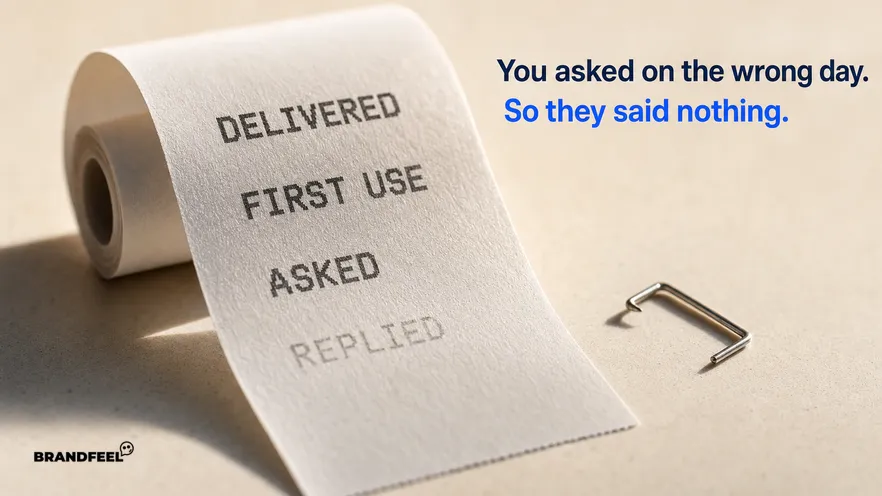
A review request sequence is a small set of timed contacts that replaces the single automated email most stores send after fulfilment. It works because it fixes the two things a single send gets wrong: it arrives when the customer has actually formed an opinion rather than when the parcel was delivered, and it asks one specific question instead of requesting a rating. Four touches is enough. An initial ask anchored to product experience, one reminder several days later, and a routing rule decided before any of it is collected, so that a positive review, a complaint and a product defect each have a destination and an owner.
- Time the first ask to when the customer formed an opinion, not to the delivery confirmation.
- Ask one specific question about their use; a star prompt returns a star and nothing else.
- Send exactly one reminder. The third ask is where unsubscribes overtake responses.
- Decide where each kind of reply goes before you collect any of them.
- Measure coverage across the variants you actually sell, not headline response rate.
Most stores ask for reviews exactly once, a fixed number of days after fulfilment, using the wording their review app shipped with. It produces reviews, which is why nobody examines it, and it under-performs for years in a way that is invisible without a comparison. A review request sequence is the comparison: the same audience, asked at a better moment, in better words, with somewhere for the answer to go. Last updated: September 2026.
Omniconvert has assessed how merchants collect and present customer feedback across the CROBenchmark dataset of 7,000+ websites in 15+ industries, against 248+ audit criteria, over 13 years in eCommerce. Stores with strong review coverage rarely have better review software than the ones without it. They have made four decisions the others left on default: when to ask, who to exclude, what to ask, and where the reply goes. This piece is about the first and third of those, which are the two that decide whether anybody replies at all.
If you have not yet decided the other two, build a Review-Generation system covers the standing programme this sequence sits inside, and get more product reviews covers the volume question more broadly. This one is narrower and more practical: the sequence itself.
What a review request sequence is
The distinction matters because the failure it fixes is invisible. A single-send review request has no control group. It produces a number of reviews every month, that number looks stable, and stability reads as health. Nothing in the reporting reveals that the same customers, asked eight days later with a different opening line, would have replied at twice the rate.
A sequence makes those choices explicit. It has a start condition you chose, a question you wrote, a reminder you decided to send, and an end. Each of those is a thing you can change and measure, which is the entire practical difference between a programme and a setting.
Why single-send review requests under-perform
Take the timing first, because it is the larger of the two and the easier to fix.
Default automation counts days from fulfilment, because fulfilment is the event the system knows about. The customer, though, is not on a fulfilment clock. They are on a usage clock, and the two only coincide by accident. A coffee grinder bought on Monday and delivered on Wednesday has been used twice by Friday and understood by the following week. A winter coat delivered in September will not be properly judged until the weather turns. Asking both customers on day seven asks one of them too early and the other far too early.
What arrives when you ask too early is a review of the delivery. This is why so much review text reads as thin: the customer had nothing else to report yet, so they reported the box. Nielsen's long-running work on consumer trust has consistently found that specific, experience-based reviews carry more weight with readers than general positive ones, which means a badly timed request does not just lower your response rate, it lowers the value of the responses you do get.
The second reason is the ask itself. A request for a star rating is answered with a star rating, because you asked a closed question and closed questions get closed answers. The customer is being cooperative, not lazy. Replace it with one open question about the specific situation the product was bought for and the same customer writes three sentences, because now there is something to say and a reason to say it.
The Four-Touch Sequence
- Anchor the first touch to experience, not to delivery. Pick the window by category: days for a consumable, a week or two for something used regularly, a month for a seasonal or durable good. If you sell across those categories, the anchor has to vary by product, and a single global delay is the setting doing the most damage in most stores.
- Ask one specific question. Not "how did we do" and not "rate your purchase". Ask about the use: what they made with it, where they wore it, whether it fitted the space. Specificity gives the customer a starting sentence, and the starting sentence is the whole obstacle.
- Send one reminder, several days later, repeating the question. Repeat the question, not the request. A reminder that says "you have not left a review" asks for compliance; one that re-asks what they thought asks for an opinion, and only the second is worth answering. Then stop. The third ask is where response rate flattens and unsubscribes climb, which trades a durable asset for a marginal review.
- Route the reply before you collect it. Decide now where a strong review goes, where a critical one goes, and where a reported defect goes, and give each an owner. A programme that only publishes reviews treats every complaint as an isolated ticket and learns nothing across a year of them.
Notice that only two of the four touches are asks. Teams under pressure to raise volume almost always add asks, because that is the visible lever. The touches that actually raise the yield are the timing decision in step one and the routing decision in step four, and neither is an email at all.
Timing: when each touch should land
Treat these as starting positions to test against your own return and repeat data, not as settings to install.
| Product type | When an opinion forms | Effect of a delivery-day ask |
|---|---|---|
| Consumables and replenishment | After the first few uses | Reviews describe packaging, not product |
| Apparel and footwear | After the first real wear | Fit feedback missing, the most useful kind |
| Home and kitchen durables | After repeated use over weeks | Early enthusiasm, no durability signal |
| Seasonal goods | When the season arrives | Request ignored entirely, no second chance |
| Electronics and tools | After setup and first task | Setup frustration reads as product fault |
| Gifts and giftable items | Often never, for the buyer | Wrong person asked, response rate collapses |
The last row is the one worth acting on immediately, because it costs nothing. A meaningful share of orders in most catalogues are gifts, and the person who bought them will never use the product. Excluding likely gift orders from the sequence raises the average quality of what comes back and removes a category of reviews that were only ever going to be about the wrapping.
What to do with what comes back
- Publish the strong ones where the shopper is deciding. On the variant page, not on a testimonials page nobody visits. Coverage on the variants you actually sell is the metric that moves conversion.
- Answer the critical ones in public, once. The reply is for the next reader rather than for the reviewer, so write it to be read by somebody comparing you against an alternative.
- Escalate repeated themes out of service and into product. Set a threshold in advance. Without one, a recurring fault stays a stream of individually handled tickets for as long as the team can absorb it.
- Feed the language back into your copy. The phrases customers use to describe why the product suited them are better product copy than anything written internally, and they are already written.
- Watch coverage, not average rating. An average of four and a half across a catalogue where a third of variants have no reviews at all is a coverage problem wearing a rating problem's clothes.
This is where Brandfeel, Omniconvert's sentiment-intelligence layer, aggregates reviews, NPS and support-ticket themes so that a recurring complaint surfaces as a theme with a size rather than as a run of separate tickets. Teams that want the resulting fixes prioritised by profit rather than by volume of mentions can see how Nexus by Omniconvert unifies commerce data and ranks the next action by True Profit, with a person approving what goes live. If you want to know how your review coverage compares with the brands you are shopped against, where you stand on reviews is the piece to read next.
Bain and Company's retention research has put the economics of this beyond argument for years: small improvements in retention move profit disproportionately, and reviews are one of the cheapest inputs to retention a store has, because they are produced by customers who already bought.
Timing decides more of the response rate than wording does, which is the argument in the best time to ask for a review.
FAQ: review request sequences
How many review requests should I send?
Two asks and two supporting touches. One initial request timed to product experience, one reminder several days later, and the remaining two touches are the confirmation and the routing that happen around them. A third ask is where response rate stops rising and unsubscribes start, which makes it the most expensive email in the sequence.
When is the best time to ask for a review?
When the customer has formed an opinion, which is a property of the product rather than of your logistics. For a consumable that is usually one to two weeks after delivery; for a durable good it is three to four. Asking on delivery day measures your courier and produces reviews about packaging, which is the most common reason review text reads as shallow.
Should the request ask for a rating or a comment?
Ask one specific question about the use they had, and let the rating follow from it. A star prompt gets a star and nothing else, because you asked for a number and numbers are quick. A question about the specific situation the product was bought for gets sentences, and sentences are the part with resale value.
Does personalising the request actually raise responses?
Naming the product does, reliably. Naming the person does very little on its own and is often the only personalisation a store bothers with. A request that references what was bought and what it is typically used for reads as though a human sent it, and that is the perception doing the work rather than the merge field.
What response rate should I expect from a review sequence?
Single digits is ordinary for a cold single send and the low tens of percent is strong for a well-timed sequence, but the rate is the wrong target. Coverage is the right one: enough recent reviews on the variants you actually sell that no shopper lands on a product with nothing to read. A high rate on a narrow catalogue slice fixes nothing.
The bottom line
The reason review requests under-perform is almost never the copy, which is where teams look first because it is the part that is easy to change. It is that the email arrives on a schedule the customer is not on, and asks a closed question that can be answered without thinking. Move the ask to the moment the product has actually been experienced, replace the rating prompt with one specific question about the use, send a single reminder that repeats the question rather than the request, and decide where each kind of answer goes before any of it arrives. That is four decisions, none of them technical, and together they are the difference between a review widget that fills up slowly and a standing source of the cheapest customer research your business can get.