
How to Run a UGC Contest That Actually Works
How to run a UGC contest that produces usable creative instead of noise: the Entry Cost Test, prize design, disclosure rules, and what to measure.
Last updated: October 2026 · By The Brandfeel Team
A UGC contest is defined as a time-boxed campaign that asks customers to submit photos, videos or written content featuring a product, in exchange for a prize, with entry conditional on granting the brand a licence to reuse the submission. Shoppers value that content: 70% say they trust opinions that other consumers post online [Nielsen, 2012]. A UGC contest works when the prize is worth more to the entrant than the effort of entering, the brief is specific and the rights grant is plain. You will learn how to design the brief, the prize and the rights, and how to measure usable assets.
- Run a contest for reusable assets, not a giveaway for follows, because only one of those is worth the budget.
- Run the Entry Cost Test before launch, because if entering takes more effort than the prize is worth, only superfans enter.
- Offer several mid-sized product prizes rather than one grand prize, because perceived odds drive entries more than prize size.
- Put rights language at the point of entry, because it separates a creative library from a folder you cannot use.
- Measure usable assets per pound of total cost, including staff hours, not entries or impressions.
A UGC contest is a time-boxed campaign that asks customers to submit photos or videos of a product in exchange for a prize, and the point of running one is not engagement. It is to build a library of customer-made creative you are legally clear to put in ads. Most contests fail at that job while looking successful on the surface: entries arrive, comments accumulate, and then the creative team discovers that almost nothing is usable. Omniconvert has measured how stores collect and display customer feedback across the CROBenchmark dataset of 7,000+ websites in 15+ industries, against 248+ audit criteria, over 13 years in eCommerce [CROBenchmark Report 2026, Omniconvert].
The Entry Cost Test
The Entry Cost Test is defined as a check, run before launch, of whether the prize is worth more to an entrant than the effort of entering. Every entrant runs a rough calculation, usually in under a second. On one side is the effort: taking a photo, writing a caption, finding the hashtag, posting it. On the other is the prize value discounted by the chance of winning. If the second number is visibly smaller than the first, they scroll past.
Three levers move the balance, and they are not equally priced:
- Lower the effort. Accept a photo the customer already has. Allow entry by reply rather than by a new post. Drop the caption requirement. Every removed step raises volume, though removing too many also removes the specificity that made the asset usable, so stop before the brief stops being a brief.
- Raise the prize value. The obvious lever and the expensive one. It also has a ceiling: past a certain point a bigger prize attracts entrants who want the prize rather than the product, and their content shows it.
- Raise the perceived odds. The cheapest lever by a wide margin. Twenty prizes of £50 cost the same as one of £1,000 and will out-pull it substantially, because every entrant can imagine winning one of twenty. State the number of winners prominently.
Designing a UGC contest brief that produces usable assets
Write the brief as a shot list, not as a theme. The difference is concrete. A theme sounds like "share your summer moments". A shot list sounds like "one vertical photo, outdoors in daylight, product in your hand and in focus".
Four elements are worth specifying every time. Format, because vertical and horizontal are not interchangeable in paid social and the aspect ratio you need is the one you should ask for. Lighting, because daylight solves most quality problems at once. Framing, because the product has to be identifiable at thumbnail size. And the exclusion, which is whatever ruins an asset in your category: other brands in shot, heavy filters, text overlays, a cluttered background.
Prize design, rights and disclosure
The rights grant is the step teams most often get wrong, and it is the one that decides whether you own a creative library or a folder of images you cannot run. Entry should be explicitly conditional on granting the brand a licence to reuse the submission in marketing, and that sentence should be readable at the point of entry rather than buried in a terms page. An entrant who understands the deal rarely objects. An entrant who finds out later reasonably does.
Disclosure is the separate obligation. A prize creates a material connection between the entrant and the brand, so content from a winner that you reshare needs to make that connection clear. The FTC's endorsement guides set out what counts as adequate disclosure and where it has to sit. Platform promotion rules are a third layer again, and Meta's own promotion policies for contests run on its surfaces override whatever your terms say.
What to measure, and what to ignore
| Metric | What it really tells you | Use it for |
|---|---|---|
| Total entries | Whether the Entry Cost Test passed. Nothing about quality. | Diagnosing a failed contest, not judging a successful one |
| Usable assets | Submissions clearing the creative bar and carrying a rights grant | The headline outcome. Everything else is secondary. |
| Cost per usable asset | Total cost, prizes plus hours plus promotion, divided by usable assets | Comparing the contest against agency or studio production |
| Rights-grant rate | Share of entries that completed the licence step | Catching a broken entry flow before the contest closes |
| Winning-asset performance | How contest creative performs once it is in paid rotation | Deciding whether to run the contest again |
| Hashtag uses and impressions | Reach of the promotion, not the value of the output | Little. Report it if asked; do not optimise against it. |
What a marketing manager should do this week
- Write the brief as a shot list: format, lighting, framing, exclusion. One sentence, readable on a phone.
- Replace one grand prize with ten to twenty mid-sized product prizes at the same total cost, and state the number of winners.
- Move the rights grant into the entry step, in plain language, and test the flow yourself end to end.
- Pull your last contest's submissions and count how many you could run today. That ratio is your baseline.
- Set the success metric as cost per usable asset before launch, and get the number agreed with whoever signs off the budget.
- Plan the disclosure language for reshared winner content now, not after a winner is announced.
The follow-on work is turning that library into tested creative rather than a folder. Omniconvert Commander (formerly Nexus), the AI for eCommerce growth engine, generates campaigns and creative you approve before they go live, and contest assets enter its queue as ranked creative hypotheses. The groundwork sits further upstream: if your review volume is thin, the guide to build a Review-Generation system is the better first project, and Omniconvert's customer value optimization methodology covers the loop the contest feeds.
Related reading: get customer UGC without a big budget.
A contest produces a burst, which is useful and finite. Where the need is steady supply rather than a spike, the quieter method is to source UGC for ads from existing customers, asking identified buyers directly instead of inviting everybody.
Frequently asked questions
What is a UGC contest?
A UGC contest is a time-boxed campaign that asks customers to submit photos, videos or written content featuring a product, in exchange for a prize or recognition. The output is a library of customer-made creative the brand has permission to reuse in ads, on product pages and in email. It differs from a giveaway in one important way: a giveaway asks for a follow or a tag and produces nothing reusable, while a contest asks for content and produces an asset.
What makes a UGC contest fail?
Three causes account for most failures. The entry cost is too high relative to the prize, so only superfans enter and volume collapses. The brief is vague, so submissions arrive in formats nobody can use in an ad. Or the rights language is missing, so the brand ends up with hundreds of images it is not legally clear to run. The first two are design problems you can fix before launch; the third is the one that quietly wastes the entire budget.
What prize should a UGC contest offer?
Offer product rather than cash, and offer several mid-sized prizes rather than one large one. Product keeps the entrant pool made of people who actually want what you sell, which is what makes the resulting content usable. Several prizes raise the perceived odds of winning, which lifts entry volume far more reliably than a bigger headline prize. A single grand prize reads as a lottery, and lottery entrants produce throwaway submissions.
Do you need permission to use contest entries in ads?
Yes, and the contest terms are where you get it. Entry should be conditional on granting the brand a licence to reuse the submission in marketing, stated in plain language the entrant actually reads rather than buried in legal copy. Separately, any entrant who receives a prize has a material connection to the brand, so if their content is reshared on social it needs a disclosure. Check the platform rules too: most have their own promotion policies that override your terms.
How do you measure whether a UGC contest worked?
Measure usable assets per unit of spend, not entries. An entry that cannot run in an ad has no value, so divide the total contest cost, prizes plus staff hours plus promotion, by the number of submissions that clear your creative bar and carry a rights grant. Track that cost against what the same creative would cost from a production agency. Follow it with the downstream metric that matters: the performance of the winning assets once they are in rotation.
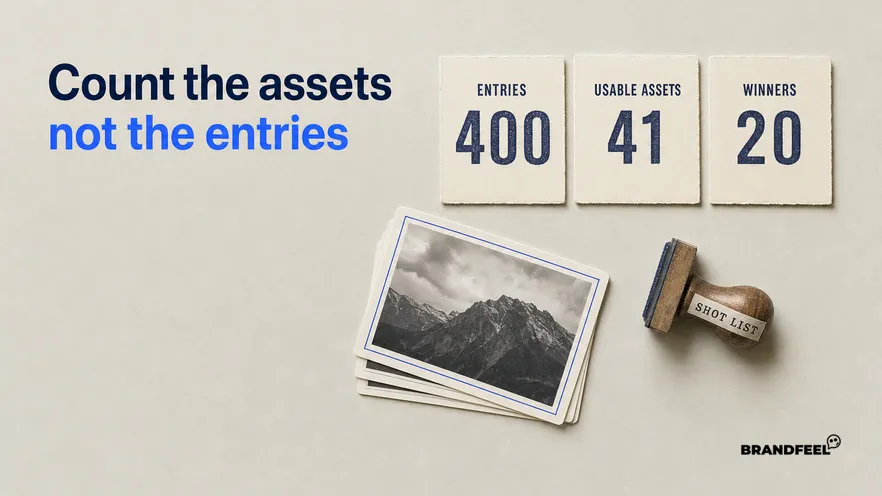
Teams running a contest usually count entries and tag the winners, then find in the creative review that most submissions are dark, cropped or unlicensed. The brief asked for enthusiasm rather than a shot, and the rights grant sat on a page nobody read. The library the contest was meant to build becomes a folder the team cannot clear for ads.
AliveCor used Omniconvert to run a structured A/B testing programme and achieved +21% conversion rate, +5% revenue per visitor, and 94% statistical relevance across their experiments. [Omniconvert, AliveCor case study] Run the contest assets the same way: put them in a controlled test against your current creative before you scale the spend.
Judge the contest by usable assets, not entries
A UGC contest is a creative production method, not an engagement campaign, and it should be judged on cost per usable asset rather than on entries. Run the Entry Cost Test before launch and fix the imbalance by raising perceived odds, which is the cheapest of the three levers. Write the brief as a four-element shot list so submissions arrive in a format the ad team can run. Put the rights grant in plain language at the point of entry, plan the disclosure for reshared winner content, and check the platform promotion rules before you publish the terms. Then measure what you got, in assets, and let that number decide whether there is a second round.