
How to Respond to Positive Reviews (and Why You Should)
How to respond to positive reviews without sounding automated, why replies to praise drive repeat revenue, and the Reply Ladder that scales it.
Last updated: October 2026 · By The Brandfeel Team
A positive review response is defined as a short public reply a brand posts beneath a favourable customer review, written to thank the reviewer, name the specific thing they praised, and add one useful detail. Shoppers read those replies: 70% say they trust opinions that other consumers post online [Nielsen, 2012], and a specific reply inherits some of that credibility. To respond to positive reviews well, keep it to two to four sentences and repeat what the customer actually said. You will learn what a good reply contains and how to scale it without going generic.
- Write replies to praise for the person deciding, because future shoppers read them more than the reviewer does.
- Repeat what the customer actually said, because specificity outperforms any template.
- Keep replies to two to four sentences, because longer ones push the next review off the mobile screen.
- Never attach a discount code to a thank you, because it converts praise into a transaction and breaches most platform policies.
- Reply to every detailed review before any short one, because coverage without quality teaches readers to skip the replies.
To respond to positive reviews means writing a short public reply beneath a favourable customer review, and it is the cheapest retention work most stores never schedule. Negative reviews get a process, an owner, and an escalation path. Praise gets a heart icon. That asymmetry is backwards: a reply is the only moment a brand gets to speak to a happy customer while they are still paying attention. Omniconvert has measured how stores collect and display customer feedback across the CROBenchmark dataset of 7,000+ websites in 15+ industries, against 248+ audit criteria, over 13 years in eCommerce [CROBenchmark Report 2026, Omniconvert]. This guide covers why replies to praise pay, what a good one contains, the Reply Ladder for scaling it, and where the practice goes wrong.
Why you should respond to positive reviews
What those shoppers are looking for is evidence of a business behind the storefront. Nielsen's long-running work on advertising trust has consistently found that recommendations from other people outrank every brand-controlled channel, and a review thread where the brand responds specifically inherits some of that credibility. The reply does not have to persuade. It has to demonstrate that a person read the review and knew what it said.
The retention case is the second one, and it is well documented. Bain & Company's work with Fred Reichheld established that a five percent lift in customer retention can raise profits by 25 to 95 percent [Harvard Business Review, 2014], and Marketing Metrics puts the probability of selling to an existing customer at roughly 60 to 70 percent against 5 to 20 percent for a new prospect. A customer who took the time to write a detailed review has already declared themselves. A reply is the lowest-cost touch available to keep that relationship warm.
What a good reply actually contains
Open with the reviewer's first name. Repeat their specific praise using different words, which proves the review was read rather than counted. Add one useful fact. Close without asking for anything.
The repetition step is the one teams skip, and it is the one that does the work. If a customer writes that the colour matched the photo exactly, a reply that says "so glad you loved it" could sit under any review on the site. A reply that says "the colour accuracy is the thing we fight hardest for, so that one lands well" could only sit under that review. A shopper scrolling five replies can tell the difference instantly, and so can the reviewer.
The Reply Ladder: how to scale without going generic
The Reply Ladder is defined as a set of reply tiers, cleared in order, that lets a team keep replies specific as volume grows. Volume is the reason reply quality decays. A store taking forty reviews a month can write forty good replies. A store taking four hundred cannot, and the usual response is to paste the same three sentences everywhere, which is worse than silence because it is visibly worse. The Reply Ladder solves this by refusing to treat all praise as equal.
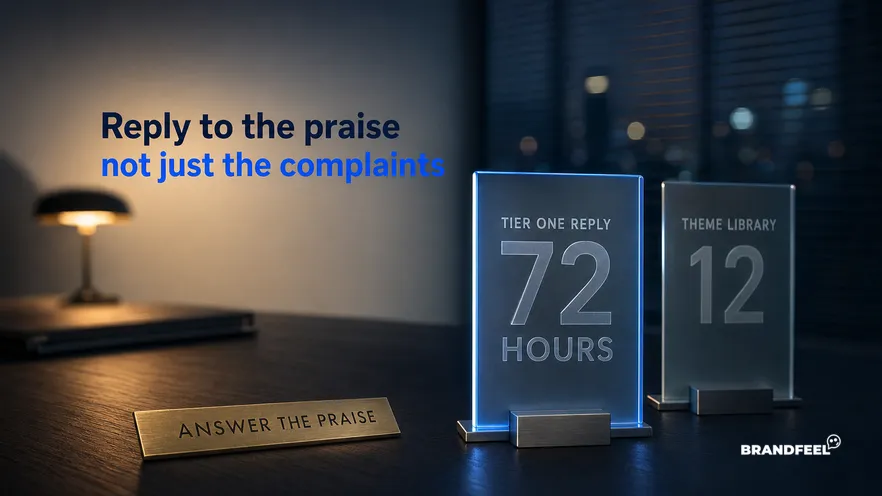
- Tier one, detailed reviews. Any review with two or more sentences, a named product attribute, or a story. These get an individually written reply within 72 hours. They are the minority of reviews and the majority of the value.
- Tier two, short product-specific reviews. One line that names a product or an attribute. These get a themed reply drafted from a library of openings, with the specific attribute swapped in. A library of twelve themes covers most categories without repetition on a single page.
- Tier three, bare ratings and one-word reviews. Five stars and nothing else, or "great". Leave these alone. There is nothing specific to answer, and a thank you here is the generic reply that devalues the others.
The cost of replying badly, by reply type
| Reply pattern | What it costs | What to do instead |
|---|---|---|
| Identical sentence on multiple reviews | Visible to any shopper who scrolls; devalues every other reply on the page | Keep a themed library and swap the specific attribute in each time |
| Discount code attached to a thank you | Breaches most platform review policies and trains customers to expect payment | Thank the reviewer; send any offer through email, separately and later |
| Immediate upsell in the same reply | Reads as the brand monetising a compliment; suppresses future reviews | Add one useful fact instead and let the product recommendation wait |
| Reply posted weeks after the review | Arrives after the customer has disengaged; retention value largely gone | Set a 72-hour service level for tier one and measure against it |
| Reply that misreads a mixed review as pure praise | The most damaging pattern: proves nobody read it, in public | Route four-star and mixed reviews to a human queue, never to templates |
What a marketing manager should do this week
- Export the last ninety days of reviews and filter to those with two or more sentences. That is your tier one backlog.
- Reply to the twenty most recent, individually. Note which product attributes keep recurring while you write.
- Turn those recurring attributes into a themed opening library. Twelve entries is enough to start.
- Set a 72-hour service level for tier one replies and put one named person on it.
- Check your top three third-party profiles. Google's own guidance on reading and replying to reviews sets out the mechanics for Business Profile, and the same review is often sitting unanswered on two other platforms.
- Feed the recurring praise themes to whoever writes your ads. They are pre-validated angles.
This is the point where tooling earns its place. Brandfeel by Omniconvert aggregates reviews, NPS responses and support-ticket themes, classifies incoming praise by the attribute it names, and drafts a reply against that theme so the human work is approval rather than composition. Brandfeel is a module inside Omniconvert Commander (formerly Nexus), the AI for eCommerce growth engine that unifies commerce data, prioritises experiments by True Profit, and generates campaigns and creative you approve before they go live. The same praise themes that drive the replies become ranked creative hypotheses in Omniconvert Commander, where you approve what goes live.
For the critical side of the queue, see how to respond to negative reviews.
Related reading: turn an angry reviewer into a repeat customer.
Frequently asked questions
Should you respond to every positive review?
No, and trying to is how reply quality collapses. Respond to every review that contains a specific detail, names a product, or comes from a repeat customer, because those are the ones where a reply can deepen a relationship that already exists. For a store taking hundreds of five-star ratings a month, a representative sample beats blanket coverage: reply to all detailed reviews and a rotating share of the short ones. A thin reply on every review teaches readers that the replies mean nothing.
How long should a reply to a positive review be?
Two to four sentences. Long enough to thank the customer by name, repeat the specific thing they praised, and add one piece of information they did not have, and short enough that the next shopper reads it all. Replies that run past four sentences start reading as marketing copy rather than a person answering, and they push the next review further down the page on mobile, which costs you the social proof the reply was meant to amplify.
Does replying to reviews help SEO?
Indirectly, and the effect is strongest on third-party profiles rather than your own product pages. Google Business Profile documentation states that responding to reviews is a signal of an active, maintained listing, and replies add unique text to a page you do not otherwise control. On your own store, review replies add keyword-relevant copy beneath product descriptions. Treat the ranking effect as a secondary benefit and the conversion effect as the primary one.
What should you never say in a reply to a positive review?
Avoid three things: a discount code, an identical sentence you have used elsewhere on the same page, and a request for the customer to buy again in the same breath as the thank you. A code turns praise into a transaction and trains customers to expect payment for reviews, which breaches most platform policies. A repeated sentence is visible to any shopper who scrolls. An immediate upsell reads as the brand monetising a compliment.
Can you automate replies to positive reviews?
You can automate the routing and the drafting, but not the sending. A sentiment layer can classify incoming reviews, group them by the theme the customer praised, and draft a reply against that theme, which removes most of the work. A human still approves each one before it posts, because the failure mode of automated replies is a generic thank you attached to a review that mentions a problem in passing, and that single mismatch undoes the trust the whole programme was built for.
Teams that start replying to praise usually draft one friendly template and paste it under every five-star review. Within weeks the page shows twenty identical thank-yous, and readers learn that nobody reads the reviews. The replies cost time and tell future shoppers the opposite of what was intended.
Northwestern University's Spiegel Research Center found that purchase likelihood typically peaks at ratings in the 4.0 to 4.7 range and begins to fall as ratings approach 5.0, and it advises retailers to embrace negative reviews because they establish credibility and authenticity. [Spiegel Research Center, 2017]
Make each reply specific, short and about the customer
Replying to praise is the most under-scheduled retention work in ecommerce, and it pays on two fronts at once: the reviewer is among your likeliest repeat buyers, and every shopper who scrolls the review section reads the reply as evidence of a business that is paying attention. Keep each one to two to four sentences, repeat the specific thing the customer praised, add one useful fact, and ask for nothing. Use the Reply Ladder to protect that quality as volume grows, clear tier one before touching tier two, and never attach a discount code to a thank you. Then send the recurring praise themes to whoever writes the ads, because customers have already told you which angle works.