
How to Protect Your Brand From Review Bombing
Review bombing is survived by what you built before it started. The baseline that detects it, the first 24 hours, and the dilution that makes it fail.
Last updated: October 2026 · By The Brandfeel Team
Review bombing is defined as a coordinated cluster of negative reviews arriving in a short window, typically from accounts with no matching transaction. A product with five reviews is 270% more likely to sell than one with none [Spiegel Research Center, 2017], so a burst hurts most on thin listings. To protect your brand from review bombing, record a baseline before it happens, capture evidence and report the cluster as one pattern during it, and keep collecting genuine reviews after it. You will learn what to do before, during and after an attack.
- Record your normal reviews per week and rating spread now, because you cannot detect a surge without a baseline.
- Report the cluster as one coordinated pattern, because platforms act on patterns and dismiss individual complaints about unfair reviews.
- Capture evidence in the first hours, because reviews get edited and deleted and the timestamps are the strongest part of your case.
- Reply once, publicly and factually, because twenty identical replies damage the page more than the attack did.
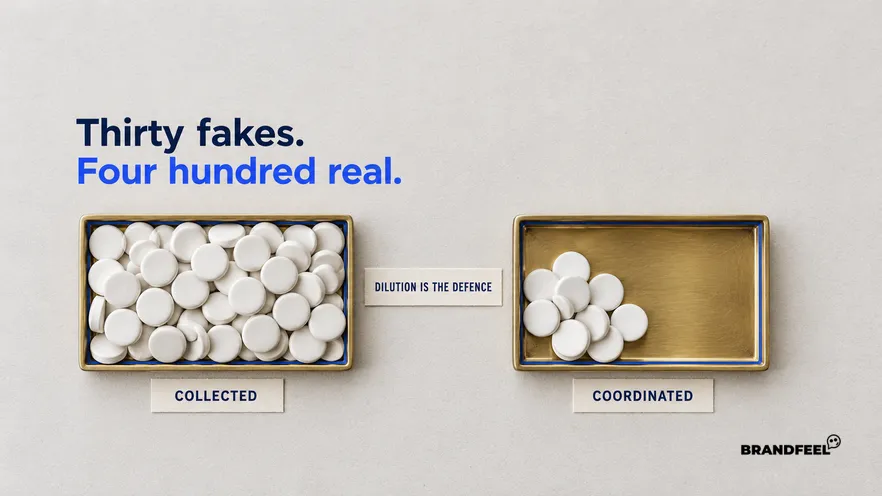
- Build genuine review volume as the real defence, because it decides whether thirty fake ones are a rounding error or the whole listing.
Review bombing is a coordinated burst of negative reviews, posted fast, usually by people who never bought anything. Protecting a brand from it is mostly work you do before it happens. Omniconvert has measured how stores collect and display customer feedback across the CROBenchmark dataset of 7,000+ websites in 15+ industries, against 248+ audit criteria, over 13 years in eCommerce [CROBenchmark Report 2026, Omniconvert]. What matters here is proportion: the same attack is a nuisance on a listing with hundreds of genuine reviews and an existential problem on a listing with forty.
What review bombing is, and what it is not
Start with the distinction, because the response diverges completely. An attack is a policy matter: the reviews breach the platform's rules because there was no transaction, or because the activity is coordinated, and your route is evidence and escalation. A genuine wave of criticism after a shipping failure or a product defect is a service matter, and reporting it as fraud is both futile and damaging to your standing with the moderation team. Shoppers weigh peer reviews heavily: 70% say they trust opinions that other consumers post online [Nielsen, 2012], which is why an attack feels so threatening.
Three markers usually separate them. Timing: an attack compresses into hours or a day, genuine feedback spreads across the period in which people actually received orders. Specificity: real complaints name an order, a variant, a date, a courier. Attacks tend to name a controversy. And transaction: real complaints almost always have a matching record somewhere in your system, and attacks almost never do.
Before: the baseline is the whole defence
A review baseline is defined as your normal review rate and rating spread on each surface where you are reviewed. Write down four figures per surface where you are reviewed: average reviews per week, average rating, the share of one-star reviews in a normal month, and the longest gap you normally see between reviews. Those four give you a tripwire. A day that triples the weekly rate, or a week where one-star share doubles, is worth a look even if nothing else is wrong.
During: the first 24 hours, in order
- Capture everything, immediately. Screenshot the cluster showing timestamps, export reviewer display names and any visible detail, and note the exact window. Do this before you tell anybody, because the next hour is when content starts changing.
- Run every name against your order records. Search the display name, any email, the delivery area and the product named. Record each search that returns nothing. An empty order search with a timestamp is the single most persuasive artefact in a platform submission.
- Separate the genuine from the coordinated. Some of the cluster will be real customers. Pull those out and handle them as service recovery, because including them in a fraud report undermines the whole submission.
- Report once, as one coordinated pattern. One submission describing the window, the volume against your normal rate, the repeated phrasing and the absent transactions. Cite the specific policy clause on coordinated or non-transactional reviews. Do not file twenty individual flags.
- Publish one calm response. On the listing if replies are allowed, and on your own channel if the situation is public. State the facts, acknowledge anything genuine, and stop. One good reply is read by everyone who matters.
Two things not to do, both tempting. Do not ask customers or staff to post positive reviews in response, because an incoming cluster of positives with no purchase behind it is the same policy breach from the other direction and can cost you reviews you legitimately earned. And do not argue in individual replies, because every reply raises the thread and keeps the page active.
After: recency does the clean-up
The week after an attack is when most teams stop paying attention, and it is the week where the most can still be changed. Reviews that are not visible on the first page have a fraction of the effect of reviews that are, and on most surfaces the first page is ordered by date. A deliberate push on genuine collection for two or three weeks does more for the listing than a second escalation attempt. Bain and Company retention research puts a 5% retention lift at 25 to 95 percent more profit [Harvard Business Review, 2014], so keeping your existing customers' trust is worth the follow-through.
| Phase | The action that matters | The common mistake | Who owns it |
|---|---|---|---|
| Before: baseline | Record normal rate and rating spread per surface | Assuming you would notice a surge | Whoever owns reporting |
| Before: dilution | Collect genuine reviews continuously | Running review drives in bursts | Customer operations |
| Hour one: capture | Screenshots with timestamps, names exported | Waiting until the case is built | Whoever saw it first |
| Day one: verify | Order search per reviewer, nulls recorded | Reporting without checking | Customer service |
| Day one: report | One pattern submission citing a policy clause | Twenty individual unfairness flags | One named person |
| Day one: respond | A single calm factual public reply | Replying to every review | Communications |
| Weeks after | Raise genuine collection rate | Going quiet once the report is filed | Customer operations |
What a brand lead should do this week
- Measure the four baseline figures for every surface you are reviewed on. Put them somewhere a non-specialist can read them.
- Write the plan on one page. Who captures, who searches orders, who submits, who replies, and in what order. One page, one named coordinator.
- Check whether review collection is continuous. If your reviews arrive in campaign-shaped spikes, your dilution defence has gaps in it, and an attack landing in a gap does maximum damage. The system for fixing that is in how to build a review-generation system.
- Know the identification signals. The six markers that distinguish a fraudulent entry, and the rule that two must agree before you act, are in how to spot fake reviews.
- Know the submission routes before you need them. Each platform's grounds and escalation path differ, and the walkthrough is in how to report fake reviews on major platforms.
At any volume this becomes a monitoring problem rather than an incident-response problem. Brandfeel by Omniconvert, the sentiment-intelligence layer, aggregates reviews, NPS responses and support-ticket themes across surfaces and flags an abnormal cluster against the store's own baseline, which is exactly the detection step that makes a same-day pattern report possible. Brandfeel is a module inside Omniconvert Commander (formerly Nexus), the AI for eCommerce growth engine that unifies commerce data and queues the next actions for you to approve before they go live. The strategic frame sits in Omniconvert's work on customer value optimization, which treats review health as a retention input rather than a reputation chore.
Frequently asked questions
What is review bombing?
Review bombing is a coordinated burst of negative reviews posted in a short window, usually by people who never bought the product, and usually triggered by something said or done rather than by the product itself. The defining feature is the pattern rather than the sentiment: a cluster of similar reviews arriving far faster than your normal rate, often repeating the same phrase or grievance, and rarely containing any verifiable purchase detail.
How do you detect review bombing early?
By knowing your normal rate, which almost nobody does until they need it. Record your typical reviews per week per surface and your typical rating distribution, then set an alert on a multiple of it rather than on a count. A store that normally receives four reviews a week should hear about twelve in a day. A store that receives two hundred a week will not notice the same twelve, which is why the threshold has to be relative to your own baseline.
What should you do in the first 24 hours of a review attack?
Capture the evidence before anything is edited or deleted, which is the step people skip and cannot recover. Screenshot the cluster with timestamps, export the reviewer names, and run each against your order records. Then report it as one coordinated pattern rather than as individual flags, and publish one calm factual response. Do not reply to each review separately, because a wall of identical replies reads as automation and makes the page look worse than the attack did.
Can you get a review bomb removed entirely?
Sometimes, and it is worth attempting once, properly. Platforms respond to coordinated patterns better than to individual complaints because the pattern is what breaches their policy, so a single submission showing the cluster, the timing and the absent transactions has a far better chance than twenty separate reports. Expect partial removal rather than total, and plan your response around what survives rather than around what you hope will disappear.
What actually protects a brand long term?
Volume and recency of genuine reviews. Thirty fake reviews on a listing holding four hundred real ones moves the average by a fraction and disappears from the first page within weeks. The same thirty on a listing holding forty real ones defines the product for a year. Nothing you do during an attack matters as much as how many genuine reviews you had collected before it, which makes the review programme the actual defence rather than the response plan.
Teams caught by a bombing usually have no baseline, so they spend the first day arguing about whether it is an attack at all. By the time someone opens a ticket, the reviews have been edited and the timestamps that prove the pattern are gone. The platform then sees a handful of complaints about unfair reviews, not one coordinated cluster.
In March 2019 Valve announced that Steam would remove what it called off-topic review bombs from a game's overall review score for the flagged period, while leaving the individual reviews visible and letting users opt out of the exclusion. [GamingOnLinux, 2019]
Build the baseline before the attack arrives
Review bombing is survived by preparation rather than by response. Measure your normal review rate and rating spread so a surge is visible, keep genuine collection continuous so any burst is diluted, and write a one-page plan naming who captures evidence, who checks orders, who submits the pattern report and who replies. During an attack the order is fixed: capture with timestamps before anything changes, separate the genuine complaints out, report the cluster once as a coordinated pattern citing a policy clause, and respond once in public. Then resume collecting, because recency is what moves the cluster off the page people actually read.