
How to Spot Fake Reviews (and Protect Your Store)
Six signals that identify fake reviews, ranked by how reliable each is alone, plus what to do about the two kinds that damage a store differently.
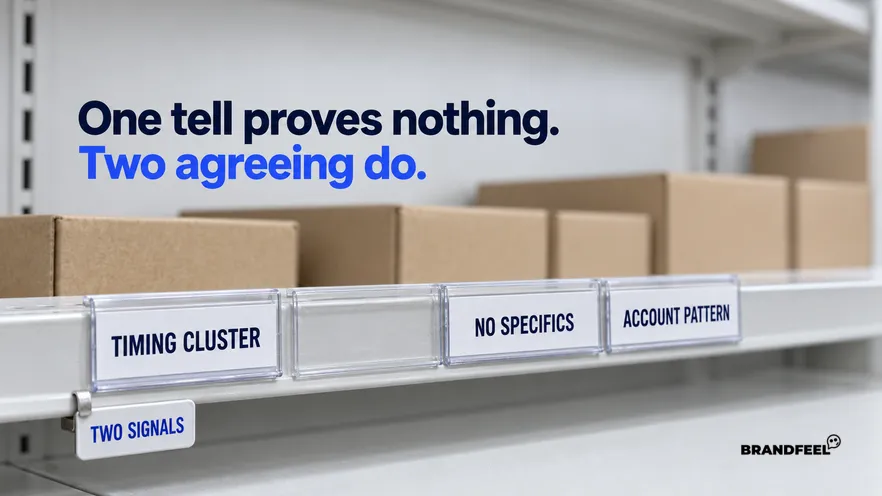
Review fraud is defined as a review written by somebody with no genuine purchase experience of the product, whether paid to praise it, paid to attack it or generated in volume to move an average. Shoppers rely on reviews: 70% say they trust opinions that other consumers post online [Nielsen, 2012]. To spot fake reviews, look for two or more signals that agree rather than one, because any single signal has an innocent explanation. You will learn the six signals and what protects a store beyond the individual dispute.
- Require two independent signals before you act on a review, because no single signal proves fraud.
- Check the timing cluster first, because it is the most reliable signal and coordinated reviews arrive in batches.
- Look for a detail only a user would know, because genuine reviews name one and fakes describe the listing instead.
- Separate inbound attacks, which hurt your conversion, from inflated competitor ratings, which distort your benchmark.
- Collect honest reviews at volume, the only durable defence, because six fakes cannot move four hundred reviews.
Last updated: October 2026 · By The Brandfeel Team
Fake reviews are usually discussed as a moral problem and experienced as an arithmetic one. A store with a modest review count has a rating that six coordinated entries can visibly move, and that movement reaches shoppers before any dispute is resolved. The question worth answering is therefore narrow and practical: how do you identify a fraudulent review with enough confidence to act, and what action actually helps?
Start from the recognition that detection is probabilistic. Omniconvert has spent 13 years measuring eCommerce behaviour, across the CROBenchmark dataset of 7,000+ websites and 70,000+ experiments [CROBenchmark Report 2026, Omniconvert]. The lesson that transfers directly here is that single signals mislead while combinations hold up. Brandfeel by Omniconvert, the sentiment-intelligence layer, aggregates reviews, NPS responses and support-ticket themes, which is the view that makes a timing anomaly visible in the first place. This guide covers the two kinds of fake review, the six signals that identify one, how reliable each signal is alone, and what protects a store beyond the individual dispute.
The two kinds of fake reviews, and why the difference decides your response
An inbound attack is the version everybody pictures: a cluster of one-star reviews with no matching orders, sometimes after a pricing change or a dispute, sometimes for no discoverable reason. It hits conversion immediately, because a shopper reading the listing today sees it. This is worth contesting individually, because each removed entry restores a measurable amount of the damage.
Inherited fraud is the quieter and more common problem. A competitor's listing carries inflated positive reviews, their rating sits half a star above yours, and you spend a quarter trying to close a gap that was never real. Nothing about your own listing is wrong. You are measuring against a corrupted benchmark, and no amount of improvement on your side closes a gap that exists in their review file rather than in their product.
The Six Signals that identify a fake review
The Six Signals is defined as a checklist of six review features that, in combination, identify a likely fake. Work through these in order. The first is the strongest and the cheapest to check.
Signal one: the timing cluster. Genuine reviews arrive at a rate governed by purchase volume and how long your product takes to form an opinion about. That rate is steady and slow. Fraud arrives in batches because it is produced in batches. Plot review arrivals by hour for the last few months and a coordinated group is visible without any analysis: six reviews inside four hours against a baseline of three a week is not a coincidence that needs modelling.
Signal two: no product specifics. A real customer names something only a user would know. The strap digs in after an hour. It smells faintly of almond. The lid is awkward with wet hands. Fraudulent text describes what the listing already said, in the listing's own vocabulary, because the writer never had the object. This is the signal that catches fraud a timing check misses, since a careful operation spaces its submissions.
Signal three: reviewer history. Look at the account. Ordinary shoppers produce a mixed record: a few reviews, mostly moderate, within a coherent range of categories. A history of nothing but five-star or nothing but one-star ratings, across unrelated products, compressed into a short window, is a pattern normal behaviour does not generate.
Signal four: listing-derived language. Related to signal two but distinct and worth checking separately. Fraudulent reviews frequently reuse the exact phrasing of the product title or bullet points, because that is the only information the writer had. A review that calls your product by its full listing name, including the variant string, was written by somebody reading a page rather than using a product.
Signal five: a rating distribution with no middle. Healthy listings produce a distribution with a visible middle: some threes and fours from people who liked it with reservations. A listing with only fives and ones, and nothing between, suggests two populations rather than one, and one of them is probably not made of customers.
Signal six: velocity change with no cause. Review volume that doubles in a week with no campaign, no press, no promotion and no sales increase is an unexplained input. The check is to line review velocity up against order velocity. Genuine review growth tracks orders with a lag. Fraud does not track anything.
The threshold rule matters more than any individual signal. A real customer can write a short, generic, five-star review the day the product arrives, from an account with two other five-star reviews. That is three weak signals and an entirely innocent explanation. Require two strong, independent signals before you act, and accept that you will leave some fraud in place rather than remove honest reviews.
How reliable each signal is on its own
| Signal | Reliability alone | The innocent explanation to rule out |
|---|---|---|
| Timing cluster | High | A campaign, a press mention or a review request batch you sent |
| Reviewer history of extremes | Medium to high | A new account, or a shopper who only reviews when strongly moved |
| Listing-derived language | Medium | A customer quoting the page to say the claim was accurate |
| No product specifics | Medium | A brief reviewer, or a product with little to describe |
| Velocity change with no cause | Medium | Seasonality, a delayed delivery wave, or a platform prompt change |
| Distribution with no middle | Low alone | A genuinely polarising product, which is common in fit and taste categories |
How to spot fake reviews and protect your store
In order of how much good each action does:
- Raise genuine review volume. Forty reviews can be moved by six fakes and four hundred cannot, so this is the structural fix. If you have no standing process, build a Review-Generation system before you spend another hour on disputes.
- Export your review data monthly and plot arrivals by hour against order volume. Ten minutes a month, and it is the only way the timing signal is ever visible early.
- Where two signals agree, report the entry through the platform with the evidence stated plainly: no matching order, the arrival cluster, the account pattern. The practical mechanics differ by platform, and the steps to report fake reviews on major platforms are worth following exactly, because a vague report is usually declined.
- Reply publicly, once, factually. State what your records show and stop. Do not accuse.
- Stop using competitor ratings as a target. Track your own rating trend instead, which cannot be manipulated from outside.
- Check your incentive practices against current rules before asking for anything, using the published guidance in the FTC's endorsement guides, so that your own review file is defensible.
The last point is easy to overlook and matters commercially. A store that has incentivised reviews loosely has a weaker position when it reports somebody else's fraud, and a weaker story if a platform audits it. Nielsen's long-running work on consumer trust explains why the whole category is worth protecting: recommendations from other people outrank brand messaging precisely because they are believed to be independent, and that is the asset fraud spends on both sides. Platforms like Omniconvert Commander (formerly Nexus) apply the monitoring side by connecting review themes directly to ad-copy briefs and experiment hypotheses, which means an anomaly in the review file surfaces as part of normal reporting rather than as a discovery somebody makes late. Bain and Company retention research puts a 5% lift in retention at 25 to 95 percent more profit [Harvard Business Review, 2014], which is why honest review volume pays back beyond the fraud question.
Frequently asked questions
How can you tell if a review is fake?
By looking for two or more signals that agree, never one. The six that matter are an unusual timing cluster, an absence of product specifics, a reviewer history of extreme ratings across unrelated categories, language that describes the listing rather than the item, a rating distribution with no middle, and a sudden change in review velocity with no campaign behind it. Any one of these has an innocent explanation; two together rarely do.
What is the most reliable single signal?
The timing cluster. Genuine reviews arrive at a rate set by how many people bought and how long the product takes to form an opinion about, which is steady and slow. Coordinated reviews arrive in batches, because they are produced in batches. A group of reviews within a few hours against a baseline of a few a week is the hardest pattern to explain away.
What are the two kinds of fake review and why does the difference matter?
Inbound attacks are negative reviews aimed at your listing, and inherited fraud is positive reviews inflating a competitor you are measured against. The first damages your conversion directly and is worth fighting entry by entry. The second distorts the benchmark you judge yourself by, and fighting it is largely futile; the response is to stop treating a competitor rating as a target.
Should I reply publicly to a review I believe is fake?
Yes, factually and once, where the review is visible to shoppers. State what your records show, such as no matching order, and leave it there. Readers are good at reading tone, and a calm factual reply beside an unsupported complaint reads well. Accusing the reviewer of fraud does the opposite, because it asks the reader to take your word over theirs.
What actually protects a store long term?
Volume of genuine reviews. A listing with forty reviews can be moved by six fakes; a listing with four hundred cannot. Every hour spent raising honest review volume buys more protection than an hour spent contesting individual entries, because it changes the arithmetic rather than the outcome of one dispute.
Teams that suspect fake reviews often act on the first signal they see, usually a short, glowing review from an account with few reviews. New shoppers write exactly that review, so the team reports genuine customers and loses credibility with the platform. The timing cluster and a second signal are what make a report stand.
In August 2024 the US Federal Trade Commission announced a final rule that bans fake or false reviews and testimonials, paying for reviews based on their sentiment, and certain forms of review suppression, and that lets the agency seek civil penalties against knowing violators. [Federal Trade Commission, 2024]
Act only when two signals agree
Detection is a matter of combinations, not tells. Export your reviews, plot their arrival against orders, and treat a timing cluster plus one other agreeing signal as your threshold for action; below that, leave it alone rather than risk removing a real customer. Then put most of the effort somewhere less satisfying and more effective: raising honest review volume until six coordinated entries cannot move your average. And stop chasing a competitor's rating, because a number you cannot audit is not a target worth a quarter of work.