How to Motivate Customers to Create Content
How to motivate customers to create content: the four motives behind almost every submission, and why an incentive replaces the motive.
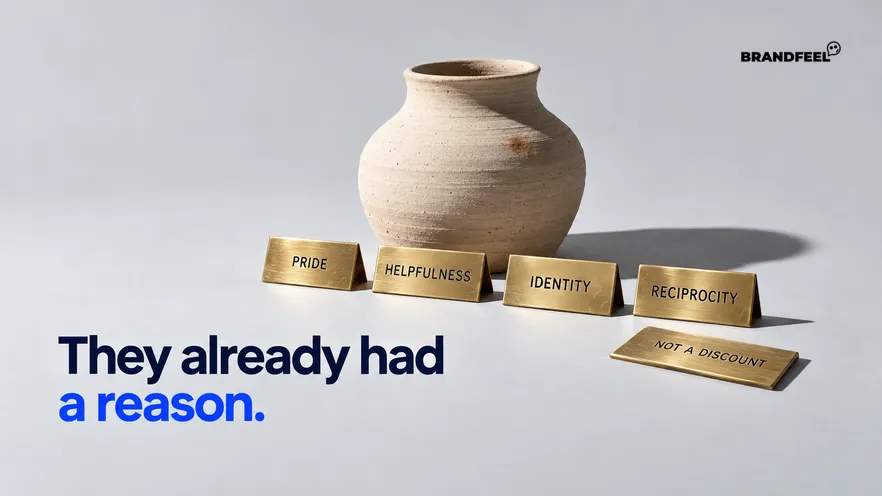
A customer motive is defined as a reason the customer already has to create content, such as pride, helpfulness, identity or reciprocity. Shoppers value what that content says: 70% say they trust opinions that other consumers post online [Nielsen, 2012]. To motivate customers to create content, match the ask to the motive instead of attaching a reward to a request they had no reason to accept. You will learn how to match the ask to each motive and why a discount makes the content worse.
- Look for four motives that explain almost every submission: pride, helpfulness, identity and reciprocity.
- Avoid rewards, which replace the motive rather than strengthening it, and the content shows it.
- Write a different ask for each motive, because one generic ask suppresses three of them.
- Read your unprompted submissions before designing anything, because they are your motive distribution.
- Show a sender where their content appeared, because that produces the second submission.
Motivating customers to create content starts from the observation that some of them already do it, unasked, for reasons that have nothing to do with a reward. Omniconvert has measured customer behaviour across the CROBenchmark dataset of 7,000+ websites in 15+ industries, against 248+ audit criteria, over 13 years in eCommerce [CROBenchmark Report 2026, Omniconvert]. The stores with the most usable customer content are rarely the ones paying the most for it. Last updated: October 2026.
This article is about the motive. For where the content comes from and when to ask, see get customer UGC without a big budget. For the written-feedback pipeline that sits alongside it, see build a Review-Generation system.
Why customers make content when nobody pays them
An unprompted submission is defined as customer content sent without a request or a reward. Every store with any traction receives photographs, messages and reviews nobody solicited, and those senders are a free sample of what motivation looks like in your category.
Pride. The customer achieved something and the product was involved. A finished room, a completed route, a plant that survived, a result they can show. The content this motive produces is a before and an after, and the sender's interest is in the result rather than in your brand.
Helpfulness. The customer remembers deciding and wants to shorten that for the next person. This is the motive behind most long, detailed, unglamorous reviews, and it produces the most persuasive material you will ever receive because it is written to inform rather than to please.
Identity. Owning the thing says something the customer wants said. This motive is strong in categories with visible taste and weak in categories without it, and it produces content that is well composed and sometimes light on substance.
Reciprocity. Somebody at your company did something unusual: fixed a problem properly, replaced something out of warranty, answered on a Sunday. The resulting content is specific, grateful and often arrives in a support thread where nobody is looking for it.
How to motivate customers to create content, step by step
- Read what already arrives unprompted. Pull every submission from the last six months out of email, reviews and support threads, and write next to each one what the sender appeared to want. This is your motive distribution and it will not match your assumption.
- Name the dominant motive. Most products have one clear motive and one secondary. Write both down. A product with pride as its dominant motive and a request written for identity will underperform badly.
- Write the ask in that motive's language. Pride gets asked to show a result. Helpfulness gets asked a question the next buyer has. Identity gets asked for a composition. Reciprocity gets asked by the person who helped them.
- Give back what only you can give. Visibility on the product page, a reply from a named person, an answer to the sender's own question. Not a discount, which converts the exchange into a purchase.
- Close the loop in public. Send a link to where their content appeared. This step costs a minute and it is the single strongest predictor of whether somebody sends a second time.
Step three is where the gain is, because a single generic request suppresses three motives to serve one. Four short asks sent to four identifiable groups will out-collect one well-written request to everybody.
Why an incentive usually makes the content worse
When you attach a reward, you change what the sender is doing. Before the reward they were saying something. After it they are fulfilling a requirement, and the rational way to fulfil a requirement is with the minimum artefact that qualifies. That is why incentivised submissions cluster around the shortest acceptable length and the most neutral possible content.
The table sets out the four motives, the artefact each one naturally produces, the ask that fits it, and the return that strengthens rather than replaces it.
| Motive | What it produces | The ask that fits | What to give back |
|---|---|---|---|
| Pride in a result | A before and an after | Show us what you finished | Feature the result, credited |
| Helpfulness | Long, specific, plain prose | What would you tell the next buyer | Publish it where buyers decide |
| Identity | A composed photograph | Show it where it lives | Share it to your own audience |
| Reciprocity | Specific, grateful, unsolicited | Asked by the person who helped | A reply from that same person |
| Curiosity | A question with context attached | Ask what they still want to know | A real answer, not a template |
| Reward | The minimum artefact that qualifies | Avoid, or apply after the fact | Recognition, never a published rate |
What stops a willing customer halfway
Uncertainty about the standard is the bigger of the two. A customer asked for a photograph does not know whether you want a studio image or a phone snap on a kitchen table, and in the absence of a signal most people assume the standard is higher than it is and quietly do nothing. Showing one previous submission resolves it in a sentence.
Uncertainty about usage is smaller in effect and simpler to remove. A plain statement that the content may appear on the product page and in marketing, with a name or without one as they prefer, is both the permission you need and the reassurance they wanted. Omitting it means chasing permission later for the submissions you want to use most.
What a brand team should do this week
- Pull every unprompted submission from six months out of email, reviews and support, and label the apparent motive next to each.
- Name the dominant and secondary motive per product line. Write them in the brief, because the next person to run this will otherwise guess again.
- Rewrite one request in the dominant motive's language, asking for one specific artefact and signed by a named person, then run it against the old request and compare submissions.
- Add one example and one usage sentence. The example sets the standard, the sentence removes the hesitation and gives you the permission.
- Reply to every sender from the last quarter with a link to where their content appeared. This is the cheapest repeat-submission mechanism available, and Bain and Company retention research puts a 5% retention lift at 25 to 95 percent more profit [Harvard Business Review, 2014].
Where review themes, NPS comments and support tickets sit in separate systems and have to be assembled before anybody can see the motive distribution at all, that unification is the problem Omniconvert Commander (formerly Nexus) addresses, with every proposed action staying something a person approves before it goes live.
FAQ: motivating customers to create content
What actually motivates customers to create content?
Four motives cover almost every unprompted submission. Pride in a result they achieved with the product, helpfulness towards the next buyer who is deciding, identity when owning the thing says something they want said, and reciprocity after a company treated them unusually well. Money is not on the list, which is why a discount so often changes the volume of content without improving it. The practical move is to work out which motive your senders are acting on and ask for the thing that motive would already produce.
Do discounts and rewards increase customer content?
They increase submissions and usually degrade them, because a reward replaces the original motive with a transaction. Content made to claim a discount tends to be posed, uniformly positive and useless as evidence, since the sender is completing a task rather than saying something. Where you want to recognise people, do it after the fact and without publishing a rate, which keeps the motive intact and still acknowledges the effort.
Which customers are most likely to make something?
People who achieved a visible result, people who had a problem resolved well, and people who have bought several times. The first group has something to show, the second has a reason to reciprocate, and the third has already demonstrated attachment. All three are identifiable from data you hold, and asking those three groups specifically works better than asking every buyer the same question on the same day after delivery.
How do you ask without sounding like a marketing campaign?
Ask one named person to answer one specific question, and sign it from somebody real. A request that describes a programme invites people to decline on behalf of the programme. A request that asks what you would tell someone deciding between this and the obvious alternative is a question a person can answer in two minutes, and the answer is usually more useful than anything a brief would have produced.
What makes a willing customer stop halfway?
Not knowing what good looks like, and not knowing where it will end up. Both are cheap to fix and both are usually missing. Showing one example of a previous submission tells a sender what counts as helpful, and one sentence stating where the content may appear removes the hesitation that quietly loses a share of willing people. Neither costs anything and both raise completion more reliably than raising a reward would.
Teams that try motivation often relabel a reward as a thank-you. The sender still completes a task to claim something, so the content arrives posed and uniformly positive. The team then cannot tell which motive the product triggers, and the next brief starts from nothing.
AliveCor used Omniconvert to run a structured A/B testing programme and achieved +21% conversion rate, +5% revenue per visitor, and 94% statistical relevance across their experiments. [Omniconvert, AliveCor case study] Compare your motive-led request against the old one in the same way, and keep the version that earns more usable submissions.
Match the ask to the motive, then say thank you
Before designing another programme, read the content people already sent you unasked. Label what each sender appeared to want, and you will have a motive distribution for your category that no amount of planning would have produced. Then write four short asks instead of one good one, because a single generic request serves one motive and suppresses the other three. Give back the things only you can give: a credited feature, a published review in the place buyers decide, a reply from the person who actually helped. Keep the discount out of it, not for reasons of principle but because the content it buys cannot do the job you need the content for. And send every sender a link to where their words ended up, which takes a minute and is the whole reason anybody sends twice.