
How Fresh Reviews Improve Your AI Visibility
Fresh reviews are the only evidence that still describes the product you sell today. Why recency drives AI visibility, and how to keep a steady flow.
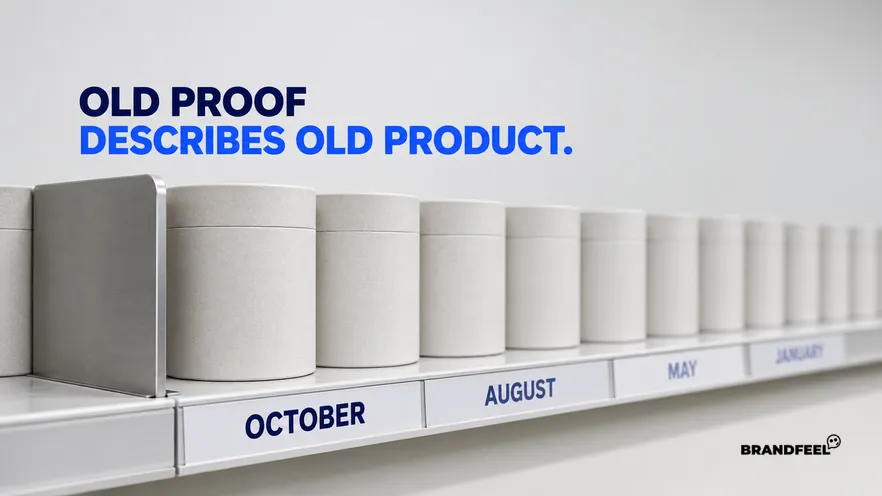
A review recency window is defined as the period within which a review still describes the product as it is sold today, which is why fresh reviews drive AI visibility more than total review count does. Reviews matter commercially, since a product with five reviews is 270% more likely to sell than one with none [Spiegel Research Center, 2017], but only recent ones still describe what you ship. A system assembling a current answer weights what it can date recently. This guide shows how to collect reviews as a steady flow, timed to actual use and reset whenever the product changes.
- Review count describes your history. Review recency describes the product you sell now.
- A big average built on dated reviews leaves recent negatives as the only current evidence.
- Requests timed to delivery produce reviews about the parcel, not about the product.
- A reformulation resets the window: old reviews now describe something you do not sell.
- Own-site reviews verify claims; third-party reviews corroborate them. You need both.
Most review programmes are built to accumulate. The target is a number on a product page, the work is a periodic push, and success is the count going up. That design made sense when the audience was a person scanning for social proof, where a large number genuinely reassures. It works considerably less well when the reader is a system trying to establish what your product is like now, because to that reader a total is close to meaningless and a date is the most useful field on the record.
Omniconvert has measured how stores collect, display and maintain customer feedback across the CROBenchmark dataset of 7,000+ websites in 15+ industries, against 248+ audit criteria, over 13 years in eCommerce [CROBenchmark Report 2026, Omniconvert]. The pattern is consistent: review volume is treated as an asset and review recency is not measured at all, so brands with large review counts often do not know that most of their evidence predates their current product.
Why fresh reviews carry the weight
Think about what a review actually is from the outside: a dated observation by someone who used a version of your product. The observation does not update. The product does. Every reformulation, supplier change, packaging revision and shift in fulfilment quietly widens the gap between what the reviews describe and what a new customer will receive.
For a human shopper this gap is partly invisible and partly forgiven. For a system assembling an answer it is the central question, because that system carries the cost of being wrong. Given a choice between a confident description based on recent evidence and one based on evidence it cannot date, it will prefer the first, and where no recent evidence exists at all it will often decline to characterise the product rather than guess.
This surprises brands with long histories. Accumulated volume, which felt like a durable moat, depreciates. The average stays high while the share of evidence describing the current product keeps falling.
The recency window, and how to set yours
The window is a planning device, not a published rule. Decide what period counts as current for your category, then measure the share of your reviews inside it. That percentage describes your review health better than any count.
Fast-moving categories need shorter windows, because a six-month-old review may already describe a different experience. Stable categories can run longer ones.
The reset condition matters more than the length. A material change to the product starts a new period regardless of how recently the previous reviews were collected, and treating that moment as a collection priority is the difference between a smooth transition and a quarter where your best-evidenced product is the one you stopped making.
Flow beats campaign
This is the most actionable finding in the whole area and the one that costs the least to apply. Two brands collecting the same number of reviews a year, one in four campaigns and one continuously, end up with materially different review profiles. The continuous one always has recent evidence. The campaign one has it for a few weeks at a time.
Flow also changes what the reviews are about. A campaign sweeps a backlog of old purchases and produces recollections. A request timed to recent use produces specific detail, the kind of review that gets quoted rather than counted.
The mechanics are not complicated, and the detail is in how to build a Review-Generation system that runs without anyone remembering to launch it. The decision that matters is the trigger point.
What a dated review profile costs you
| Consequence | Why it happens | How soon |
|---|---|---|
| Recent negatives dominate | They are the only current evidence | Immediately |
| Product changes go undescribed | Nothing describes the new version | One quarter |
| Quotable detail dries up | Old reviews are recollections | One quarter |
| Rating stops reflecting service | Average is anchored by history | Two quarters |
| Weaker independent corroboration | Third-party profiles age too | Two quarters |
| Newer competitors read as safer | Their evidence is all current | Ongoing |
The first row is the one that catches brands out. A store with a long history and a stalled review flow is unusually exposed to a handful of bad months, because those reviews are not diluted by anything equally recent.
Making the recency visible
This is the technical half of the job and it is usually quick. Review text, rating and date published as structured data on the product page is a well-established pattern, and schema.org's review vocabulary has carried the fields for years. The common defect is a review widget that renders dates visually for humans while exposing nothing machine-readable. Shopify's product-data guidance asks for complete, consistently structured records across sales channels, and review records fall inside that advice, so check what your widget actually emits.
Independent platforms do the other half. Reviews on a source you do not control are stronger corroboration precisely because you do not control them, which is the same logic set out in the GEO playbook for eCommerce. A programme that feeds only your own product pages has built verification without corroboration.
The same work helps people. Roughly 70% of carts are abandoned [Baymard Institute, 2025], and a dated, specific review is one of the few things on a product page that answers whether the product still delivers.
What to do this month
- Measure your recency share. What proportion of your reviews, per product, falls inside your window. This one number should be on the same report as the count, and usually it has never been calculated.
- Move the trigger to use, not delivery. One change in the request timing, which costs nothing and changes what the reviews are about as well as when they arrive.
- Convert campaigns into flow. The same annual volume, spread weekly. No increase in spend, materially better profile. The effect on conversion is covered in how reviews affect conversion.
- Flag product changes as resets. Add a step to your product change process that triggers a collection push on the new version. Where you want to see how your profile compares with the category, you can benchmark your reviews against competitors directly.
Nothing above needs a new platform, and the sequence works on whatever review system you already run. A sentiment layer earns its place later, in reading the themes inside the flow: Brandfeel, Omniconvert's sentiment-intelligence layer, aggregates reviews, NPS and support themes so that a change in what customers say surfaces as a theme rather than as a slow drift in a number. Downstream of that, Omniconvert Commander (formerly Nexus) is an AI for eCommerce growth engine that unifies commerce data, prioritises experiments by True Profit, and generates campaigns and creative you approve before they go live.
Most teams run one big review push after a launch, watch the count jump, and then let the flow go quiet for months. The headline number keeps looking healthy, so nobody notices that every review on the page is a year old until a competitor with a steady trickle of recent ones starts reading as the safer choice.
AliveCor used Omniconvert to run a structured A/B testing programme and achieved +21% conversion rate, +5% revenue per visitor, and 94% statistical relevance across their experiments. [Omniconvert, AliveCor case study] Apply the same discipline to review timing: change one trigger at a time and compare the recency share before and after.
Worth reading alongside this: display reviews for maximum conversion.
Frequently asked questions
Why do fresh reviews matter more than total review count?
Because a count describes history and a recent review describes the product you sell today. Formulations change, suppliers change, packaging changes and service changes, so a four-year-old review is evidence about a product that may no longer exist. A system assembling a current answer weights what it can date recently, which is why a store with two hundred recent reviews often reads as better evidenced than one with four thousand old ones.
How recent does a review need to be?
There is no fixed threshold, and the useful way to think about it is as a window rather than a cutoff. Reviews from the last three to six months carry the most weight as current evidence, the previous year still counts, and anything older mostly contributes to a rating average. The window should shorten for categories that change quickly and reset entirely when the product itself changes.
Does a high rating with old reviews still help?
It helps less than it looks. A strong average built from dated reviews supports the claim that the product was good, which is a weaker statement than the one a shopper is asking about. It also leaves you exposed to a small number of recent negative reviews, because those will be the only current evidence available and will carry disproportionate weight.
What should we do after reformulating a product?
Treat it as the start of a new evidence period. The existing reviews describe something you no longer sell, and continuing to rely on their average is both misleading and fragile. Prioritise collecting reviews of the new version, and where your platform allows it, make the version change visible so that older reviews are read in context rather than as current.
Can you ask for reviews too often?
You can ask the same customer too often, and asking at the wrong moment is a larger problem than asking too much. A request sent on delivery produces a review about the parcel, which is worth very little as evidence about the product. Steady weekly volume across your whole customer base, timed to actual use, avoids both failure modes.
Do reviews on our own site count, or only third-party ones?
Both count and they do different jobs. Reviews on your own product pages are what a system reads when verifying a claim about the product, so they need to be present, dated and structured. Reviews on platforms you do not control carry more weight as independent corroboration, because the source does not depend on you. A programme that produces only one of the two is leaving half the benefit unclaimed.
How to keep your review evidence current
Review count is the metric every programme is built around and the one that ages worst. The question being asked is almost always about now, and only the reviews you collected recently answer it. Treat collection as a flow to maintain: steady weekly volume, triggered by actual use, dated and structured on the page, corroborated on platforms you do not own, and reset whenever the product changes.
Measure the share of reviews inside your window alongside the count. It tells you whether your evidence still describes what you sell.