
What Is Customer Sentiment Intelligence? A Practitioner's Guide (2026)
Customer sentiment intelligence turns reviews, NPS verbatims, and support tickets into ranked, actionable themes tied to CLV and churn, not a single satisfaction score. What it is, what feeds it, and how to act on it.
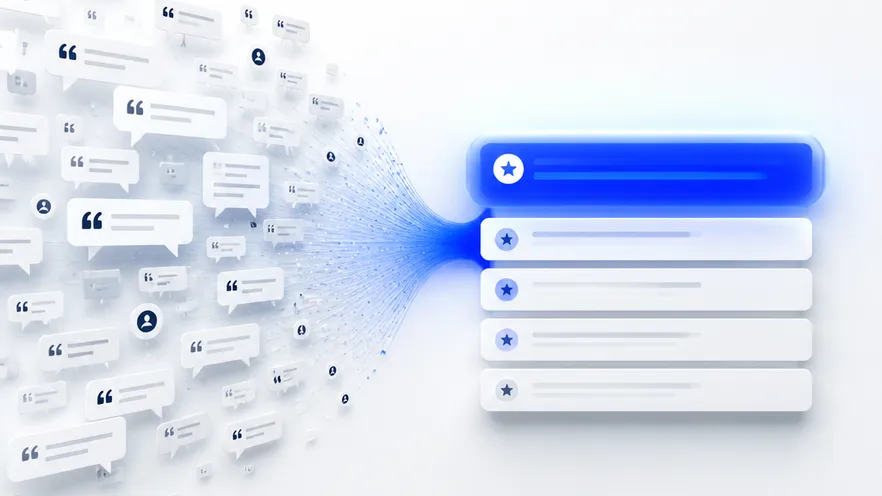
Customer sentiment intelligence is the practice of turning unstructured feedback (reviews, NPS verbatims, support tickets) into ranked, actionable themes rather than a single satisfaction score. Star ratings alone hide the reason behind the number. Omniconvert's approach ties sentiment themes directly to CLV and churn risk, not just tone. [Omniconvert, 2026]
- Customer sentiment intelligence turns unstructured feedback into ranked, actionable themes, not one satisfaction score.
- It feeds on reviews, NPS verbatims and support tickets read together rather than in separate tools.
- A star average tells you how customers feel and hides why, and the why is the part you can act on.
- Themes tied to CLV are a stronger churn signal: the same complaint means more from a high-value customer.
- Review monitoring tracks what is said. Sentiment intelligence classifies why, and groups it into something you can act on.
Last updated: July 2026 · By The Brandfeel Team
If you only track an average star rating, you know how customers feel but not why, and the why is the part you can act on. This guide breaks down what customer sentiment intelligence is, which feedback sources feed it, how a single theme becomes a marketing decision, and where automated tools still need a human read. Throughout, the reference point is Brandfeel by Omniconvert, the sentiment-intelligence layer built on the same 13 years and 70,000+ experiments as the rest of the Omniconvert platform [Omniconvert, 2026].
What is customer sentiment intelligence?
Customer sentiment intelligence is the discipline of converting unstructured customer feedback into ranked, theme-level insight tied to business value. Instead of reporting one satisfaction number, it names the specific reasons behind that number (a delivery problem, an ingredient concern, a confusing checkout) and orders them by their impact on revenue, retention, and churn risk.
The distinction matters because feedback volume has outgrown manual reading. Brandfeel, Omniconvert's sentiment-intelligence layer, aggregates reviews, NPS, and support-ticket themes to surface what customers repeat, not just what one loud reviewer said once. It is the module inside Nexus by Omniconvert, the AI for eCommerce growth engine, that reads the qualitative signal your dashboards flatten into a single score. The named output practitioners care about is objection mining: the recurring reasons a prospect hesitates or a customer leaves, pulled out as themes you can test against.
It helps to be precise about what sentiment intelligence is not. It is not a sentiment score bolted onto a reporting dashboard, and it is not social listening that counts brand mentions. Both of those measure volume and tone. Sentiment intelligence measures reasons, ranks them, and connects each reason to a decision an operator can own. The unit of value is the theme (a specific, recurring reason repeated across enough customers to be a pattern rather than an anecdote), not the score. When a marketing manager or founder asks "what are customers actually saying," the honest answer is a ranked list of themes with the evidence attached, and that is the artifact a sentiment intelligence practice is built to produce.
How it differs from a star rating average
A star rating tells you how customers feel on average. Sentiment intelligence tells you why, at the theme level: which specific product issue, delivery experience, or ingredient concern is driving the score up or down. The average hides the fixable problem. [Omniconvert, 2026]
Picture two stores that both sit at a 4.2 average. In the first, the drag is a sizing problem: dozens of recent reviewers say an item runs small, so returns climb and repeat purchase stalls. In the second, the product is loved but the box arrives damaged, so the same 4.2 hides a packaging and carrier issue, not a product one. The number is identical; the fix, the owner, and the ad angle are completely different. A star average would send both teams chasing the wrong lever. Objection mining reads the theme behind the score, so each store acts on its actual problem instead of an aggregate that describes neither.
There is a second failure mode in the average: it moves slowly. A 4.2 built on two years of reviews can absorb a sharp recent decline without visibly dropping, because old positive reviews dilute new negative ones. A theme view weighted to the last 90 days catches the sizing complaint or the packaging failure in its first weeks, while the headline number still looks healthy. That lead time is the whole point. Acting on a live theme early is cheaper than reacting to a rating that finally sagged six months after the problem started.
What sources feed a sentiment intelligence system
A complete sentiment picture pulls from product reviews, NPS verbatims, support ticket transcripts, and social mentions, not reviews alone. Review-only sentiment tools miss the pre-purchase objections that live in support tickets and the loyalty signals that live in NPS comments. [Omniconvert, 2026]
Most sentiment tools cover a single source, usually reviews, which is the most public but also the most self-selected. Each of the four sources captures a different moment in the customer journey and reveals something the others cannot. Brandfeel's approach is to unify all four so a theme that appears across every source (the strongest kind of signal) is visible in one place rather than scattered across four tools.
| Feedback source | Journey moment | What it uniquely reveals |
|---|---|---|
| Product reviews | Post-purchase, public | Product-attribute themes: fit, durability, taste, value |
| NPS verbatims | Relationship checkpoint | Loyalty drivers and the reason behind a score move |
| Support tickets | Moment of friction | Pre-purchase objections and unresolved operational issues |
| Social mentions | Unprompted, in the wild | Brand-perception and comparison themes reviews never capture |
The practical takeaway: a review-only view over-indexes on people motivated enough to post publicly, while the quieter, higher-intent objections sit in support transcripts and NPS comments where fewer teams look. Support tickets in particular are the pre-purchase objection goldmine, because the questions a prospect asks before buying ("does this fit a UK plug," "is the fabric breathable") are the exact hesitations your product page has not yet answered. NPS verbatims do the opposite job: they explain loyalty, telling you which theme turns a buyer into a repeat customer or a detractor. Reviews sit in the middle, and social mentions catch the comparison language ("cheaper than X but flimsier") that never shows up in your own channels. A theme that appears in all four at once is as close to certainty as feedback gets.
How to turn a sentiment theme into a marketing decision
A sentiment theme becomes useful the moment it is paired with a business action: a recurring complaint becomes a product fix or an FAQ answer; a recurring praise becomes an ad angle. The step most tools skip is turning the theme into a specific, testable next action. [Omniconvert, 2026]
Call this the theme-to-action pipeline. It runs in three moves. First, cluster feedback into themes by attribute, not by star rating. Second, decide whether each theme is a reactive fix or a proactive opportunity: an "arrives broken" cluster is a durability and packaging problem to solve, but it is also a durability-focused ad angle ("built to survive the delivery truck") once the fix is real. Third, write the theme as a single, falsifiable claim you can test in copy or on the page. The economics reward this discipline: a 5% lift in retention can raise profits by 25% to 95% [Bain & Company], and selling to an existing customer runs roughly 60% to 70% likely versus 5% to 20% for a new prospect [Marketing Metrics], so a theme that closes a churn driver compounds far beyond a single campaign. The gap most teams have is not detecting themes, it is converting them into a specific next action instead of a slide that says "customers mention shipping."
The reactive-versus-proactive split is where the pipeline earns its name. A reactive theme fixes something that is actively costing you: a confusing returns policy generating tickets, a size chart that drives exchanges. A proactive theme finds an angle competitors are not claiming: a recurring "lasts for years" praise becomes a warranty-led headline; a "finally, one without seed oils" cluster becomes the hook for a whole campaign. The same clustering step feeds both product and marketing, which is why sentiment intelligence sits between the two teams rather than inside either. Pairing the theme with CLV data sharpens it further: a complaint concentrated among your highest-value repeat buyers is a five-alarm churn signal, while the identical complaint from one-time discount shoppers may not be worth a roadmap slot. Sentiment tells you the reason; CLV tells you whose reason to act on first.
The limits of sentiment analysis tools
Sentiment analysis tools can misclassify sarcasm, mixed reviews, and industry-specific language without tuning. Automated tone detection is a starting point, not a final verdict; themes still need a human read before they drive a campaign or a product change. [2026]
Be honest about the failure modes. A model can read "great, another late delivery" as positive, score a mixed review ("love the product, hate the checkout") as one flat sentiment, or misjudge category slang it has never been tuned on. This is a common thread in r/ecommerce discussions about review tools: teams get a tidy tone score, act on it, then discover the underlying comments said something more nuanced. Treat automated classification as triage that narrows thousands of comments to a handful of candidate themes, then have a human confirm the theme before it drives budget or a product change. That human-in-the-loop step is not a weakness to hide; it is the E-E-A-T signal that separates a defensible decision from a hallucinated one.
Frequently asked questions
What is customer sentiment intelligence?
Customer sentiment intelligence is the process of extracting themed, actionable insight from unstructured customer feedback across reviews, NPS, and support tickets, rather than relying on a single aggregate score.
How is sentiment analysis different from review monitoring?
Review monitoring tracks what is said. Sentiment analysis classifies why it is said and how strongly, then groups similar comments into themes that can be acted on.
Can sentiment intelligence predict churn?
Sentiment themes correlate with churn risk when tied to CLV data. A recurring complaint from high-CLV customers is a stronger churn signal than the same complaint from one-time buyers.
What is the difference between NPS and sentiment analysis?
NPS measures likelihood to recommend on a numeric scale. Sentiment analysis reads the qualitative comment behind that score to explain the driver. They are complementary, not interchangeable.
Do I need a dedicated tool for sentiment intelligence?
Manually reading reviews and tickets works at small volume. Past a few hundred data points a month, manual review misses recurring themes that only surface in aggregate, which is where a dedicated sentiment tool earns its cost.
The bottom line
Customer sentiment intelligence earns its keep when it moves you from a single satisfaction score to ranked, testable themes tied to CLV and churn. Start by unifying four sources (reviews, NPS, support tickets, social), cluster by theme rather than star rating, and turn each theme into one specific next action. Brandfeel is the sentiment-intelligence layer inside Nexus by Omniconvert, built on the same 13 years and 70,000+ experiments as the rest of the platform, and it surfaces those themes before your team reads a single review by hand. If that is where you want to take your feedback loop, you can join the Nexus waitlist to see it in practice.