
NPS vs Sentiment Analysis: The Difference, and Do You Need Both?
NPS scores loyalty as a single number; sentiment analysis reads the themes behind it. Here is how the two customer-feedback methods differ, when you need both, and how to run them together, with data from Brandfeel, Omniconvert's sentiment-intelligence layer.
Last updated: July 2026 · By The Brandfeel Team
NPS vs sentiment analysis is a comparison of two different customer-feedback methods: NPS scores loyalty as a single number, how likely a customer is to recommend you on a 0 to 10 scale, while sentiment analysis reads the qualitative text behind any feedback source to identify the theme driving that number. They answer different questions, which is why most brands need both. Across ecommerce NPS responses processed by Brandfeel, Omniconvert's sentiment-intelligence layer, the reason behind a score movement almost always surfaces in the open-text comments before it shows up in the numeric trend. The score tells you something changed; the sentiment behind it tells you what and why.
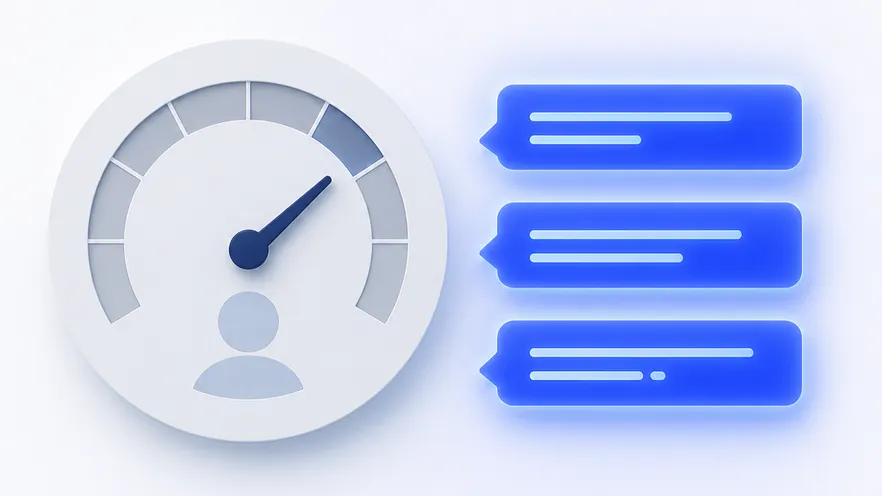
NPS measures a single number, how likely a customer is to recommend you, on a 0 to 10 scale. Sentiment analysis reads the qualitative text behind any feedback source (NPS comments, reviews, tickets) to identify the theme driving that number. Most brands need both: NPS for the trend line, sentiment analysis for the reason.
- NPS measures one number: likelihood to recommend, on a 0 to 10 scale.
- Sentiment analysis reads the text behind any feedback source to name the theme driving that number.
- Most brands need both: NPS for the trend line, sentiment for the reason it moved.
- Manual reading works at small volume. Past a few hundred data points a month it misses themes that only appear in aggregate.
- Neither replaces the other, and treating a score as a diagnosis is the mistake both are meant to prevent.
What does NPS actually measure, and what does it miss?
NPS measures likelihood to recommend, a proxy for loyalty and word of mouth. It does not explain why a score moved. A dropping NPS trend without theme-level sentiment analysis tells you something is wrong without telling you what.
The calculation is deliberately simple. You ask one question, how likely are you to recommend us, on a 0 to 10 scale. Scores of 9 and 10 are promoters, 7 and 8 are passives, and 0 through 6 are detractors, and your NPS is the promoter percentage minus the detractor percentage. The metric was introduced by Fred Reichheld and popularised as "the one number you need to grow" [Reichheld, Harvard Business Review 2003], and it correlates with retention and referral behaviour well enough to have become a standard board-level KPI [Bain & Company]. Its core limitation is structural: it is a number without a reason. A single figure of 40 can describe two completely different businesses, one with mild indifference spread across the base and one with passionate fans offset by a furious minority, and the score cannot tell them apart. The one detail most teams overlook is that the open-text comment field on an NPS survey is itself a sentiment analysis input, not a separate thing, so the explanation you need is usually already sitting next to the score you collected. Treating the digit as the deliverable, rather than the comments behind it, is the most common way brands waste the survey they paid to run.
Where sentiment analysis adds what NPS cannot
Sentiment analysis applied to the open-text NPS comment, plus reviews and support tickets, surfaces the specific theme behind a score movement, "shipping got slower" or "new packaging feels cheaper," in a way the numeric score never can. It turns an aggregate number into a ranked list of causes.
Picture a relationship survey where NPS drops eight points in a quarter. The number sets off the alarm, but on its own it cannot tell you whether the cause is a price rise, a courier change, or a reformulated product. Run sentiment analysis across the verbatim comments and the answer often resolves in minutes: a cluster of detractors all citing a recent packaging change identifies the driver, and the fix becomes obvious rather than argued. This is the difference between an aggregate score and theme-level sentiment. The same technique applies across every feedback channel, not just NPS comments, and themes that recur in reviews and support tickets as well as the survey are the ones worth acting on first. The move that matters is connecting each theme to a business outcome, which is where connecting customer feedback to lifetime value turns a comment into a priority instead of a note. A recurring question in r/ecommerce threads comparing feedback tools is whether NPS software and sentiment tools do the same job; they do not, and the table below shows exactly where they diverge.
NPS vs sentiment analysis at a glance
The two methods are complementary, not competing. NPS gives you a trackable trend line; sentiment analysis explains the movements in that line. Read side by side, one tells you the score changed and the other tells you why, which is the pairing that turns feedback into a decision rather than a dashboard.
| Dimension | NPS | Sentiment analysis |
|---|---|---|
| What it measures | Likelihood to recommend (loyalty) | Themes and tone in open-text feedback |
| Data format | One number on a 0 to 10 scale | Unstructured text, coded into themes |
| Output | A single score, -100 to +100 | A ranked list of recurring themes |
| Question it answers | How loyal are customers overall | Why the score moved, and what to fix |
| Sources it reads | NPS survey responses | NPS comments, reviews, tickets, social |
| Best for | Tracking a trend over time | Explaining a change and prioritising action |
| Volume threshold | Works at any response volume | Manual below ~50 to 100/month, tooling above |
| Cadence | Quarterly relationship, event-based transactional | Continuous across all feedback channels |
Read the table as a division of labour, not a choice between two products. NPS owns the trend column and sentiment analysis owns the reason column, and a mature CX programme runs both against the same feedback so a score movement and its explanation land together. The practical failure mode is asking one method to do the other's job: teams that only track the score end up guessing at causes, and teams that only mine comments lose the clean, trackable benchmark that tells them whether things are getting better or worse over time.
Do you need both, or can you track it manually?
Manual tracking works below roughly 50 to 100 responses a month. Past that volume, recurring themes get lost in the noise of individual comments, and a dedicated sentiment layer becomes the more reliable way to catch a trend early. Frame the decision as a volume-and-time tradeoff, not a mandate.
If you collect a few dozen NPS responses a month, you do not need software to do this well. Tag each comment into five to eight recurring theme buckets by hand, read the score alongside the theme mix, and route the biggest detractor theme to an owner. Smaller brands should not over-invest here early; the discipline of reading the comments matters more than the tooling. The threshold to automate arrives when hand-tagging stops being reliable, usually once a single person can no longer hold the full theme distribution in their head across hundreds of monthly comments and three or four channels. That is the point where a sentiment layer earns its cost, because it applies the same tagging consistently at scale and flags a rising theme weeks before a manual reviewer would notice it. Brandfeel is the sentiment-intelligence layer inside Nexus by Omniconvert, an AI for eCommerce growth engine built on the same 13 years and 70,000+ experiments as the rest of the platform, where NPS and Brandfeel sentiment data feed the same CX Intelligence hub so a score movement and its reason show up together; you can join the Nexus waitlist to follow it.
Frequently asked questions
What is the difference between NPS and sentiment analysis?
NPS is a numeric loyalty score. Sentiment analysis is the qualitative classification of open-text feedback into themes. NPS tells you the trend; sentiment analysis tells you the reason.
Can sentiment analysis replace NPS?
No, they measure different things. NPS gives a trackable benchmark over time; sentiment analysis explains what is driving that benchmark. Most mature CX programs use both together.
What is a good NPS score for ecommerce?
Benchmarks vary by category, but ecommerce NPS scores in the 30 to 50 range are generally considered solid; above 50 is strong. The number matters less than the trend and the theme behind any change.
How do I start doing sentiment analysis on my NPS comments?
Start by manually tagging comments into 5 to 8 recurring theme buckets each month. Once volume makes that unsustainable, a dedicated sentiment tool automates the same tagging at scale.
Should sentiment analysis cover reviews, or just NPS comments?
Ideally both, plus support tickets. Each source captures a different moment in the customer journey, and themes that appear across all three are the strongest signal.
The bottom line
NPS and sentiment analysis are not rivals, they are two halves of one feedback system. NPS gives you the trend line to track loyalty over time; sentiment analysis reads the themes behind the number and tells you what to fix. Track the score against your own history and your category, run sentiment across your NPS comments, reviews, and support tickets, and always act on the theme rather than the digit. A sentiment layer like Brandfeel, Omniconvert's sentiment-intelligence layer, closes the loop by attaching the reason to every score movement so the next action is obvious.