
How to Get More Reviews for Baby & Kids Brands
Getting more reviews for baby and kids brands means recording the child, not the buyer: age at use, size at use, and how the thing survived a wash.
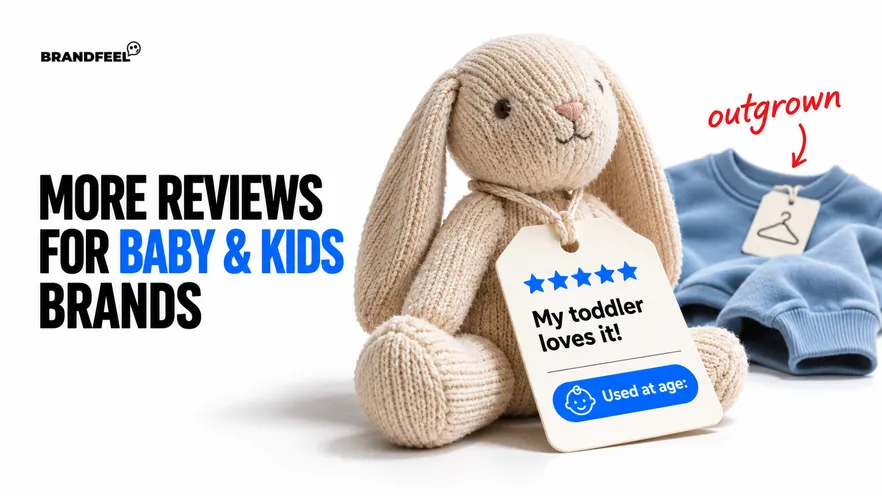
Age-at-use is defined as the child's age at the time a product was actually used, recorded as a reviewer attribute rather than inferred from the purchase date. Collecting more reviews for baby and kids brands depends on it, because without it a parent's verdict cannot be read by any other parent, and the product has usually been outgrown before enough verdicts arrive. Around 70% of carts are abandoned, frequently where a shopper goes looking for a specific reassurance and finds none [Baymard Institute, 2025]. This guide covers why this category under-collects, the fields that make a parent review usable, and how to handle gifts and safety comments.
- Time the request to use and to a wash cycle, not to the delivery confirmation.
- Record the child's age and size at use, as fields rather than as free text.
- Build the corpus at age-band level, because individual products are outgrown too fast.
- Flag gift purchases and ask them a different question, or none at all.
- Answer safety comments publicly and quickly, since they outweigh their star rating.
- Ask about washing and durability, the two things parents cannot judge from photographs.
- Expect the average rating to drop slightly as the comments become genuinely useful.
Using 248+ audit criteria applied to 7,000+ websites across 15+ industries over 13 years in eCommerce, Omniconvert's CROBenchmark research maps where baby and kids brands fall short on product evidence [CROBenchmark Report 2026, Omniconvert]. In this category the shortage is rarely review volume as such. It is that almost no review records the child, which is the only context that makes a parent's experience transferable to somebody else's family.
The cross-category mechanics are in build a Review-Generation system. The nearest neighbour, where the deciding verdict is fit rather than survival, is get more reviews for fashion brands, and the display side, which is where most of the conversion effect is realised, is in how to display reviews for maximum conversion.
Why reviews for baby and kids brands arrive late and say little
Think about what a review request actually catches in this category when it is sent three days after delivery. The parent has unwrapped the item, probably liked it, and possibly not used it at all. If it is clothing, it has not been washed. If it is equipment, it has not been through a week of real handling.
So the review that comes back is about anticipation rather than experience. It is pleasant, it is honest, and it answers none of the questions the next shopper has: does it last, does it wash, did it fit a child of my child's size, and is it as sturdy as it looks.
The relevance window is the structural problem
This is the quiet reason brands in this category seem to work harder for less review volume than their peers. In a slower vertical a product accumulates reviews for years. Here, by the time two hundred parents have had the experience, the product line has moved on and the shoppers arriving are asking about a different stage.
The Age-Band Corpus is the fix, and it is a data-model decision rather than a content one. Group products by the age and size band they serve, and let fit, durability and washing evidence accumulate across the whole band rather than per item. A new design then launches with the band's accumulated evidence behind it instead of with nothing.
Most catalogues in this category already hold the information needed for this and do not expose it. The same sleepsuit pattern appears in four fabrics across three seasons, and each one starts its review life at zero despite performing identically.
The fields that make a parent review usable
Review utility is defined as the degree to which a review lets a different shopper predict their own outcome, which in this category depends almost entirely on the child's recorded context rather than on the quality of the writing. A paragraph of warm prose with no age attached is unusable; one line with an age and a wash note is the most persuasive content on the page.
| Captured | Why it matters | Common failure |
|---|---|---|
| Age at use | Anchors every other comment | Inferred from purchase date |
| Size at use | Lets a parent translate the verdict | Not asked, or free text |
| Survived washing | The durability question parents ask | Never requested |
| Months of use | Separates value from first impression | Request sent far too early |
| Received as a gift | Routes the request correctly | Everyone asked the same question |
| Safety observation | Outweighs its own star rating | Treated as a complaint to resolve privately |
Shopify's merchant guidance has pushed complete and consistent product data across sales channels for years, and reviewer attributes are the same argument applied to the evidence layer rather than the catalogue [Shopify, 2026]. Unexpected cost and unclear information have been among the leading reasons shoppers abandon purchases for as long as Baymard Institute has measured it, at around 70% average cart abandonment [Baymard Institute, 2025], and an unanswerable durability question belongs to the same family of failures. The four fields above are cheap, they are optional, and parents fill them in willingly, because they remember arriving at a product page needing exactly this information and not finding it.
The way baby and kids programmes most often stall is by deciding that asking a child's age is too sensitive to put in a form. The team ships a star rating and a comment box, and then spends a year wondering why a page with three hundred reviews converts like a page with none. Parents are the people most aware that a verdict without an age is meaningless, because they have tried to read other people's and got nothing from them. The field that feels intrusive to a marketing review is the one the audience is waiting for.
Gifts are a different request, not a lower response rate
This is the simplest fix on the list and almost nobody does it. One question at the point of purchase, or inferred from a gift-wrap or different-delivery-address signal, tells you whether the buyer is also the user's household.
Where they are not, you have two sensible options. Ask them only about the things they can actually judge, which is the buying experience and the presentation, and keep that separate from the product corpus. Or ask them to pass the request on, which works better than expected when the framing is that the next parent needs the information.
Safety comments decide more than the rating does
Every brand in this category knows safety is the governing concern and many handle safety feedback as a customer service escalation to be resolved privately. That instinct protects the rating and damages the thing the rating is for.
A published, fast, specific response to a safety observation is more persuasive than an unbroken run of positive reviews, because it demonstrates the one thing a cautious parent is trying to establish: that the brand reacts properly when something is wrong. Brandfeel, Omniconvert's sentiment-intelligence layer, aggregates reviews, NPS and support-ticket themes so that a recurring safety or durability comment surfaces as a theme rather than as a slow drift in an average.
One test from a programme of 60, run on Omniconvert, changed product thumbnails and benefits on desktop for AliveCor and recorded a +21% conversion rate, +5% revenue per visitor, and 94% statistical relevance. [Omniconvert, AliveCor case study] That is a testing result rather than a reviews result, and the transferable discipline is the same: change the request timing for one cohort, hold everything else still, and resist reading the first fortnight.
What to do this week
- Move the request delay. From the tool's default to after use, and for clothing after a wash. One setting, measurable in a month.
- Add the two age fields. Age at use and size at use. Optional, single-tap, above the comment box.
- Flag gift orders. Then ask them a different question, or nothing at all.
- Write the safety response template. Public, specific, within a day. Agree who signs it before you need it.
Above the mechanics sits interpretation: what the durability comments are telling you about the product itself, which is a design decision rather than a content one. Omniconvert Commander (formerly Nexus) is an AI for eCommerce growth engine that brings your commerce data together, ranks experiments by True Profit, and builds campaigns and creative that only go live after you approve them. For how a healthier corpus reads to answer engines, see how fresh reviews improve your AI visibility.
Frequently asked questions
How do you get more reviews for baby and kids brands?
Ask after the child has used the product, not after the parcel arrived, and ask about the child rather than about the buyer. Age at use, size at use and how the item washed are the three fields that turn a kind comment into something the next parent can act on, and almost no programme collects them.
Why do baby and kids review programmes under-collect?
Because the relevance window is short. A product that suits a child for six months is outgrown before a review corpus matures, so the brand restarts at zero with each new cohort of buyers. Collecting at age-band level rather than at product level is what breaks that cycle.
What makes a parent review useful?
The child's context. A five-star comment saying it is lovely helps nobody. The same comment with the child's age and size at the time of use, and a note on how it survived washing, answers the question the next parent actually has, and it is a form field rather than a writing problem.
How should gift purchases be handled?
Flag them and route them differently. A large share of purchases in this category are gifts, so the buyer never saw the product in use and a standard request asks them something they cannot answer. A single question about whether this was a gift lets you ask a different question, or none.
How should safety comments be handled?
With a named process and a short response time. Safety is the decisive concern in this category, so a comment about a strap, a fastening or a small part carries far more weight than its star rating suggests. Suppressing it damages trust more than the comment does; answering it publicly and quickly is what persuades the next reader.
What should a baby and kids brand fix first?
The request timing, then the two age fields. Most tools send a request a few days after delivery, before the item has been used or washed. Pushing it out and adding age at use and size at use costs an afternoon of configuration and changes both how many reviews arrive and whether anyone can use them.
Move one setting, add two fields
Find the review request delay in your tool and push it past the point where a child could plausibly have used the item and a garment could have been washed. Then add age at use and size at use, both optional. Those two changes take an afternoon between them and they decide whether the reviews you already collect are readable by anybody else.
Read the result in return rate and in support volume alongside review count, because the point of recording a child's age is not the rating attached to it. A programme collecting honest age-anchored evidence will show a slightly lower average and fewer wrong-size orders, and the second number is the one that pays for the work.