
UGC Ideas for Fashion Brands
UGC ideas for fashion brands only work with fit context attached. Nine formats that show how a garment sits, and the three fields that make them usable.
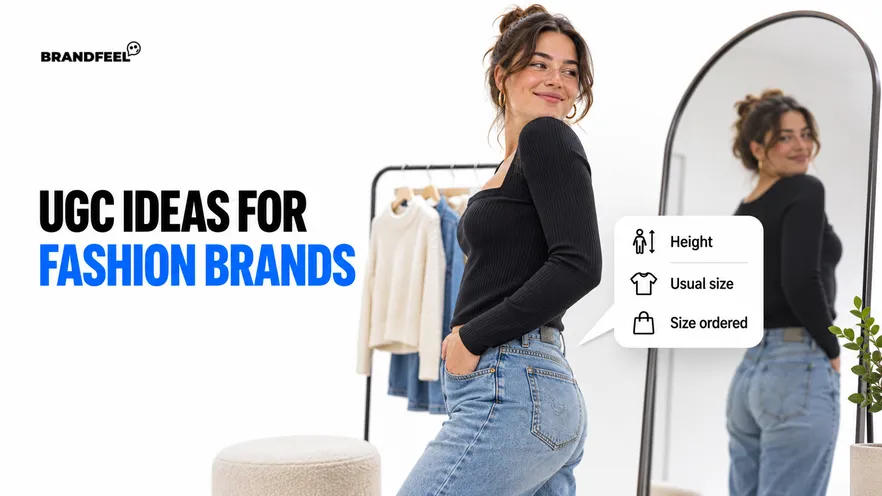
Fit context is defined as the height, usual size and size ordered attached to a piece of customer content, which is what lets a shopper translate how a garment looked on somebody else into how it would look on her. The UGC ideas for fashion brands that reduce returns all carry it, and a library without it is advertising rather than evidence. Around 70% of online carts are abandoned, with missing product information named repeatedly among the reasons shoppers leave [Baymard Institute, 2025]. This guide covers nine formats that show how a garment behaves, and the three fields that make them usable.
- Capture height, usual size and size ordered on every upload, because those three make an image comparable.
- Prefer movement over stills for anything where drape or weight decides the purchase.
- Ask customers who returned an item, since they hold the most precise fit information you have.
- Request one defined task rather than inviting content, as a finishable ask converts far better.
- Show the garment after washing, which answers the durability question nobody publishes.
- Judge the programme on return rate rather than on how many assets you gathered.
Drawing on 13 years of eCommerce work, Omniconvert's CROBenchmark covers 7,000+ websites, 15+ industries and 248+ audit criteria [CROBenchmark Report 2026, Omniconvert]. In fashion the finding that recurs is a brand sitting on thousands of customer photographs, none of which says how tall anybody is.
Why fashion customer content persuades less than it should
Fashion brands collect more customer content than almost anyone and get less out of it, because what they collect is aesthetic rather than informational.
Put yourself in front of the gallery as a shopper. You are five foot two, you usually take a medium, and you are looking at eleven photographs of people whose height you cannot guess within six inches. There is nothing to reason from, so you close the tab or you order two sizes.
Ordering two sizes is the expensive outcome, and it is the one your current library quietly encourages. The timing question of when to ask at all is covered in how to get more reviews for fashion brands.
UGC ideas for fashion brands: nine formats that show fit
- The height-and-size caption. Any photograph, with three numbers attached. The cheapest improvement available to most brands.
- The walking clip. Ten seconds of movement, which shows drape, weight and whether a fabric clings.
- The seated test. How a garment behaves sitting down, which is where trousers, skirts and fitted dresses fail.
- The fifth-wash shot. The same item after real laundering. Durability is the claim customers most distrust and brands least evidence.
- The between-sizes report. A customer explaining which size she chose when she fell between two and whether it worked.
- The body-shape note. How a cut sits on a specific shape, described by somebody with it, which no size chart conveys.
- The three-ways styling set. One piece worn for three occasions, which raises perceived value on a higher-price item.
- The fabric close-up. Weight and texture in natural light, answering the question of whether something looks cheap in person.
- The return explanation. A customer saying why she sent it back. Uncomfortable, and the most useful content in this list.
The last one is worth arguing for because the instinct is to avoid it. A clear, specific explanation of why a garment did not work for one body helps the next shopper decide correctly, and a shopper who decides correctly keeps the item.
| Format | Question it answers | What it must carry |
|---|---|---|
| Height-and-size caption | How will it look on me | Height, usual size, size ordered |
| Walking clip | How does the fabric move | A few seconds of motion |
| Seated test | Is it comfortable to wear out | A seated frame |
| Fifth-wash shot | Will it last | Stated number of washes |
| Between-sizes report | Which size do I order | Both sizes considered |
| Return explanation | Why would this not work | The specific fit failure |
The three fields that make everything else work
This is the whole intervention, and it is smaller than it sounds. You are not asking customers to write, to film differently or to produce more. You are asking three optional questions at the moment they upload.
Make them optional and make them quick. A height field with imperial and metric, a usual-size dropdown and a size-ordered dropdown that prefills from the order. Prefilling the third one removes the only question requiring recall.
Shopify's variant guidance has pushed complete and consistent attributes across sales channels for years [Shopify, 2026], and fit context is the attribute set only a customer can provide. Independent research from the Baymard Institute keeps finding missing product information among the leading causes of abandonment [Baymard Institute, 2025].
Fashion teams that add these fields often make them mandatory, reasoning that optional fields get skipped. Submission volume then falls by a third, because a customer who was going to post one photograph now meets a form. The pattern that holds is optional fields with the size-ordered value prefilled from the order record, which gets most of the data without costing the submission.
Ask the people who sent it back
The returns flow already captures a dropdown reason, which is close to useless: too big, too small, not as expected. None of that tells the next shopper anything.
Replace or supplement it with one open question asking what specifically did not fit, and ask permission to publish the answer anonymously. A sentence saying the shoulders were narrow on an otherwise generous cut is worth more on the product page than ten photographs of people it suited.
It also feeds the product side. Repeated fit comments on one line are a grading problem rather than a content problem, and they arrive months before the pattern would show up in aggregate return rates.
With Omniconvert, Orange Romania tested an urgency statement on the cart page in one A/B test and recorded a +7.65% conversion rate, +11.53% revenue per user, and a 98.65% chance to win. [Omniconvert, Orange Romania case study] That is a testing result rather than a fashion result, and the transferable discipline is reading revenue per user beside conversion, which is how you catch content that lifts orders and raises returns.
What to do this week
- Add the three fit fields to the upload form, optional, with size ordered prefilled.
- Add one open question to the returns flow asking what specifically did not fit.
- Publish one walking clip on your highest-return garment and watch the return rate on that line.
Reading the fit comments in aggregate is the next job. Brandfeel, Omniconvert's sentiment-intelligence layer, aggregates reviews, NPS and support-ticket themes so a repeated comment about narrow shoulders surfaces as a theme rather than as a slow drift in a rating. Where a theme points to a grading or page change worth testing, Omniconvert Commander (formerly Nexus) is an AI for eCommerce growth engine that unifies commerce data, ranks experiments by True Profit and produces campaigns and creative that go live only once you approve them. The adjacent category, where the deciding question is shade match rather than fit, is in UGC ideas for beauty brands, and the system view is in how to build a review-generation system.
Frequently asked questions
What UGC works best for fashion brands?
Content showing how a garment behaves on a body, with fit context attached. A still photograph of somebody looking good in a dress is advertising. The same image captioned with her height, her usual size and the size she ordered is a measurement another shopper can reason from, and that is what shifts a hesitant purchase.
What three fields should every fashion upload capture?
Height, usual size and size ordered. Those three turn any image into a comparison a shopper can run against herself. They take a few seconds to collect at upload, they require no writing skill from the customer, and without them a library of thousands of images answers no practical question.
Is video better than photographs for fashion UGC?
For anything involving drape, weight or movement, yes. A still cannot show whether a fabric clings when you walk or creases when you sit, and those are the questions that produce returns. A few seconds of movement is worth more than a carefully composed photograph for exactly the garments where fit uncertainty is highest.
Should you ask customers who returned an item for content?
Yes, and almost nobody does. A customer who sent something back knows precisely why, has no reason to flatter you, and can explain the fit issue better than anyone who kept the garment. Asking for that explanation turns a refund into the content that prevents the next refund.
How do you get fashion UGC without paying for it?
Ask for one defined thing rather than inviting content in general. A request to film ten seconds of walking in the dress converts better than an open brief, because the customer can see the end of the task. Paid content also tends to arrive without fit context, since a paid creator is producing imagery rather than reporting an experience.
Where should a fashion brand start?
By adding the three fit fields to the upload form and making them optional. That single change makes every future submission usable, costs one form edit, and does not depend on persuading anyone to create anything new.
Add three fields, then ask the returners
Edit your upload form this week so it collects height, usual size and size ordered, all optional, with the last one prefilled from the order. Every photograph a customer sends after that becomes something another shopper can measure herself against, and you will not have had to commission anything.
Then add one open question to the returns flow asking what specifically did not fit. Those answers are the most accurate fit data your business will ever hold, they currently vanish into a dropdown, and published honestly they prevent the next return instead of explaining the last one.