
8 Review-Request Email Templates That Convert
Eight review-request email templates, each matched to the moment it is sent, with the subject lines, the wording that works and why each one performs.
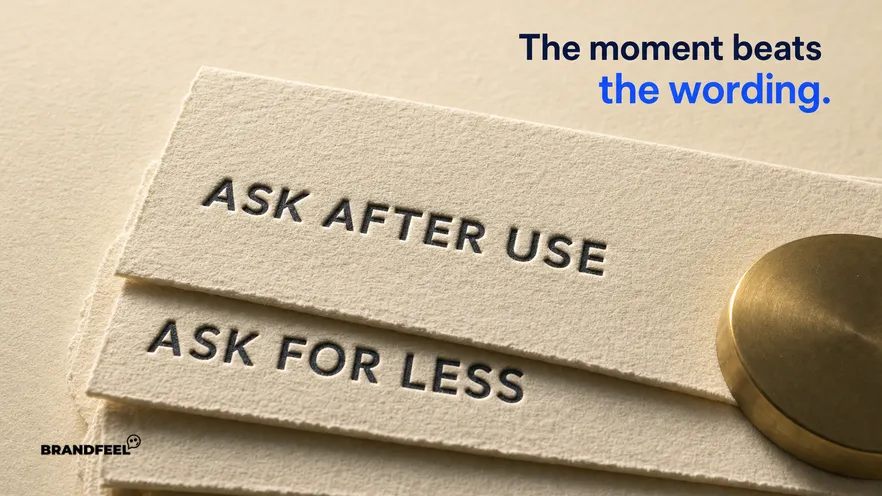
A review-request email converts when it arrives after the product has been used, asks for the smallest useful thing, and makes the first click possible inside the message itself. Almost every template below is a variation on those three rules applied to a different moment: the first purchase, the repeat purchase, the product nobody has reviewed, the customer who complained and was looked after. The wording matters less than most teams expect and the timing matters more. What separates a message that gets a response from one that does not is rarely persuasion. It is whether the person can see, without opening anything else, exactly how long this is going to take them.
- Send after use, not after delivery: the delivery trigger collects opinions of the box.
- Ask for the smallest useful thing first, then offer the photo after the rating is submitted.
- Put the rating control in the email so the first click happens before any page loads.
- Four situations deserve four different messages, and none of the splits are demographic.
- One reminder, on a different channel, adds about a third again. A second adds almost nothing.
A review-request email is the message that asks a customer to rate or describe something they bought, and it is the most rewritten and least tested asset in most eCommerce programmes. Teams rewrite the copy because copy is the part they can see. The response rate usually moves for reasons that have nothing to do with the words. Last updated: September 2026.
Omniconvert has measured how stores collect and display customer feedback across the CROBenchmark dataset of 7,000+ websites in 15+ industries, against 248+ audit criteria, over 13 years in eCommerce. The pattern is consistent: the stores with the strongest review coverage are rarely the ones with the best-written requests. They are the ones whose requests arrive at the right moment and ask for less.
What follows is eight templates, each tied to the moment it belongs to, with the reason each shape works. For the machinery around them, see how to build a Review-Generation system. For the three levers at a general level, see how to get more product reviews. For the quarter plan they sit inside, there is 12 ways to get more reviews this quarter.
What makes a review-request email convert
Timing is first because it is the only one that changes what the customer has to say. A request that arrives on the day of delivery reaches someone who has opened a box and formed no opinion of the product, so it collects either silence or a review of the packaging. The same request three weeks later reaches someone with something to report.
Size of ask is second. Every required field removes a share of the people who were willing a moment ago: a title, a nickname, a category breakdown, an account. The version that performs asks for a rating and one optional sentence and stops there.
Placement of the first click is third and the most often missed. If the stars are rendered in the email and clicking one carries the rating through to the form, the customer has already committed before any page loads. If the email contains a button that opens a blank form, the decision happens on a page they have to wait for.
The Request Ladder: ask for the smallest useful thing
The rungs, from cheapest to most expensive: a single tap on a star rating, a rating plus one optional line, a written review, a written review with a photograph, a video. Each step up costs you a meaningful share of respondents and buys you a more useful artefact.
The productive move is to climb the ladder across messages rather than inside one. Ask for the rating, accept it, and then offer the photograph on the thank-you screen to the people who just demonstrated they are willing. You keep the ratings you would have lost and still collect a useful share of images.
The eight templates
1. The first ask, after use. Subject: How is the [product] working out? Body: one line naming what they bought and when, one question, and the star row. This is the workhorse and it carries most of your volume. Send it at the category-appropriate gap after delivery, never on the delivery event itself.
2. The single reminder. Subject: Thirty seconds on the [product]? Body: one sentence acknowledging the first message, the same star row, nothing new. Send three to five days later, ideally by SMS if you have consent, because a different channel behaves like a different message rather than like a repeat.
3. The uncovered product. Subject: You are the first to try the [product] Body: say plainly that this item has no reviews yet and that theirs would be the first. This is the highest-performing template in the set by response rate, because it converts the request from a favour into a contribution, and it is the one that moves coverage rather than volume.
4. The repeat buyer. Subject: Your [nth] order of [product] Body: name the repeat, ask what keeps them coming back, and offer a single line rather than a form. A customer who has bought the same thing three times has the most credible review available to you and is rarely asked for it.
5. The recovered complaint. Subject: Did we get that sorted? Body: reference the issue, confirm the resolution, then ask. Send it a week after the ticket closes, never on the same day. A publicly resolved problem is more persuasive to the next reader than an untroubled purchase, and most stores suppress exactly these customers out of nervousness.
6. The backlog request. Subject: You bought the [product] last year Body: be honest that this is an old order and that you never asked. Send once, to delivered orders from before the programme existed. The rate is lower than a fresh request and the base is vastly larger, which makes this the biggest one-off win most stores have available.
7. The photo follow-up. Subject: Would you add a photo? Body: thank them for the rating they already left, then ask for the image on its own. Send only to people who submitted, only after they submitted, and never as a field inside the original form.
8. The experience split. Subject: How was the delivery? Body: ask about the service rather than the product, in one question. Send it to customers who are neutral on the item itself. It recovers responses from people who had nothing to say about a sock and plenty to say about when it arrived.
What each template is actually worth
| Template | When it is sent | Moves volume | Moves coverage |
|---|---|---|---|
| First ask, after use | 1 to 4 weeks post-delivery | Large, ongoing | Small |
| Single reminder | 3 to 5 days after the first | Moderate, ongoing | Small |
| Uncovered product | Same gap, routed by review count | Small | Large |
| Repeat buyer | On the second or third order | Small | Moderate |
| Recovered complaint | A week after the ticket closes | Small | Small |
| Backlog request | Once, to historical orders | Large, once | Moderate |
| Photo follow-up | Immediately after submission | Protects volume | None |
| Experience split | To neutral respondents | Moderate | None |