
How to Get More Reviews for Jewelry Brands
Getting more reviews for jewelry brands means asking the buyer and the wearer separately, then waiting for the durability verdict that drives repeats.
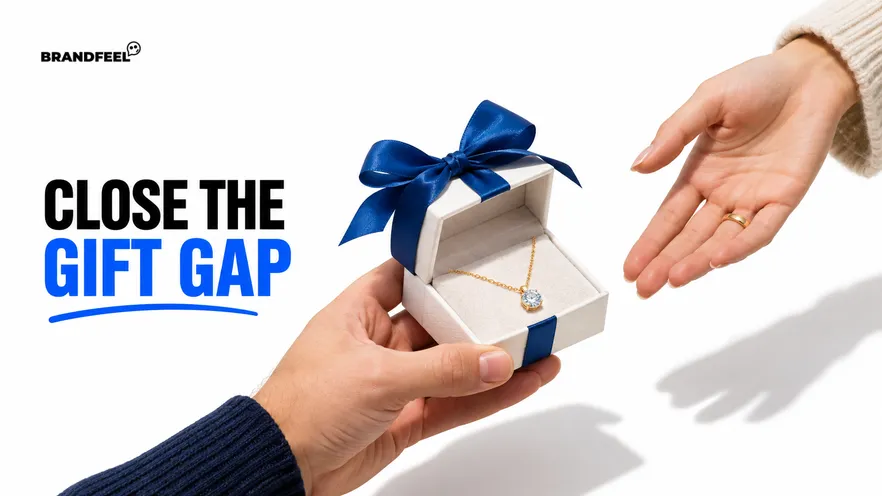
A gift gap is defined as the distance between the person who bought a piece of jewelry and the person who wears it, which means a request sent to the purchaser collects an opinion about packaging rather than about the product. Getting more reviews for jewelry brands starts by closing that gap with one question at checkout, then asking the buyer and the wearer different things. Around 70% of carts are abandoned, frequently where a shopper looks for sizing or durability evidence and finds none [Baymard Institute, 2025]. This guide covers who to ask, when to ask, and which attributes make a jewelry review usable.
- Ask at checkout whether the purchase is a gift, because the answer routes everything after it.
- Split the request: the buyer describes arrival, the wearer describes fit and comfort.
- Send a second request after about thirty days for the durability verdict.
- Capture ring size, chain length and wrist measurement as structured fields.
- Treat engraved and personalised pieces as their own review stream.
- Request one specific photograph rather than inviting photographs in general.
Omniconvert has measured how product evidence is published across the CROBenchmark dataset of 7,000+ websites in 15+ industries, against 248+ audit criteria, over 13 years in eCommerce [CROBenchmark Report 2026, Omniconvert]. In jewelry the shortage is rarely review volume. It is that almost every review present describes the unboxing, because that is the only experience the person who received the request actually had.
Why getting more reviews for jewelry brands fails by default
Start with gifting, because it is the biggest and the least addressed. A meaningful share of jewelry and accessories orders are bought for somebody else, and your order record holds the buyer. Every automated request goes to them.
What that buyer can tell you is genuine and nearly useless to the next shopper. The box was beautiful, delivery was quick, the recipient was delighted. None of it says whether the chain sits well, whether the clasp is fiddly, or whether the plating survived a fortnight of daily wear.
The second problem is timing, and jewelry has it worse than most categories. A garment reveals itself the first time it is worn. A ring reveals itself after a month: whether the plating holds, whether it marks, whether it catches on things. The verdict that decides a repeat purchase is simply not available when most tools send their request.
The third problem is that nobody writes down the measurements. A review saying a bracelet runs small is unusable without the reviewer's wrist size, and a review saying a chain is the perfect length is unusable without knowing whether they bought the 16 inch or the 18 inch.
Close the gift gap with one question
Most stores already have the field, because gift wrapping and gift messaging are standard in this category. What is missing is using the answer downstream, in the review sequence rather than only in the warehouse.
Where the answer is yes, two things change. The buyer gets a short request about the arrival and the presentation, which is what they can answer, and the brand gets an opportunity to reach the wearer through them: a forwarded request, or a card in the box with a short link.
The card in the box is the unglamorous solution that works. It travels with the product to whoever ends up wearing it, needs no data about the recipient, and asks the one person who can answer the questions that matter. The mechanics of running this reliably are in how to build a Review-Generation system.
Unexpected cost and missing information have been among the leading reasons shoppers abandon purchases for as long as Baymard Institute has measured it, at around 70% average cart abandonment [Baymard Institute, 2025]. In jewelry the missing information is almost always sizing or durability, and both are answerable only by a wearer.
Ask twice, because the durability verdict arrives late
Review utility is defined as the degree to which a review lets a different shopper predict their own outcome, and in jewelry that prediction is mostly about longevity. Will the plating last, will the stone stay set, will the clasp still work in six months.
No request sent three days after delivery can answer that. So the second request asks a different question, at the only point where an answer to it exists.
Response rates on the delayed request are lower, which is why most programmes never add it, and the reviews it collects are worth several of the early ones. A single review describing a month of wear outperforms a dozen saying the packaging was lovely.
There is a defensive reason to ask as well. If plating is failing at four weeks, you want to know from your own review stream rather than from a marketplace listing, and the delayed request is the only instrument that surfaces it early.
Capture the measurements, not just the stars
Jewelry sizing is harder than clothing sizing because the shopper frequently does not know their own measurement. Ring size is guessed, chain length is imagined against a mirror, and the result is a return driven by a number nobody established.
Structured reviewer attributes are the cheapest fix. Once a few hundred exist, the product page can state how a style runs rather than leaving every shopper to work it out, and that statement is the exact content an answer engine will quote.
| Captured | Why it matters | Common failure |
|---|---|---|
| Gift or self purchase | Routes the request to the wearer | Known at checkout, unused after |
| Size or length bought | Anchors every sizing comment | Not asked at all |
| Wrist or neck measurement | Lets a shopper translate the verdict | Free text, unusable in aggregate |
| Wear frequency | Contextualises every durability claim | Never requested |
| Thirty day condition | The verdict that drives repeat purchase | Asked on day three instead |
| Worn photograph | Outperforms studio imagery on scale | Invited in general, not specifically |
Shopify's merchant guidance has pushed complete and consistent product data across sales channels for years, and reviewer attributes are the same argument applied to the evidence layer rather than to the catalogue [Shopify, 2026]. The display side of this is covered in how to display reviews for maximum conversion.
The way jewelry teams most often stall is by optimising the unboxing review instead of noticing what it is. The early requests come back glowing, the average rating sits near five stars, and the programme is reported as healthy. Nobody asks why the reviews read interchangeably, because a wall of five-star packaging praise looks like success rather than like a sample of people who were asked the wrong question. Then returns for sizing stay flat, repeat purchase stays flat, and the brand concludes reviews do not move the needle in this category, when it has never collected one from somebody who wore the thing for a month.
Personalised and engraved pieces need their own stream
Personalisation carries the highest anxiety in this category and usually the thinnest evidence. The shopper is committing to something unreturnable, based on a mock-up, and the reviews on the page are about the brand's standard products.
So ask engraved buyers two questions nobody else gets: whether the finished piece matched the preview, and how the lettering reads in person. Those answers map directly onto the hesitation, which is what makes them persuasive.
It also pays to ask early here, because the engraving verdict is available immediately and does not need the thirty day wait. Two streams, two clocks.
AliveCor used Omniconvert to run a structured A/B testing programme and achieved +21% conversion rate, +5% revenue per visitor, and 94% statistical relevance across their experiments. [Omniconvert, AliveCor case study] That is a testing result rather than a reviews result, and the transferable discipline is the same: add the delayed request to one collection, hold everything else still, and resist reading the first fortnight.
What to do this week
- Route on the gift field. Use the answer you already collect to decide who gets asked what.
- Add a card to the box. One short link, aimed at whoever ends up wearing the piece.
- Add a thirty day request. Durability only, one question, on your best-selling collection.
- Add the four sizing fields. Size bought, measurement, wear frequency, all optional.
Above the mechanics sits interpretation: whether a recurring sizing complaint is a guide problem or a manufacturing one, which is a product decision rather than a content one. Brandfeel, Omniconvert's sentiment-intelligence layer, aggregates reviews, NPS and support-ticket themes so a repeated clasp complaint surfaces as a theme rather than as a slow drift in an average. Downstream of that, Omniconvert Commander (formerly Nexus) is an AI for eCommerce growth engine that unifies commerce data, prioritises experiments by True Profit, and generates campaigns and creative you approve before they go live. The fit-driven version of this problem is get more reviews for fashion brands, and the proxy version, where the user cannot speak at all, is get more reviews for pet brands.
Frequently asked questions
How do you get more reviews for jewelry brands?
Find out whether the purchase was a gift, then ask the right person the right question. Buyers can describe the arrival and the presentation, wearers can describe fit and comfort, and nobody can describe durability until about a month has passed. One request sent to one person a few days after delivery collects the least useful of the three.
Why is gifting such a problem for review collection?
Because the person on your order record is frequently not the person wearing the piece. A request sent to the buyer collects an opinion about the box, the delivery and the recipient reaction, which is pleasant and tells the next shopper nothing about whether a bracelet sits comfortably or a plating survives a month.
How long should I wait before asking?
Ask twice. A short request after delivery captures presentation while it is fresh, and a second request after about thirty days captures the durability verdict. The second one is harder to get and worth more, because tarnish, clasp wear and comfort in daily use are what decide whether somebody buys from you again.
What should a jewelry review capture beyond stars?
The measurements and the wear context. Ring size, chain length, wrist size and how often the piece is worn turn a compliment into something another shopper can act on. Without them a five-star review saying a necklace is beautiful competes with every other five-star review saying the same thing.
How do I handle personalised and engraved pieces?
Treat them as a separate review stream, because they cannot be returned and the stakes are higher. Ask specifically about the engraving quality and whether the preview matched the result, as those two questions address the exact fear that stops the next customer ordering a personalised piece.
What should a jewelry brand fix first?
The gift question at checkout. It costs one field, it routes every request that follows, and without it a meaningful share of your review programme is asking somebody who never wore the product to describe how it wears.
Route on the gift field, then wait a month
Use the gift answer you already collect at checkout to decide who gets asked and what they are asked. Put a card in the box for the pieces that are usually gifts, so the request reaches whoever is actually wearing the thing. That is a packaging change and a routing rule, not a project.
Then add one delayed request about durability and accept that fewer people will answer it. Those replies are the ones that describe a month of real wear, which is the evidence the next shopper is looking for and the earliest warning you will get if a plating or a clasp is not holding up.