
UGC Ideas for Beauty Brands
UGC ideas for beauty brands work when they carry shade proof. Nine formats that answer the match question a product page cannot answer on its own.
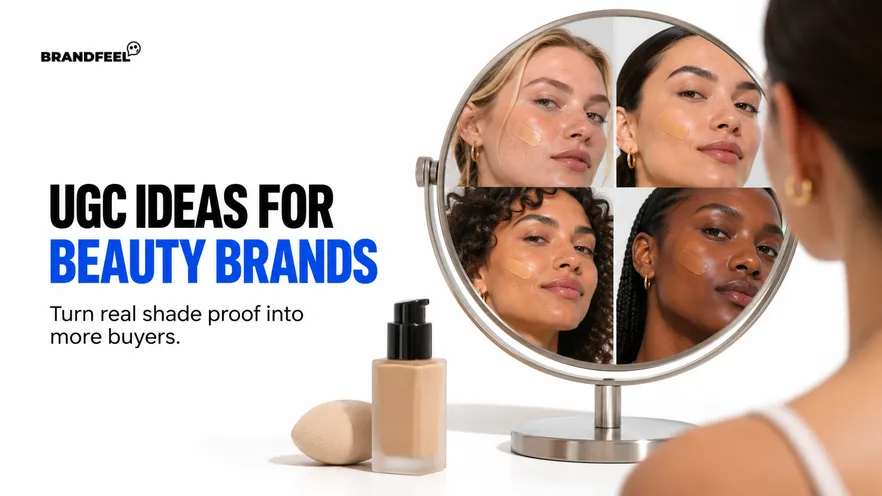
Shade proof is defined as customer content carrying enough information about the person wearing a product, meaning depth, undertone and lighting, for another shopper to work out whether the shade would suit them. The UGC ideas for beauty brands that move revenue all produce it, because the question blocking a first beauty purchase is a match question and no amount of attractive imagery answers it. Around 70% of online carts are abandoned, with missing product information named repeatedly among the causes [Baymard Institute, 2025]. This guide covers nine formats that carry shade proof, and how to collect the attributes.
- Collect depth, undertone and lighting with every upload, since those three fields make an image usable.
- Publish daylight and indoor pairs, because shifting under office light is the complaint customers repeat.
- Ask for undertone with options rather than an open field, as most people cannot name it unprompted.
- Tag the library you already hold, which is the cheapest win available in this category.
- Judge the programme on repeat purchase, because beauty fails by never reordering rather than by returning.
- Treat the between-two-shades report as content, since it is the moment most purchases stall.
Drawing on 13 years of eCommerce work, Omniconvert's CROBenchmark covers 7,000+ websites, 15+ industries and 248+ audit criteria [CROBenchmark Report 2026, Omniconvert]. In beauty the recurring finding is a brand with a large, attractive customer gallery that cannot answer the one question costing it first purchases.
Why beauty UGC underperforms the reach it gets
Beauty brands are better at collecting customer content than almost any other category. Customers photograph themselves wearing the product without being asked, the volume is high, and the imagery is genuinely good.
Then it goes onto the page as a grid, and the grid persuades nobody. A shopper looking at twelve attractive faces has no way to find the one with her own colouring, so the gallery functions as atmosphere rather than as evidence.
What changes that is three fields in the upload form. The same twelve images, each labelled with depth, undertone and the light they were taken in, become a tool a shopper can use. The content did not improve, the metadata did. The timing side of this argument is in the best time to ask for a review.
UGC ideas for beauty brands: nine formats that carry proof
- The labelled swatch. Product on skin with depth and undertone stated in the caption. The single most useful asset you can hold.
- The lighting pair. The same face in daylight and under indoor light. This answers the shifting-shade complaint directly.
- The hour-eight check. How the product looks most of a day later, which is what wear claims are really about.
- The flash test. How it photographs under a camera flash, a genuine failure mode for products with certain finishes.
- The between-two-shades report. A customer explaining which of two shades she chose and why. It rescues the purchase that stalls most often.
- The application correction. A customer showing what she did wrong at first and what fixed it, which prevents a bad first impression becoming a lost customer.
- The competitor equivalence. A customer naming the shade she wore in another brand. It converts shoppers who already know their number elsewhere.
- The hit-pan shot. A product used to the bottom, which proves a full cycle of use rather than a first impression.
- The skin-condition note. How a formula behaves on texture, redness or dryness, described by someone who has it.
The fifth one deserves attention because it maps onto a measurable moment. Shoppers who reach two shades and cannot choose are at the point of highest intent and highest friction, and content from somebody who stood in the same place is the most efficient thing you can show them.
| Format | Objection it answers | Attribute it must carry |
|---|---|---|
| Labelled swatch | Will this shade suit me | Depth and undertone |
| Lighting pair | Will it shift under office light | Light source, stated |
| Hour-eight check | Does the wear claim hold | Elapsed time |
| Between-two-shades | Which of these two do I pick | Both shade names |
| Competitor equivalence | What am I in your range | The other brand shade |
| Skin-condition note | Will it sit badly on texture | The condition described |
Collect the attributes, not just the images
The practical blocker is that undertone is jargon. Asked to state it in a free-text field, most customers skip the question or guess, and the resulting data is worse than none.
Asked to choose between three plain descriptions, the same customers answer accurately and in seconds. Describe the options the way a person would notice them, by how jewellery looks against their skin or how they burn in sun, rather than by the technical word.
Do the same for lighting with two options and for depth with a short visual scale. Three questions, ten seconds, and every image collected afterwards is worth several times what the unlabelled ones were.
Beauty teams that add these fields usually apply them going forward and leave the existing library alone, because retro-tagging feels like a project. It is normally an afternoon: most brands hold a few hundred usable images, and depth and lighting can be judged from the photograph itself by whoever knows the range. Skipping that step means the matching tool stays empty for months while new content trickles in, and the page that needed it stays a grid.
Measure it on the second order
This is the measurement trap specific to the category, and it makes shade proof look less valuable than it is. A store judging content on conversion alone will see a modest lift and conclude the work was marginal.
Read repeat purchase rate on the cohort instead. A shopper who chose correctly because another customer told her what to expect comes back, and that second order is where the economics of this category live. A 5% improvement in retention can raise profits by 25% to 95% [Harvard Business Review, 2014].
Shopify's product guidance has pushed complete and consistent product detail across sales channels for years [Shopify, 2026], and in beauty the detail with the most commercial weight is the one only customers can supply.
With Omniconvert, PRISM+ tested a listing page redesign that grouped products in one A/B test and recorded a +40.74% conversion rate, +14.81% revenue per user, and a 99.48% chance to win. [Omniconvert, PRISM+ case study] That is a testing result rather than a beauty result, and the transferable point is that grouping the options a shopper is choosing between beat improving any single one of them.
What to do this week
- Add depth, undertone and lighting as options in the upload form.
- Tag the existing library rather than waiting for new content to accumulate.
- Publish one lighting pair on your best-selling complexion product and watch what it does.
Reading what the content says in aggregate is the next job and a different one. Brandfeel, Omniconvert's sentiment-intelligence layer, aggregates reviews, NPS and support-ticket themes so a recurring comment about a shade running warm surfaces as a theme rather than as drift in an average. Where a theme points to a page or range change worth testing, Omniconvert Commander (formerly Nexus) is an AI for eCommerce growth engine that unifies commerce data, ranks experiments by True Profit and produces campaigns and creative that go live only once you approve them. The adjacent category, where the verdict is a change over weeks rather than a match on the day, is in UGC ideas for skincare brands, and the system view is in how to build a review-generation system.
Frequently asked questions
What UGC works best for beauty brands?
Content that carries shade proof, meaning the depth, undertone and lighting of the person wearing it. A beautiful photograph of a product on an unidentified face tells the next shopper nothing they can act on. The same photograph captioned with the wearer skin depth and undertone becomes the most persuasive asset on the page.
Why does beauty UGC underperform its reach?
Because it is collected as imagery and published as decoration. A gallery of attractive faces raises the visual quality of a page without resolving the question that stopped the purchase, which is whether this shade will suit a specific person. Volume cannot substitute for the attributes that make one image useful.
How do you get customers to state their undertone?
Ask with options rather than an open field. Most customers cannot name their undertone unprompted and can choose between three described options easily. Three tick boxes in the upload form collect the data that makes every image in the library usable, and they take ten seconds.
Should beauty UGC be filmed in daylight?
Collect both daylight and indoor versions and label them. A foundation that matches in daylight and goes grey under office lighting is one of the most common complaints in the category, and a pair of images taken in two lighting conditions answers it directly. Publishing only the flattering one is the reason some brands have high conversion and high dissatisfaction.
Does beauty UGC reduce returns?
It reduces the silent failure that matters more. Beauty customers rarely return a wrong shade, they keep it, stop using it and never buy again. Content that helps a shopper choose correctly shows up in repeat purchase rate rather than in the returns report, so judge the programme on the second order instead.
Where should a beauty brand start?
By adding depth, undertone and lighting fields to the upload form, then going back and tagging the content you already hold. Most beauty brands have a usable library sitting unlabelled, so the first win is retrospective and costs nothing but an afternoon of sorting.
Label what you already have
Open your customer content library and look at how much of it carries a depth, an undertone or a light source. In most beauty brands the answer is none of it, which means several hundred genuinely useful images are sitting there working as wallpaper. Tagging them is an afternoon with somebody who knows the range.
Then add the three fields to the upload form so the problem stops recreating itself. Judge the result on second orders rather than on conversion, because in this category a wrong shade does not come back as a return. It comes back as a customer who never reorders, and that is the number shade proof actually moves.